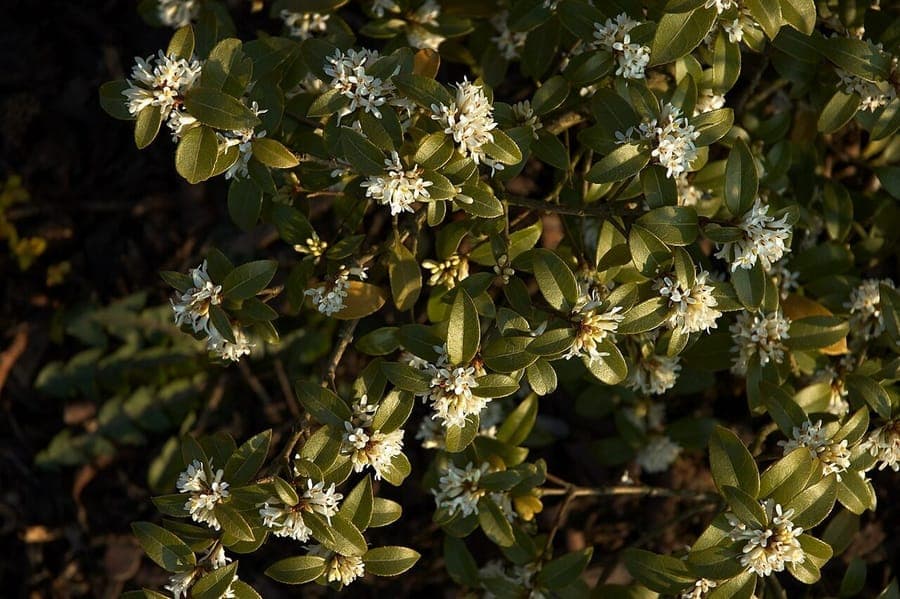
Wouter Hagens / Public domain, via Wikimedia Commons
Burkwood osmanthus (Osmanthus × burkwoodii): complete guide
Osmanthus × burkwoodii
Want to see Burkwood osmanthus (Osmanthus × burkwoodii): complete guide in your garden?
Full design in HD: €7.99
Look after your Burkwood osmanthus with the GardenWorld app
Identify plants with your camera and get a care calendar with reminders for this plant.


Overview
Osmanthus × burkwoodii, known as Burkwood osmanthus, is an evergreen shrub that fills the garden with a sweet, almost jasmine-like scent in spring. It is not a wild species but a garden hybrid: around 1928 the English nursery Burkwood & Skipwith in Kingston upon Thames crossed Osmanthus delavayi with Osmanthus decorus. Because the latter was then placed in a different genus, the plant was long known as × Osmarea burkwoodii, a name you may still find in older books.
It has inherited the best of both parents: the rich, fragrant flowering of Osmanthus delavayi, and the sturdiness and greater hardiness of Osmanthus decorus. The result is a dense, rounded shrub with small, dark green, leathery leaves that responds very well to clipping. That makes it one of the best shrubs for a fragrant evergreen hedge, a neat ball or a topiary shape in a container.
It grows slowly to moderately, about 15 to 25 cm a year, and eventually reaches 2 to 3 m in height and spread if left unpruned. If you would like to see how a fragrant hedge or a single specimen would fit into your garden, you can have a garden design made on gardenworld.app that takes your space, the sun and the views from the house into account.
Appearance and bloom cycle
The leaves are oval to elliptic, 3 to 5 cm long, thick and leathery, glossy dark green above and paler beneath. The edges are finely toothed but not spiny like holly. The branches grow closely together, so the shrub screens well even in winter.
Flowering falls in April, sometimes as early as late March depending on the weather. Clusters of four to seven small, tubular white flowers with four spreading lobes appear in the leaf axils. Each flower is barely 1 cm long, but together they cast a white haze over the whole shrub. The scent is sweet and intense and carries several metres on a mild day. Bees and early bumblebees find a welcome source of nectar.
After flowering, small egg-shaped blue-black fruits sometimes form, but in northern Europe fruiting is usually sparse. Outside the flowering period it is mainly a calm, dark green shrub that makes other plants stand out in front of it.
Ideal location
Osmanthus × burkwoodii grows in full sun to partial shade. In sun it flowers most freely; in partial shade the leaves stay a deeper green. It tolerates deep shade too, but then grows looser and flowers less.
Ideally choose a spot sheltered from cold, drying east winds, as evergreen leaves can scorch in hard frost combined with wind and sun. Plant it near a patio, front door or path so you can enjoy the scent in April. For a hedge, set three plants per metre; for a free-standing shrub, allow 1.5 to 2 m of space. It also does well in a large container, provided it is watered regularly.
Soil requirements
This shrub is not fussy. It grows in any ordinary garden soil that does not stay waterlogged: sand, loam or clay, acidic or slightly chalky. That is an advantage over many other evergreens, such as rhododendrons, which need acidic soil.
When planting, work some compost or well-rotted manure into the soil, especially on poor, sandy ground. On heavy clay, improve the structure with compost and some coarse grit so excess water can drain away. A layer of compost each spring is enough feeding. In containers, use a good loam-based compost with a drainage layer at the bottom.
Watering
After planting, the shrub needs regular watering, especially in its first year. In dry weather give about 10 litres per plant twice a week. A hedge planted in autumn often still needs extra water the following spring.
Once established, Osmanthus × burkwoodii copes reasonably well with dry spells. During long, dry summers, give it an occasional thorough soak. Pay attention in late summer, when next spring's flower buds are forming. Plants in containers need watering almost daily in summer, and even in winter the root ball should never dry out completely.
Free preview
Want to see Burkwood osmanthus (Osmanthus × burkwoodii): complete guide in your garden? Make a free preview of your design.
Pruning
Prune Osmanthus × burkwoodii straight after flowering, in May or early June. The flowers appear on the previous year's wood, so if you prune in autumn or winter you will cut away the flower buds and lose most of next spring's display.
Clip a hedge once a year after flowering. If you want it very crisp, you can give it a light tidy in July, but no later than early August. Free-standing shrubs need hardly any pruning; just remove dead or crossing branches. The plant also tolerates hard renovation pruning into old wood, but spread this over two or three years so the shrub is never left bare all at once.
Maintenance calendar
March: Spread a layer of compost around the base. Still a good time to plant.
April: Flowering and full fragrance. Water in dry weather.
May-June: Prune or clip the shrub or hedge straight after flowering.
July-early August: A light shape-up for hedges if needed. Water during prolonged drought.
September-October: Flower buds are forming, so do not prune. A good time to plant.
November-February: Dormant period. Protect young plants from drying winds. Shake heavy snow off a hedge to prevent broken branches.
The plant calendar on gardenworld.app shows month by month which shrubs to prune and which are best left alone.
Winter hardiness
Osmanthus × burkwoodii is fairly hardy and tolerates temperatures down to about -15 °C, a little lower in a sheltered spot. In most gardens in Britain and the Low Countries it grows without protection, and it is somewhat hardier than its parent Osmanthus delavayi.
In hard frost, especially combined with wind and winter sun, some leaves may turn brown. That damage usually grows out in spring; trim off brown shoots after flowering. Young plants and container plants are more vulnerable, so protect them during their first winters with a windbreak or horticultural fleece, and move pots against a wall.
Toxicity
Osmanthus × burkwoodii is not known to be poisonous to people, dogs or cats, and there are no recorded poisonings. The hard, leathery leaves do not invite animals to nibble either. That makes the shrub a good choice for a family garden or as a hedge beside a play area.
Companion plants
The early white, fragrant flowers combine beautifully with spring bulbs. Plant daffodils (Narcissus pseudonarcissus) and snowdrops at the foot of a free-standing shrub for a festive start to the season. Lenten roses (Helleborus orientalis) suit partial shade and flower as early as February and March.
Other evergreen shrubs can join it in a mixed hedge or border framework with scent in different seasons. Consider laurustinus (Viburnum tinus), which flowers in winter, Mexican orange blossom (Choisya ternata), fragrant in May, and Skimmia japonica for shade. A tightly clipped ball of Osmanthus × burkwoodii also makes an attractive, scented alternative to box where box tree caterpillar causes problems.
Final thoughts
Osmanthus × burkwoodii is a dependable evergreen shrub that provides structure all year and fills the garden with a sweet scent in April. It is undemanding about soil, reliably hardy, tolerant of clipping and not poisonous. That makes it suitable for small town gardens and larger country gardens alike.
The one thing to remember is when to prune: always straight after flowering. Respect that, and every spring you will have a shrub covered in white, fragrant flowers.
Frequently asked questions about Burkwood osmanthus
Is Burkwood osmanthus winter hardy?
Osmanthus × burkwoodii is fairly hardy and tolerates temperatures down to about -15 °C, a little lower in a sheltered spot. In most gardens in Britain and the Low Countries it grows without protection, and it is somewhat hardier than its parent Osmanthus delavayi.
When and how do you prune Burkwood osmanthus?
Prune Osmanthus × burkwoodii straight after flowering, in May or early June. The flowers appear on the previous year's wood, so if you prune in autumn or winter you will cut away the flower buds and lose most of next spring's display.
How much water does Burkwood osmanthus need?
After planting, the shrub needs regular watering, especially in its first year. In dry weather give about 10 litres per plant twice a week.
Where does Burkwood osmanthus grow best?
Osmanthus × burkwoodii grows in full sun to partial shade. In sun it flowers most freely; in partial shade the leaves stay a deeper green.
What soil does Burkwood osmanthus need?
This shrub is not fussy. It grows in any ordinary garden soil that does not stay waterlogged: sand, loam or clay, acidic or slightly chalky.

See it in your garden
See Burkwood osmanthus in your garden
One photo of your garden and a few questions. You see the result in about a minute.
Try it with a photoIdentify this plant in your own garden. Identify a plant
Similar plants
Laurustinus: complete guide
Viburnum tinus
Everything about Laurustinus (Viburnum tinus): planting, care, pruning and winter flowering. Expert tips for this evergreen winter-blooming shrub.
Choisya ternata: complete guide
Choisya ternata
Mexican orange: fragrant blooming shrub for warm spots. Elegant foliage and white flowers. Mediterranean character for gardens.
Skimmia japonica: complete guide
Skimmia japonica
Evergreen shrub with red berries and fragrant leaves that remain visible long. Winter hardy to -10C, perfect for shade.
