
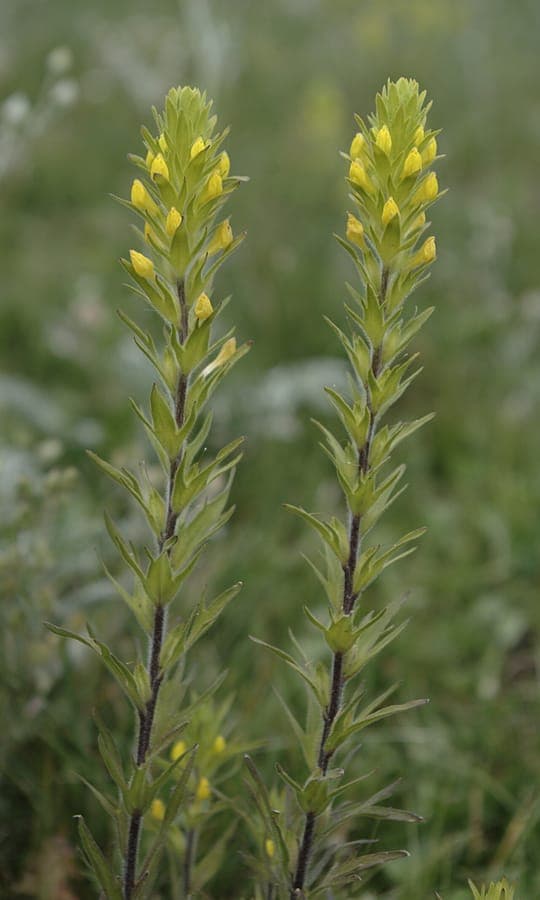
JerryFriedman / CC BY-SA 3.0, via Wikimedia Commons
Yellow owl's-clover: complete guide
Orthocarpus luteus
Want to see Yellow owl's-clover: complete guide in your garden?
1 minute, no credit card
Overview
Orthocarpus luteus, commonly known as yellow owl's-clover or golden-tongue owl-clover, is a fascinating annual to biennial herb in the family Orobanchaceae. Native to western and central North America, from British Columbia and Alberta southward through Montana, Wyoming, Colorado, Utah and Nevada to Oregon and New Mexico, it grows naturally on open prairies, dry plains, rocky slopes and open parkland communities. In its native range it is a characteristic species of the mixed prairie and steppe communities of the American west.
One of the most intriguing properties of Orthocarpus luteus is its hemi-parasitic lifestyle. The plant is capable of tapping into the roots of neighbouring plants via specialised organs called haustoria, extracting water and nutrients from host plants. Grasses and other herbaceous plants serve as preferred hosts. Despite this parasitic behaviour, Orthocarpus luteus is fully green and capable of photosynthesis, making it not entirely dependent on its host. This trait makes it a particularly fascinating subject for ecological gardens and wildflower meadows.
For gardeners and naturalists, yellow owl's-clover is a rare and rewarding addition to prairie plantings, wildflower meadows and ecological borders. Its cheerful yellow flowers attract bees, bumblebees and butterflies, contributing to garden biodiversity. Visit gardenworld.app to explore how wildflower plants like Orthocarpus can be incorporated into an ecological front garden or meadow edge.
The scientific name was first published by Thomas Nuttall in 1818 in his landmark work on North American plants. The synonym Orthocarpus strictus is occasionally encountered in older flora and identification guides.
Appearance & bloom cycle
Yellow owl's-clover is a slender, upright annual to biennial, typically 10 to 40 cm tall depending on soil fertility and moisture availability. It has a single main stem that branches toward the top, giving it its characteristic Single Crown growth habit. On lean, dry soils the plant stays compact and wiry; with slightly richer conditions it can form more robust clusters of flowering stems.
The leaves are linear to narrowly lanceolate, coarse in texture and green to grey-green in colour. They are alternately arranged along the stem and have a distinctly rough, hairy or finely divided structure. Leaf form is relatively simple, characteristic of plants from dry open habitats.
The flowers are the most striking feature of Orthocarpus luteus. They are bright yellow, relatively small (1 to 2 cm long) but numerous, borne in dense spike-like inflorescences at the tops of stems and side branches. Each flower has the characteristic two-lipped form of the Orobanchaceae family: a short, broad upper lip (the galea) and a three-lobed lower lip with small bump-like nectar guides. The flowers are especially attractive to small bees and bumblebees that visit for nectar and pollen.
The flowering period extends from July through September, depending on altitude and climate. At lower elevations on warm, sheltered sites, flowering may begin as early as June. Individual plants flower for three to six weeks. After flowering, small oval seed capsules develop, splitting open when ripe to disperse the tiny seeds. Seeds may remain viable in the soil for several years.
Ideal location
Yellow owl's-clover is a plant of open, sunny positions. It needs at least five to six hours of direct sunlight daily for good development and flowering. In light shade the plant may survive but grows slender and flowers less freely. Deep shade is not tolerated.
Given its origins on dry open prairies and alpine meadows of the American west, it performs best in sheltered, sunny spots with good air circulation. It is particularly well-suited to:
- Wildflower meadows and ecological borders alongside grasses
- Rock gardens and dry open borders
- Prairie plantings with native or naturalised species
- Unfertilised grass strips along garden paths
- Seed mixtures with summer-flowering grasses such as Stipa capillata or Bouteloua gracilis
Importantly, as a hemi-parasitic plant, Orthocarpus luteus benefits from the presence of host plants - preferably grasses. Sow it in combination with native or prairie grasses for the best results. It performs less well as a solitary plant in bare soil without suitable host roots nearby.
Sowing distance: 10 to 20 cm. The plant propagates solely by seed.
Soil requirements
Yellow owl's-clover makes few demands on soil fertility but does best in light to moderately moist, free-draining soil. The ideal pH range is 6.0 to 8.5, from slightly acid to moderately alkaline. On overly rich soils the plant grows lushly but flowers less freely; lean to moderately fertile soils are most appropriate.
Loamy and sandy-loam soils are ideal. Pure sand can be too dry unless it receives regular moisture. Heavy clay with poor drainage is less suitable, but improvement through incorporation of coarse sand makes it usable.
Avoid high-nitrogen fertilisers near Orthocarpus luteus. Excessive nitrogen promotes leaf growth at the expense of flowers and makes the plant more susceptible to fungal disease. Small amounts of organic compost to improve soil structure are acceptable, but direct application of manure or artificial fertiliser should be avoided.
Soil texture should be open enough to allow the roots of host plants (grasses) to penetrate and the haustoria of Orthocarpus to make contact with host roots. A light, non-compacted soil structure is therefore desirable.
Watering
Yellow owl's-clover has moderate water requirements. It performs best with regular but not excessive moisture. During the germination phase and early development, consistent soil moisture is essential: keep the soil lightly moist until seedlings are 5 to 10 cm tall.
Once established, the plant is fairly drought-tolerant, but prolonged drought of more than two to three weeks without rainfall during the flowering period can shorten the bloom season and cause premature die-back. A weekly to fortnightly watering during dry, warm weather supports a longer flowering display.
Avoid excessive watering and standing moisture around the stem base, as this promotes fungal growth. Water at the base of the plant; wetting the foliage encourages powdery mildew. In wet summers, supplemental watering is rarely needed.
In containers, extra attention to drainage is required. Use a well-draining substrate and ensure a good drainage hole. Container growing is less ideal for this hemi-parasitic plant as the host plant is absent.
Free design
Want to see Yellow owl's-clover: complete guide in your garden? Make a free design now.
Pruning
Yellow owl's-clover is an annual that self-propagates and dies after flowering and seed ripening, so pruning is virtually unnecessary. The only worthwhile intervention is removing spent flowering stems if you wish to prevent the plant from spreading too vigorously through self-seeding.
If you wish to harvest seed for sowing in other locations or for storage, wait until the seed capsules turn brown and are about to split open. Cut the stems above a paper bag to catch the tiny seeds. Store seeds in a dry, cool place until use in the following growing season.
If you wish to allow the plant to naturalise in a wildflower meadow or among grasses, allow the seed plants to fully ripen and disperse. On suitable soils with the right host roots the plant will return year after year.
In autumn, remove dead plant material if you prefer a tidy appearance. In a wild garden, leaving the dry stems standing provides overwintering shelter for insects.
Maintenance calendar
February-March: Sow seeds in trays at 10-15 degrees Celsius. Yellow owl's-clover germinates best after a cold stratification period of four to six weeks at 4 degrees Celsius. Mix seeds with slightly moist sand and store in the refrigerator.
April: For direct outdoor sowing, wait until soil temperature is above 8 degrees Celsius. Sow at the final location in the presence of grasses or other host roots. Transplant tray seedlings after the last frost risk has passed.
May: Young plants establish; keep lightly moist. Protect against slugs at this stage.
June: Growth accelerates in warmer weather; plants form their characteristic upright stems. First buds may appear at warm sites. No supplemental feeding needed.
July-August: Peak flowering season; yellow blooms attract bees and butterflies. Water once a week in dry weather. Enjoy the display without further intervention.
September: End of flowering; seed capsules ripen. Harvest seed for storage or allow in-situ ripening for self-seeding.
October-November: Plants die after seed dispersal. Remove or leave for a wild garden look. Note where the plant thrived for next season.
December-January: Seeds overwinter in the soil. Store in cold stratification in the refrigerator for spring sowing.
Winter hardiness
Yellow owl's-clover is an annual that overwinters as seed in the soil. The plant itself does not survive winter. However, the seeds are very cold-hardy and survive frosty periods in the soil without difficulty. In USDA zones 3 to 8, seeds germinate reliably in spring when soil temperature rises above 8 degrees Celsius.
In the Netherlands and Belgium (USDA zone 7-8), seeds germinate in April to May and the plant develops through summer. On favourable sites with the right host roots, the species can maintain itself year after year through self-seeding as a semi-permanent resident of the wild garden.
Germination is promoted by a cold stratification period: seeds that have spent a cold winter in the soil germinate faster and more evenly than freshly harvested seed. This mechanism ensures reliable re-establishment each spring.
In containers outdoors, providing some protection for the pot during extreme frost is sensible to prevent the seed bed from completely drying out.
Companion plants
Yellow owl's-clover functions best in an ecological plant community with grasses and other prairie plants as hosts and companions. Good combinations include:
- Bouteloua gracilis (blue grama grass): one of Orthocarpus's preferred hosts in its native range; slender, drought-tolerant prairie grass that performs well in European conditions too.
- Stipa capillata (needle grass): an elegant, fine-textured steppe grass that serves as an excellent host while adding ornamental value.
- Festuca ovina (sheep's fescue): low, clumping grass for dry, sunny soils; an ideal host for Orthocarpus in European conditions.
- Echinacea purpurea (purple coneflower): a summer-blooming perennial that pairs beautifully with yellow owl's-clover for a colourful red-and-yellow prairie effect.
- Gaillardia aristata (blanket flower): bright yellow-orange blooms that complement the pure yellow of Orthocarpus flowers perfectly.
- Ratibida columnifera (Mexican hat coneflower): a long-blooming prairie perennial in yellow to red-brown for an authentic prairie feel.
- Penstemon strictus (Rocky Mountain penstemon): blue-purple flower spikes that provide striking colour contrast with the yellow.
Avoid planting alongside strongly dominant, tall-growing grasses such as common reed (Phragmites) or giant miscanthus (Miscanthus giganteus). These overshade the small Orthocarpus plants before they reach flowering.
At gardenworld.app you will find further inspiration for prairie gardens and ecological plantings with wildflowers like Orthocarpus luteus.
Closing
Yellow owl's-clover is a remarkable and underappreciated plant for gardeners interested in ecology, biodiversity and wildflower meadows. Its hemi-parasitic lifestyle, its bee-friendly yellow flowers and its relatively modest size make it an interesting and versatile addition to prairie plantings, steppe borders and ecological green strips.
Success with Orthocarpus depends on the right combination of host roots and the absence of overly rich, nitrogen-heavy soils. Create these conditions and you will be rewarded with charming yellow flowers through the summer months and an ecologically rich plant community that returns year after year.
Explore prairie designs and ecological front garden styles at gardenworld.app and discover how wildflower plants like Orthocarpus luteus can transform your outdoor space into a flower-rich, insect-friendly habitat.
Want to see Yellow owl's-clover: complete guide in your garden? Make a free design now.
Upload a photo, pick a style, and get a photorealistic design with plant list in under a minute.
10,000+ gardens designed already
No credit card required


Similar plants
Northwestern Indian paintbrush: complete guide
Castilleja angustifolia
All about Castilleja angustifolia, the northwestern Indian paintbrush from dry western US steppes. Growing, care, and companion plant advice.
Wavyleaf Indian paintbrush: complete guide
Castilleja applegatei
Everything about Castilleja applegatei, the wavyleaf paintbrush from Oregon and California. Host plants, care, location, and garden use covered.
Bushy bird's-beak: complete guide
Cordylanthus ramosus
Complete guide to Cordylanthus ramosus, the hemiparasitic annual of western US steppes: ecology, host plants, cultivation and uses.