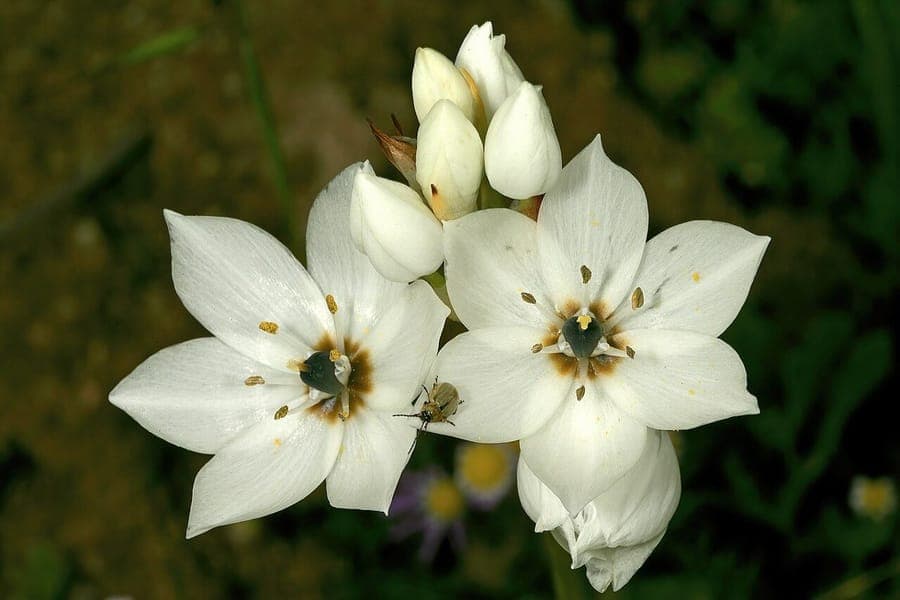
SAplants / CC BY-SA 4.0, via Wikimedia Commons
Chincherinchee (Ornithogalum thyrsoides): complete guide
Ornithogalum thyrsoides
Want to see Chincherinchee (Ornithogalum thyrsoides): complete guide in your garden?
Full design in HD: €7.99
Look after your Chincherinchee with the GardenWorld app
Identify plants with your camera and get a care calendar with reminders for this plant.


Overview
Ornithogalum thyrsoides is a bulb from the Cape region of South Africa, where it grows through the winter and flowers in the southern hemisphere spring. Florists know it as chincherinchee, a name that comes from the Afrikaans word for the squeaking sound the stems make when they rub together. It belongs to the genus commonly called star of Bethlehem, although that name usually refers to the European Ornithogalum umbellatum.
In northern European gardens it behaves as a summer bulb. You plant the small bulbs in spring, and ten to twelve weeks later a sturdy stem appears, topped with a dense, conical spike of white starry flowers. They open from the bottom upwards, so each spike stays attractive for weeks. As a cut flower it is famous: in a vase the stems easily last two to three weeks.
The plant has one important drawback: every part is poisonous, the bulb most of all. A separate section below deals with this. Placed with care, away from small children and pets that graze or chew, it can be enjoyed without trouble. If you would like to know where summer bulbs will look their best in your garden, you can have a garden design made on gardenworld.app that takes sun, soil and the way you use your garden into account.
Appearance and bloom cycle
The bulb, 2 to 4 cm across, produces five or six lance-shaped, bright green leaves 15 to 30 cm long. They lie fairly flat around the base and often wither while the plant is in flower. Between them rises a bare, sturdy flower stem 30 to 50 cm tall.
At the top sits a dense raceme of twenty to fifty flowers. Each is a white to creamy star 2 to 3 cm across, with six tepals. In the centre is a dark, almost blackish-green ovary, surrounded by a brownish blotch at the base of the tepals. That dark eye gives the flower its distinctive look. The buds at the top of the spike stay closed and greenish white, so the flower head keeps a pointed tip.
Planted in spring, Ornithogalum thyrsoides flowers in June, July or August depending on when it went in. Planting in three batches in April, May and early June spreads the display across the summer. The flowers partly close in dull weather and at night.
Ideal location
Give this bulb full sun and a warm spot sheltered from strong wind. Against a south-facing wall, at the front of a sunny border or in a pot on a south-facing patio it flowers most freely. In partial shade the stems grow longer and weaker and flop more easily.
It does very well in pots and containers, which is practical because you can move the pot somewhere dry after flowering. Do choose a place where children and pets cannot reach the plants. A row of chincherinchee is also a good idea in a cutting garden: cut the spikes once the lowest flowers have opened.
Soil requirements
The bulbs rot quickly in cold, wet ground, so an open, free-draining and moderately fertile soil is essential. Sandy loam, or garden soil improved with some coarse grit, is ideal. On heavy clay, grow them in pots or a raised bed instead.
Plant the bulbs 8 to 10 cm deep and about 10 cm apart, pointed end up. In pots, use multipurpose compost with a third added sand or fine grit and a generous drainage layer at the bottom. A light feed with a bulb or tomato fertiliser during growth is enough; heavy feeding mainly produces leaves.
Watering
After planting, water once thoroughly and then sparingly until the first leaves appear. From then on, keep the soil lightly moist. During growth and flowering the plant needs regular watering, especially in pots during warm spells.
Once flowering is over and the leaves begin to yellow, reduce watering gradually. During dormancy the bulb must be kept completely dry. This mirrors the South African climate: moisture during growth, drought during rest. Always water the soil rather than the flower spike, as wet flowers turn brown.
Free preview
Want to see Chincherinchee (Ornithogalum thyrsoides): complete guide in your garden? Make a free preview of your design.
Pruning and cutting
For the vase, cut the stems when the lowest two or three flowers are open; the rest of the spike will open indoors. Wear gloves while doing so, as the sap can irritate the skin. Change the water every few days and recut the stems at an angle.
In the garden, cut faded stems off just above the foliage so the plant does not put energy into seed. Leave the leaves until they have turned completely yellow and withered, because they feed the bulb for next year. Only then remove the dead foliage.
Toxicity to people and animals
Ornithogalum thyrsoides is highly poisonous. All parts contain toxic compounds, including glycosides and saponins, with the highest concentration in the bulb. In South Africa the species is notorious for poisoning livestock; animals that eat it develop severe, sometimes fatal diarrhoea. Related species in the same genus can also disturb the heart rhythm.
In people, eating the bulb, leaves or flowers can cause nausea, vomiting, abdominal pain and diarrhoea. The sap can irritate skin and eyes. The plant is just as dangerous for dogs, cats and rabbits: vomiting, diarrhoea, drooling and lethargy are the first signs. Cats nibbling cut flowers in a vase are at risk too, and even the vase water may contain toxins.
So follow a few rules. Do not plant chincherinchee in a garden where young children play or where dogs dig, and do not put a vase of these flowers in a home with cats. Store lifted bulbs out of reach and clearly labelled so no one mistakes them for onions or shallots. Wear gloves when handling them. If someone has swallowed part of the plant, contact a doctor or NHS 111 straight away, and take the plant or label with you. If an animal is involved, phone your vet at once.
Maintenance calendar
March: Check stored bulbs for rot and discard any soft ones. Prepare pots.
April-early June: Plant bulbs outdoors once hard frosts are over, in three batches if you want a longer display.
June-August: Flowering. Water regularly and give pots some bulb fertiliser. Cut stems for the house.
September: Reduce watering and let the foliage die down.
October: Lift bulbs before the first frost, dry them off and store them frost-free.
November-February: Dormancy. Keep dry and cool at 10 to 15 °C.
The plant calendar on gardenworld.app shows month by month when it is time to plant your summer bulbs and when to lift them again.
Winter hardiness and overwintering
This species tolerates only light frost, down to about -5 °C in dry soil. In much of Britain and the Low Countries that is not enough to leave it out with confidence. You have two options: lift the bulbs every autumn, or treat them as annuals and plant fresh ones each spring.
To lift them, dig the bulbs up in October, let them dry for a week somewhere airy, clean off the old soil and store them in a paper bag or a box of dry sand in a cool, frost-free, dry place. Pots can be left whole and kept dry in a frost-free shed or garage. In very sheltered coastal gardens a bulb sometimes survives outside under a thick mulch, but do not count on it.
Companion plants
The white spikes of chincherinchee look good with blue and purple. Combine the bulbs with African lily (Agapanthus africanus), also from South Africa and keen on the same sunny spot. Round-headed leek (Allium sphaerocephalon) adds deep wine-red accents at the same height.
For a light summery feel, plant them among Mexican feather grass (Nassella tenuissima) and lavender (Lavandula angustifolia). In a cutting garden, they make a long run of summer bouquets together with gladioli (Gladiolus communis). In pots, low silver-leaved plants work well alongside, provided they do not need too much water.
Final thoughts
Ornithogalum thyrsoides is an elegant summer bulb with spikes of white starry flowers that last for weeks in the garden and even longer in a vase. Full sun, free-draining soil and a dry winter rest are the keys to success. Treat it as an annual or lift the bulbs in autumn.
Above all, keep its toxicity in mind. Choose a spot out of reach of children and pets, wear gloves and keep bouquets out of homes with cats. Take those precautions and this bulb brings a touch of the Cape spring into a European summer.
Frequently asked questions about Chincherinchee
Is Chincherinchee winter hardy?
This species tolerates only light frost, down to about -5 °C in dry soil. In much of Britain and the Low Countries that is not enough to leave it out with confidence.
When and how do you prune Chincherinchee?
For the vase, cut the stems when the lowest two or three flowers are open; the rest of the spike will open indoors. Wear gloves while doing so, as the sap can irritate the skin.
How much water does Chincherinchee need?
After planting, water once thoroughly and then sparingly until the first leaves appear. From then on, keep the soil lightly moist.
Where does Chincherinchee grow best?
Give this bulb full sun and a warm spot sheltered from strong wind. Against a south-facing wall, at the front of a sunny border or in a pot on a south-facing patio it flowers most freely.
What soil does Chincherinchee need?
The bulbs rot quickly in cold, wet ground, so an open, free-draining and moderately fertile soil is essential. Sandy loam, or garden soil improved with some coarse grit, is ideal.

See it in your garden
See Chincherinchee in your garden
One photo of your garden and a few questions. You see the result in about a minute.
Try it with a photoIdentify this plant in your own garden. Identify a plant
Similar plants
Lily-of-the-Nile: complete guide
Agapanthus africanus
Everything you need to grow Agapanthus africanus: ideal conditions, watering, winter care, and companion planting for UK and US gardens.
Ball-head onion: complete guide
Allium sphaerocephalon
Discover how to grow and care for Allium sphaerocephalon, a striking ornamental onion with deep purple spherical blooms. Perfect for sunny borders and drought-tolerant gardens.
Argentine needlegrass: complete guide
Nassella tenuissima
Nassella tenuissima, the finest ornamental grass. Elegant, silvery threadlike awns that dance in the slightest breeze. Drought hardy.
