
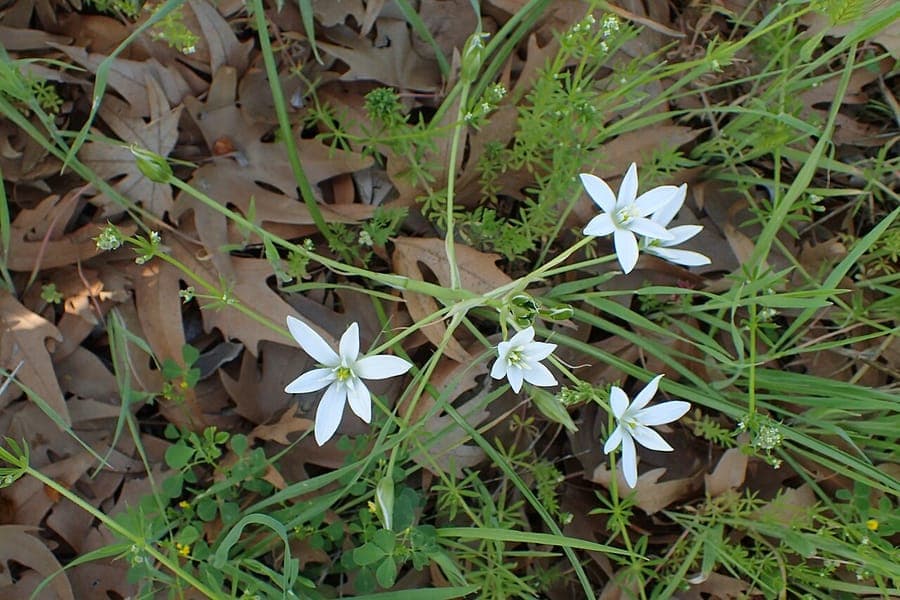
Krzysztof Ziarnek, Kenraiz / CC BY-SA 4.0, via Wikimedia Commons
Ornithogalum divergens: complete guide
Ornithogalum divergens
Want to see Ornithogalum divergens: complete guide in your garden?
1 minute, no credit card
Ornithogalum divergens: complete guide
Overview
Ornithogalum divergens, commonly known as garden star-of-Bethlehem, is a cheerful bulb that flowers in early spring. This hardy plant occurs naturally in Central and Mediterranean Europe. The plant is popular with gardeners because it is highly reliable, flowers year after year and requires little maintenance. It is a perfect choice for naturalistic gardens, beds and borders.
Appearance and bloom
Ornithogalum divergens grows to about 20-30 centimetres tall, with narrow grass-like leaves that grow in clusters from the ground. The flowers are small, white with green or brown stripes on the back, and grow in loose umbels atop the stems. Flowering occurs from April to May and lasts several weeks. Although individual flowers are small, their number and arrangement makes them very decorative and striking in the landscape.
Ideal location
Star-of-Bethlehem grows best in sunny to semi-shaded locations. At least four hours of sun per day is ideal, although the plant can also tolerate some shade. In very warm climates, some afternoon shade may be welcome. The plant thrives in open border beds, under deciduous trees that are not yet fully leafed out in spring, or in rock and stone gardens.
Soil
Star-of-Bethlehem is flexible regarding soil composition but grows best in well-draining soil. Heavy, waterlogged soil can lead to bulb rot, so ensure adequate drainage. Add sand or gravel if your garden has heavy clay. The soil may be poor to moderately fertile; rich soil promotes unnecessary leaf growth.
Watering
Once the bulbs are planted and sprouts begin to emerge, they need regular watering until flowering is over. Once the leaves fade after flowering, gradually reduce watering. In summer and autumn, the plant needs little water unless there are dry periods of more than four weeks. The plant rests and wants to stay dry as its foliage dies off.
Free design
Want to see Ornithogalum divergens: complete guide in your garden? Make a free design now.
Pruning
Pruning is not necessary. Once flowering is over, foliage can be removed once it is completely dead and yellowed. This is usually six to eight weeks after flowering. Do not remove star-of-Bethlehem foliage prematurely, as the plant must transport nutrients back into the bulb for next year.
Maintenance calendar
October to December: Plant bulbs in draining soil. January to March: Sprouting, flower bud formation. April to May: Full flowering, regular watering. June to September: Foliage disappears, reduce watering to stop.
Winter hardiness
Ornithogalum divergens is very winter hardy and can tolerate many frost periods. The plant naturally grows in regions with severe winters and seems to prefer cold to anything else. In fact, excessive warmth can be problematic in very warm climates. It can safely overwinter outdoors in most European regions.
Companion plants
Star-of-Bethlehem combines beautifully with other spring bloomers such as tulips, daffodils and crocus. The white or light-coloured flowers form a beautiful background for bright tulips. Also plant it among Anemone blanda and early phlox for a varied spring colour feast. Grouping in masses of at least ten to twenty bulbs is most visually effective.
Closing
Ornithogalum divergens is the reliable spring-blooming bulb for gardeners of all levels. Plant it in autumn, forget about it, and enjoy flowering every spring. It asks very little maintenance and rewards you with repeated blooms for years. For more plant recommendations, visit gardenworld.app.
For more garden tips and plant selection, visit gardenworld.app for personalized garden designs.
Want to see Ornithogalum divergens: complete guide in your garden? Make a free design now.
Upload a photo, pick a style, and get a photorealistic design with plant list in under a minute.
No credit card required


Similar plants
Narrow-leaved dracaena: complete guide
Dracaena angustifolia
Everything about Dracaena angustifolia - the narrow-leaved dracaena: location, care, overwintering and use as a houseplant or patio plant.
Chaparral yucca: complete guide to Hesperoyucca whipplei
Hesperoyucca whipplei
Hesperoyucca whipplei (Our Lord's candle) is a dramatic rosette-forming plant from California that produces a towering flower spike, ideal for dry and gravel gardens.
False lily-of-the-valley: complete guide
Maianthemum dilatatum
Everything about Maianthemum dilatatum, the false lily-of-the-valley. Care, shade location, propagation and garden combinations for this popular shade ground cover.