
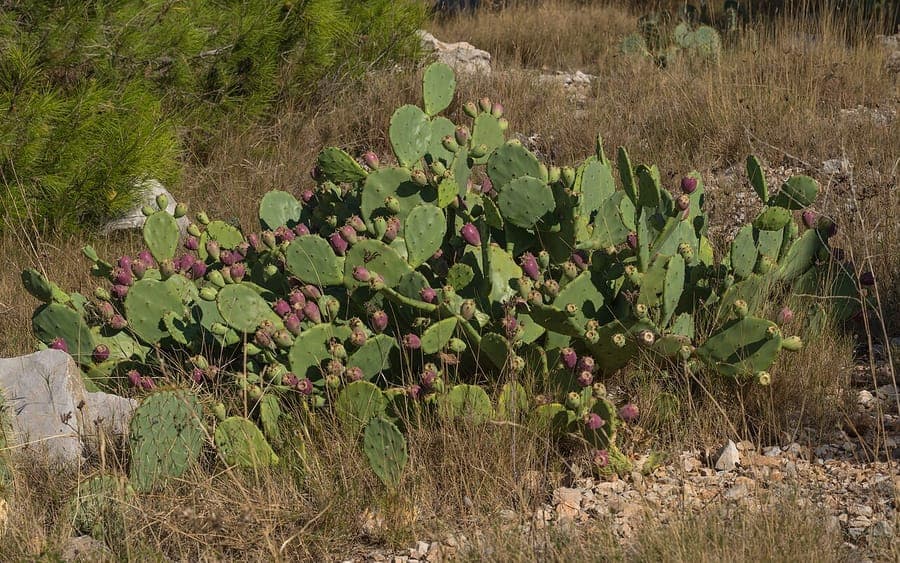
Christian Ferrer / CC BY-SA 4.0, via Wikimedia Commons
Opuntia stricta: complete guide
Opuntia stricta
Want to see Opuntia stricta: complete guide in your garden?
1 minute, no credit card
Overview
Opuntia stricta, known as the Erect Prickly Pear or Spineless Cactus, is a striking plant that naturally occurs in Florida, Mexico, and the Caribbean. This cactus distinguishes itself through its upright, flat stem segments (cladodes) and bright yellow flowers followed by red fruits.
Appearance and Bloom
The Erect Prickly Pear grows as a compact cactus with upright, flat stem segments densely set with small spines. The stem segments are greenish and can reach 15-20 cm in length. In summer, bright yellow flowers appear on the edges of the segments, followed by red to purple fruits in autumn.
The plant reaches a height of approximately 50-100 cm and forms a compact, upright form. The fruits are edible and have a pleasant taste.
Ideal Location
The Erect Prickly Pear is extremely light-loving and requires at least 6-8 hours of direct sunlight daily. Plant this cactus in the sunniest location in your garden where shelter from strong winds is available. The plant can also be grown in containers and placed indoors on a sunny windowsill.
Ensure sufficient space around the plant so the spines cannot harm anyone. Place the plant in a safe, accessible location.
Soil
The Erect Prickly Pear demands well-draining soil. Use cactus compost or make a mixture of standard potting soil mixed with sand and perlite in a 2:1:1 ratio. The plant cannot grow in wet or soggy soil and therefore requires excellent drainage.
For outdoor cultivation, ensure sandy, well-draining garden soil. Add coarse sand or gravel to heavy clay soils to improve drainage.
Watering
The Erect Prickly Pear is extremely drought-tolerant and requires minimal watering. Water only when the potting soil is completely dry, which during the growing period (April-October) may be once every two weeks. In winter, give virtually no water.
Excessive watering causes root rot and plant death. The plant stores water in its stem segments and can survive extended periods without water. In warm, dry periods, more frequent watering may be needed.
Free design
Want to see Opuntia stricta: complete guide in your garden? Make a free design now.
Pruning
The Erect Prickly Pear does not require regular pruning. Remove only damaged or diseased stem segments by breaking them off or carefully cutting them away. Dry segments can easily be broken off and replanted for propagation.
Pruning can be done in spring to maintain shape. Wear gloves when handling due to the spines.
Maintenance Calendar
In spring (March-April), when the plant emerges from dormancy, restart feeding. May through October is the growth period. Water moderately during this time. June through September bright yellow flowers may appear.
In autumn, gradually reduce watering. In October-November, stop feeding. Winter (December-February) is the rest period with minimal watering and no feeding.
Winter Hardiness
The Erect Prickly Pear is somewhat winter hardy and can overwinter outdoors in temperate climates (zones 8b-11) with protection. In cold winters in northern regions, the plant must be brought indoors. Place it in a cool, dry location.
The plant can tolerate temperatures down to approximately -5 degrees Celsius for short periods, but prolonged frost causes damage.
Companion Plants
The Erect Prickly Pear grows well with other drought-tolerant plants in succulent borders. The plant combines beautifully with stones and gravel mulching. Avoid densely planted situations due to the spines.
The plant is very resistant to pests and diseases. Occasionally, mealybug scale insects may occur, but these are usually not a serious problem. The plant does not attract pests.
Closing
The Erect Prickly Pear is ideal for those seeking a very low-maintenance, drought-tolerant plant. With minimal care, this cactus will produce beautiful flowers and fruits for many years.
Visitors to gardenworld.app can use this plant in their designs for xeriscaping and Mediterranean gardens. The yellow flowers add color while the form remains architecturally interesting.
Source this cactus from plant centers or specialized succulent nurseries. Enjoy the minimal maintenance and continuous beauty of this special cactus!
Want to see Opuntia stricta: complete guide in your garden? Make a free design now.
Upload a photo, pick a style, and get a photorealistic design with plant list in under a minute.
No credit card required


Similar plants
Plains prickly pear: complete guide
Opuntia polyacantha
All about plains prickly pear cactus: hardiness, soil, placement and care. One of the most cold-tolerant cacti for temperate gardens.
Saguaro: complete guide
Carnegiea gigantea
Everything about growing saguaro cactus: container care, watering, overwintering, and companion plants for this iconic desert giant.
Cylindropuntia imbricata: complete guide
Cylindropuntia imbricata
The Tree Cholla offers distinctive segmented stems and vibrant red flowers. A unique ornamental succulent perfect for sunny, dry gardens and large containers.