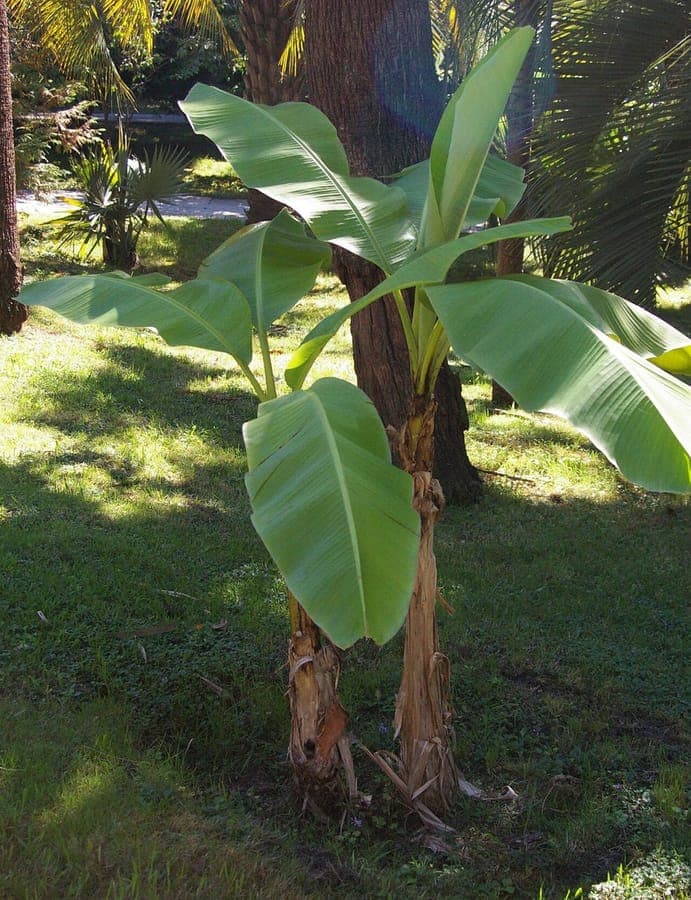
Materialscientist / CC BY-SA 3.0, via Wikimedia Commons
Japanese Banana (Musa basjoo): complete guide
Musa basjoo
Want to see Japanese Banana (Musa basjoo): complete guide in your garden?
Full design in HD: €7.99
Look after your Japanese Banana with the GardenWorld app
Identify plants with your camera and get a care calendar with reminders for this plant.


Overview
The Japanese banana (Musa basjoo) brings a slice of the tropics into your garden within a single season. No other banana can be left outdoors as reliably in Britain, Ireland and the Low Countries. Its enormous leaves, up to 2 m long, give a border, patio or courtyard an instantly exotic look, and the plant returns year after year.
The name is a little misleading. Musa basjoo originally comes from subtropical China, including Sichuan province, but it was grown in Japan for centuries, particularly on the Ryukyu Islands. There, fibres from the leaf sheaths were woven into a tough cloth, which is why it is also called the Japanese fibre banana. It is not grown for its fruit: the bananas are small, packed with seeds and barely edible.
What makes it special is its hardy rootstock. What you see above ground is not a true trunk but a pseudostem of tightly rolled leaf sheaths. That freezes in a light frost, but the rhizome below ground survives much harsher winters and resprouts in spring. If you wrap the pseudostem in winter, you gain metres of height each year. On gardenworld.app you can have a garden design made that gives the Japanese banana a sheltered, warm spot among other exotics.
Appearance and flowering
In our climate a Japanese banana reaches 2 to 4 m, sometimes more in a mild town garden where the pseudostems are well wrapped. The leaves are fresh green, glossy, up to 2 m long and 50 to 60 cm wide, with a sturdy midrib. They fan out from the top of the pseudostem. Wind tears the leaves into strips along the side veins; that is natural and does no harm, but it does look untidy.
Growth is astonishingly fast: with plenty of water and food, a new leaf unfurls almost every week in summer. Suckers appear around the mother plant each year, so after a few seasons you have a clump of several pseudostems.
Flowering is not guaranteed here. A pseudostem usually has to survive two or three seasons before it flowers, and that only happens if it is wrapped well. When it does, a hanging flower head appears at the top with creamy yellow flowers among large brownish-yellow bracts, followed by small green bananas 5 to 10 cm long. A pseudostem that has flowered then dies, and the suckers take over.
Position
Give the Japanese banana a sunny to lightly shaded, warm and, above all, sheltered spot. Against a south- or west-facing wall, in an inside corner or among taller shrubs is ideal. Wind is the biggest enemy of those handsome leaves. It grows fastest in full sun, though it then needs the most water in a hot, dry summer. It copes well with partial shade, where the leaves even stay a fresher green.
Allow plenty of room: a mature clump soon spreads 2 to 3 m across. Do not plant it right next to a path or the edge of a patio, and bear in mind that the leaves will arch over neighbouring plants.
Soil, compost and repotting
In open ground Musa basjoo wants deep, fertile, humus-rich soil that holds moisture but does not lie waterlogged in winter. When planting, dig plenty of garden compost and well-rotted manure into the planting hole. On heavy clay, also work coarse grit into the top layer so the rhizome does not sit in wet soil over winter. Plant in May, once the soil has warmed, so it has a full season to root before its first winter.
In a pot or tub it stays smaller, but it grows perfectly well. Choose a container of at least 50 to 60 litres with drainage holes and fill it with good multipurpose compost mixed with garden compost and some grit. Move it to a larger tub or divide the clump every two to three years in April. Suckers with their own roots can be severed with a sharp spade in spring and potted up separately.
Free preview
Want to see Japanese Banana (Musa basjoo): complete guide in your garden? Make a free preview of your design.
Watering and feeding
Bananas drink and eat a lot. In summer a mature plant in the ground needs 10 to 20 litres per watering in warm weather, several times a week. A plant in a tub often needs water every day in a heatwave. Drooping, limp leaves mean it is thirsty.
Feed every two weeks from May to mid-August with a liquid feed for foliage plants or a tomato feed. A mulch of compost or rotted manure around the base in spring also helps. Stop feeding after mid-August so the pseudostem can harden off before winter. A wrapped plant in the ground needs no water in winter; a potted plant in a shed only an occasional splash.
Pruning and tidying
There is no real pruning. In summer, cut brown, dead leaves off close to the pseudostem and remove torn leaves if they bother you. After the first frost, usually in late October or November, the foliage collapses. Then cut off all the leaves and, if you like, shorten the pseudostem to the height you want to wrap, often 1 to 1.5 m. If you do not want to wrap, cut the pseudostems down to 30 to 50 cm and protect just the rootstock.
Overwintering and wrapping
This is what separates a 1.5 m banana from a 4 m one. The leaves die at 0 °C, and the pseudostem is damaged from around -2 to -5 °C. The rhizome in the ground survives roughly -10 °C unprotected, and much harder winters under a thick mulch. So always protect at least the base.
How to wrap: after the first frost, cut off the leaves. Set a cylinder of chicken wire around the pseudostems, 20 to 30 cm away from them, and fill it with dry straw or dry leaves. Wrap two layers of horticultural fleece around it and add a rain cap on top, such as an upturned bucket or a sheet of plastic over the crown, while leaving the sides able to breathe. Spread 20 to 30 cm of leaves or straw over the whole root zone. The key is that the filling stays dry: wet straw freezes and makes the pseudostem rot.
Remove the protection in April or early May, once hard frosts are over. If a late frost threatens, drape fleece over the young leaves. Bring potted plants into a frost-free, cool space at 5 to 10 °C, such as a garage or shed, in November; light or dark both work, with very little water.
Maintenance calendar
March–April: Check the wrapping for damp. Remove it during April or early May. Repot or divide container plants.
May–June: Plant new specimens. Start feeding and water generously. Cut away any rotten or frosted tissue at the top of the pseudostem.
July–August: Peak growth. Water in warm weather and feed until mid-August.
September–October: Stop feeding and water less. Get your wrapping materials ready.
November–February: After the first frost, cut off the leaves, wrap the pseudostem and mulch the base. Move tubs under cover.
The planting calendar on gardenworld.app shows you when to wrap, when to feed and when to take the protection off again.
Toxicity to pets
Banana plants are known to be non-toxic. The ASPCA lists the common banana (Musa × paradisiaca) as non-toxic to cats, dogs and horses, and no toxic compounds are known for Musa basjoo. Large pieces of leaf or pseudostem can still upset a dog's stomach or cause vomiting, simply because of the amount of coarse fibre. Do not let a young dog chew on the plant unsupervised. It is not known to be toxic to children either.
Companion plants
The Japanese banana is the backbone of an exotic garden. Pair it with the hardy Chusan palm (Trachycarpus fortunei) for structure in winter, while the banana is wrapped up. The rice-paper plant (Tetrapanax papyrifer) and Japanese aralia (Fatsia japonica) add even more big foliage. Canna indica brings red and orange in summer and enjoys the same rich, moist soil. Black bamboo (Phyllostachys nigra) makes a fine windbreak, but plant it with a root barrier.
Final thoughts
Musa basjoo is the easiest way to grow real banana leaves in a north-western European garden. Give it a warm, sheltered spot, plenty of water and food in summer and a dry coat in winter, and it grows larger every year. Even if you skip the wrapping, a lush plant will push up from the ground again by June. Start with one plant in a sheltered corner and see how quickly that corner looks tropical.
Pruning
Frequently asked questions about Japanese Banana
When and how do you prune Japanese Banana?
There is no real pruning. In summer, cut brown, dead leaves off close to the pseudostem and remove torn leaves if they bother you.
How much water does Japanese Banana need?
Bananas drink and eat a lot. In summer a mature plant in the ground needs 10 to 20 litres per watering in warm weather, several times a week.
What soil does Japanese Banana need?
In open ground Musa basjoo wants deep, fertile, humus-rich soil that holds moisture but does not lie waterlogged in winter. When planting, dig plenty of garden compost and well-rotted manure into the planting hole.

See it in your garden
See Japanese Banana in your garden
One photo of your garden and a few questions. You see the result in about a minute.
Try it with a photoIdentify this plant in your own garden. Identify a plant
Similar plants
Chinese windmill palm: complete guide
Trachycarpus fortunei
Chinese windmill palm is a hardy palm with fan-shaped leaves and exotic appearance. Suitable for temperate gardens as a specimen or accent plant.
Chinese Rice-Paper Plant: Complete Care Guide
Tetrapanax papyrifer
Discover the spectacular Chinese rice-paper plant (Tetrapanax papyrifer) with enormous leaves and vigorous growth. Learn about care and location.
Japanese fatsia: complete guide
Fatsia japonica
Discover the Japanese fatsia, a tropical houseplant with large, hand-shaped leaves. This guide covers cultivation, care, and creating a tropical atmosphere.
