
Wikimedia Commons / Public domain, via Wikimedia Commons
Chinese Rice-Paper Plant: Complete Care Guide
Tetrapanax papyrifer
Want to see Chinese Rice-Paper Plant: Complete Care Guide in your garden?
1 minute, no credit card
Overview
The Chinese rice-paper plant (Tetrapanax papyrifer), also called Aralia papyrifera, is a spectacular shrub native to China and Taiwan. This plant is renowned for its enormous, hand-shaped leaves and vigorous growth, making it a favorite for subtropical and Mediterranean gardens across Europe.
Although technically a shrub, the rice-paper plant can develop into a small tree under ideal conditions. Traditionally, the plant is used to produce rice-paper (also called pith paper), a delicate material much valued in Asian culture.
Appearance and Bloom
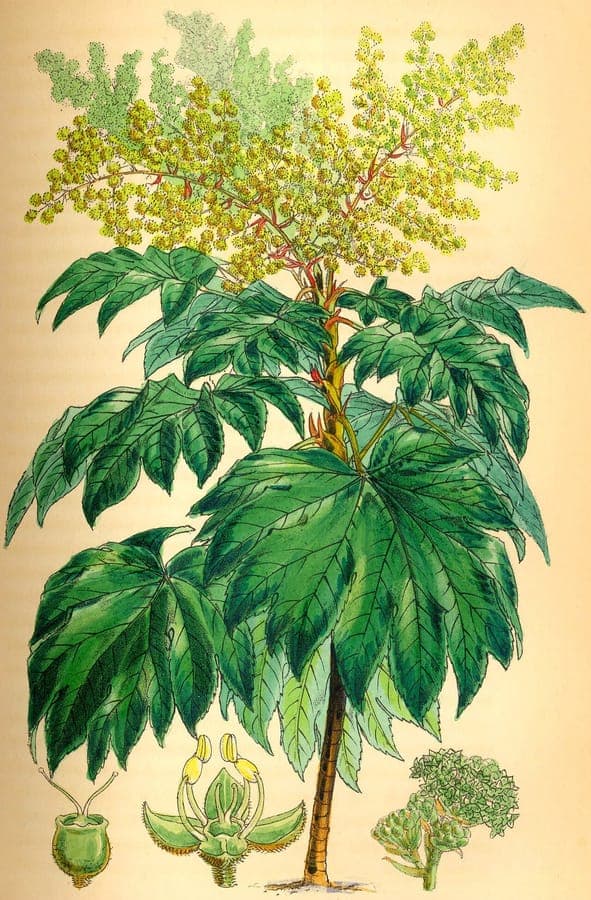
The most striking feature of the rice-paper plant is its colossal leaves - up to 90 centimeters long, deeply lobed, and softly clothed with silvery-grey hairs. These leaves give the plant a tropical, parasol-like appearance that immediately commands attention.
The stems are thick, succulent, and green, providing contrast against the silvery-grey foliage. In late autumn through winter, small cream-yellow flowers appear in dense panicles against the dark green leaves. These are followed by blue-black berries that attract birds.
Growth is phenomenal - young plants can grow 60-90 centimeters per season under favorable conditions.
Ideal Location
The rice-paper plant thrives in part-shade to full sun, depending on your climate. In warm Mediterranean zones, it tolerates full sun; in colder areas, part-shade helps prevent frost damage.
Protection from strong winds is essential, as the large leaves tear easily and stems break. Plant in a sheltered corner or against a wall.
Allow ample space around the plant as it can grow quite substantial - do not plant close to boundaries or buildings.
Soil
The rice-paper plant prefers fertile, well-draining soil rich in organic matter. Add compost, garden loam, and vermiculite to heavy soils.
A pH between 6.0 and 7.0 is ideal. The plant struggles in heavy clay without amendment. For container culture: use premium potting soil with extra organic material.
Depth: ensure at least 50 centimeters of root depth. Young plants grow rapidly, so adequate soil space promotes quick establishment.
Watering
The rice-paper plant loves moist soil especially during the growing season (spring through autumn). Regular watering 2-3 times weekly in warm weather is typically needed.
In winter, watering can be reduced substantially, though soil should never completely dry out.
Water deeply and consistently; shallow spraying does not reach lower roots. Mulching around the plant helps retain moisture.
Free design
Want to see Chinese Rice-Paper Plant: Complete Care Guide in your garden? Make a free design now.
Pruning
Pruning is useful for shaping and size control. Because the rice-paper plant grows so vigorously, monthly pruning may be needed to keep it manageable.
Remove lower leaf stems to achieve a more tree-like form. Prunings can be used for propagation from cuttings.
Timing: best to prune in spring (March-April) for formative shaping, summer pruning for size management.
Maintenance Calendar
Spring (March-May): Formative pruning, increase watering, begin bi-weekly fertilizing with balanced fertilizer.
Summer (June-August): Maintain intensive watering, perform summer pruning, prepare for flowering.
Autumn (September-October): Enjoy blooms, gradually reduce watering, final fertilization in August.
Winter (November-February): Minimal watering, no pruning, no feeding. In very cold climates, consider winter protection.
Winter Hardiness
The rice-paper plant is not frost-tolerant. Temperatures below -3 to -5 degrees Celsius can cause serious damage or be fatal.
In Mediterranean climates (USDA 8+, warmer than -10 degrees Celsius), it can overwinter outdoors with protection. In colder zones, container cultivation with relocation to shelter (greenhouse, conservatory) is essential.
Protection measures: wrap the stem with insulation material, mulch the root zone to 20 centimeters depth.
Companion Plants
The rice-paper plant works superbly alongside complementary tropical/subtropical plants:
- Japanese aralia (Fatsia japonica) - similar growth preference
- Palms (Phoenix, Chamaerops) - tropical atmosphere
- Fatshedera (Fatshedera lizei) - related growth pattern
- Feijoa (Feijoa sellowiana) - fruiting shrub
- Cannas and exotic perennials - color accent
Conclusion
The Chinese rice-paper plant is a dramatic addition to subtropical European gardens. With its gigantic leaves, vigorous growth, and bird-attracting berries, this plant brings genuine exotic appeal.
Specialist nurseries throughout Southern Europe stock this plant. Online retailers offer cuttings and rooted specimens. Gardenworld.app helps you visualize how this sculptural shrub transforms your garden design.
The rice-paper plant: for gardeners who dare to dream big.
Want to see Chinese Rice-Paper Plant: Complete Care Guide in your garden? Make a free design now.
Upload a photo, pick a style, and get a photorealistic design with plant list in under a minute.
No credit card required


Similar plants
American marsh pennywort: complete guide
Hydrocotyle americana
Everything about Hydrocotyle americana: location, soil, moisture and winter care. A delicate groundcover for shaded pond edges and boggy garden borders.
Devil's club: complete guide
Oplopanax horridus
Full guide to growing Oplopanax horridus: ideal site, soil, watering, and care for this dramatic spiny woodland shrub.
Water pennywort: complete guide
Hydrocotyle umbellata
Everything about Hydrocotyle umbellata: ideal location, soil, watering, winter care and pond planting. A versatile aquatic plant for garden ponds and boggy spots.