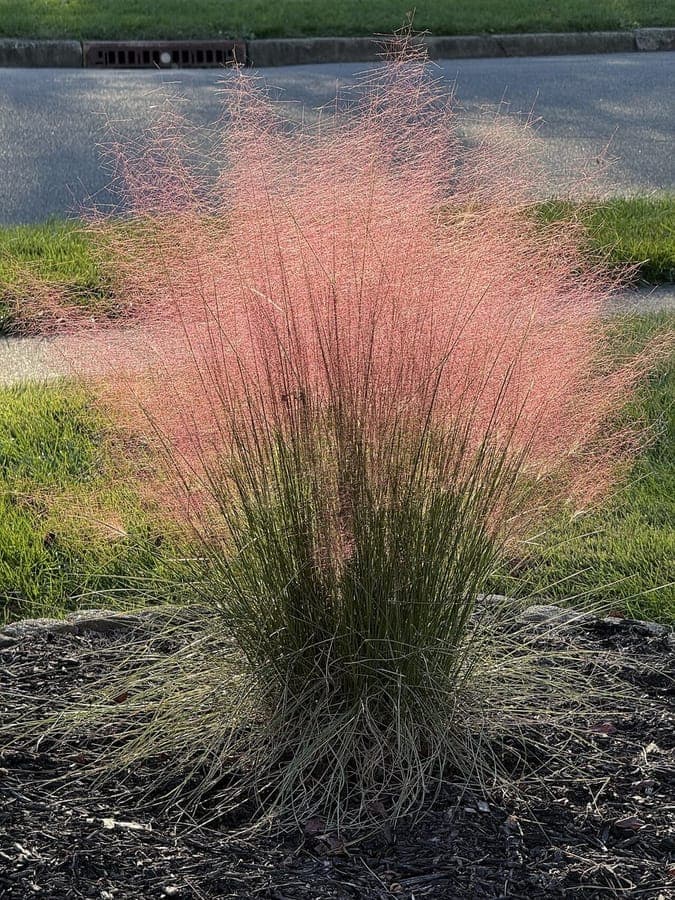
Famartin / CC BY-SA 4.0, via Wikimedia Commons
Pink muhly grass (Muhlenbergia capillaris): growing guide
Muhlenbergia capillaris
Want to see Pink muhly grass (Muhlenbergia capillaris): growing guide in your garden?
Full design in HD: €7.99
Look after your Pink muhly grass with the GardenWorld app
Identify plants with your camera and get a care calendar with reminders for this plant.


Overview
Pink muhly grass (Muhlenbergia capillaris) has become something of a celebrity. Every autumn, photographs of whole hillsides wrapped in a rosy haze, with people wandering through what looks like candyfloss, circulate around the world. In the American South it is everywhere in October, from Charleston front gardens to motorway verges in Georgia. Gardeners in Britain have noticed, and demand has grown accordingly.
The species, also known as hairawn muhly, is native to the south-eastern and southern United States, from coastal Massachusetts down to Florida and across to Texas, reaching into Mexico. There it grows on sandy coastal plains, in open pine woods and on dry limestone slopes: places with hot summers, free-draining soil and relatively mild winters. That background explains almost everything you need to know about growing it successfully in a British or Irish garden.
Muhlenbergia capillaris belongs to the grass family (Poaceae) and is a warm-season grass. It forms a dense, rounded mound of fine, wiry leaves 60 to 90 cm tall. When the flowers arrive, a cloud of panicles rises above the foliage and the plant reaches 90 to 120 cm in height and spread.
The crucial point is timing. In northern Europe it flowers late, usually from the end of September into October, and it needs a warm summer to flower well. It is not a grass for every garden, but in the right spot it is one of the most spectacular autumn plants you can grow. A few selections are available, including 'White Cloud' with white panicles and the ruby-pink seed strain 'Ruby'.
Appearance and flowering
For much of the year this is a modest plant. The leaves are narrow and rolled almost into threads, glossy dark green to grey-green, forming a fine but rather stiff tussock. In mild winters the foliage stays green for a long time; in colder ones it bleaches to straw.
From late August the flowering stems push upwards, and in September and October the panicles open. Each one is 20 to 45 cm long and finely branched, the side branches as thin as hair and tipped with minute spikelets carrying a long, fine awn. Those awns and stalks are coloured pink to purplish red, so that together the panicles form a translucent cloud. The photograph shows this well: a single clump in a bark-mulched bed beside a road, its pink haze lit up by low sun above the grey-green leaves.
Backlighting is the secret. With the sun behind it, early in the morning or late in the afternoon, the plant seems to glow from within. On dull days the colour reads as a soft dusky pink. After a few weeks the pink fades to beige and buff, and the panicles hang on into winter, though they are much less striking by then.
Ideal location
Give pink muhly the hottest, sunniest spot you have. Full sun is not a preference but a requirement: with fewer than six hours of direct sun a day, flowering is sparse. A south-facing slope, a border in front of a warm wall, a gravel garden or a bed beside a sun-baked terrace are all ideal.
Position it so that you see it in autumn with the sun behind or to the side, ideally against a dark background such as a yew hedge or dark fence. It copes well with wind and salt spray, which makes it a good choice for seaside gardens.
Space plants 60 to 80 cm apart. Three plants are enough to create the cloud effect; in large drifts it becomes truly theatrical.
Soil requirements
Sharp drainage is the single most important factor. Sandy, stony or light loamy soils are excellent. In the wild the grass grows on poor ground and needs no extra feeding. On rich soil it produces plenty of foliage but fewer flowers and becomes less hardy.
Heavy clay that stays wet in winter will finish it off. If your soil is clay, plant on a raised bed or mound and work in generous amounts of coarse grit. Muhlenbergia capillaris tolerates both mildly acidic and chalky soils. Do not feed it, or at most give a very light dressing in spring.
Free preview
Want to see Pink muhly grass (Muhlenbergia capillaris): growing guide in your garden? Make a free preview of your design.
Watering
Plant in late spring, ideally May, so that the plant has a whole warm summer to establish. In the first season, water weekly in dry weather, about 5 to 8 litres per plant, and let the soil dry out between waterings.
Once established, the grass is very drought-tolerant, and a dry, warm summer actually encourages flowering. In a heatwave, one deep soak every fortnight is the most it needs. Above all, keep the roots dry in autumn and winter: cold, wet soil is a far greater threat than frost. In containers, drainage matters even more. Raise pots on feet and use a gritty compost.
Pruning
Cut pink muhly back later than most grasses. The old leaves and stems protect the crown from cold and wet, so leave them until late March or early April, once the worst frosts have passed. Then cut everything down to 10 to 15 cm. Do not go lower, or rainwater can collect in the heart of the plant.
In mild winters some of the foliage stays green. In that case you can simply remove the old flower stems and comb out the dead leaves with a rake or gloved fingers. Large, old clumps can be divided in May, although the grass is slow-growing and rarely needs it.
As far as is known, pink muhly is not toxic to people, dogs or cats. It is not listed as invasive anywhere in Europe, and in the British climate it barely self-seeds.
Maintenance calendar
January–February: Leave the plant alone. Check that water is not pooling around the crown.
March–April: Cut back to 10 to 15 cm in late March or early April. Comb out dead foliage.
May: The best month to plant or divide. New growth begins as the soil warms.
June–August: Full leafy growth. Water only young plants in prolonged drought.
September–October: Flowering stems and pink clouds. The high point of the year, best enjoyed in low sunlight.
November–December: Panicles fade to beige. Leave everything standing as winter protection. For a month-by-month guide to jobs across your garden, the planting calendar on gardenworld.app is a useful reference.
Winter hardiness
It pays to be realistic here. In North America Muhlenbergia capillaris grows as far north as USDA zone 6, which equates to about -18 °C to -20 °C on dry soil, and European nurseries usually quote -15 °C to -20 °C. In practice, cold is rarely the problem in Britain; the combination of cold and wet is. A long, sodden winter on heavy soil can rot the crown even when frosts are mild.
In southern England, in towns and on sandy or stony soils, it generally overwinters well. On cold, wet clay in the north it is a gamble. The second limitation is summer warmth: after a cool, damp summer it flowers late or poorly, and in some years the first frosts arrive before it has fully coloured. It is a plant for warm, dry corners, not for every garden.
If in doubt, grow it in a large pot and move it under cover in winter so the root ball stays dry.
Companion plants
Pink muhly looks best beside plants that share its love of sun and drainage and that leave space for the pink cloud to breathe. Russian sage (Perovskia atriplicifolia) is a classic partner: its silver stems and lavender-blue spires are still in flower as the grass begins to colour. Blue fescue (Festuca glauca) makes a low, steely-blue edging in front of the pink haze.
For colour at the same moment, ice plant (Hylotelephium spectabile) is ideal, with flat heads of pink to dusky red that pick up the tones of the grass. Verbena bonariensis floats its purple flower clusters among the panicles and self-seeds happily on dry soil. At the front of the border, Salvia nemorosa provides violet spikes in early summer, long before the grass takes centre stage.
Final thoughts
Muhlenbergia capillaris will not thrive everywhere, and it is better to know that from the start. But give it a hot, dry, well-drained spot in full sun and every autumn it repays you with a display no other grass can match: a glowing pink mist that stretches the season well into October.
If you are wondering whether your garden has such a spot, and what to plant alongside, you can have a garden design created on gardenworld.app that takes your aspect and soil into account, so this remarkable grass gets the chance it deserves.
Frequently asked questions about Pink muhly grass
Is Pink muhly grass winter hardy?
It pays to be realistic here. In North America Muhlenbergia capillaris grows as far north as USDA zone 6, which equates to about -18 °C to -20 °C on dry soil, and European nurseries usually quote -15 °C to -20 °C.
When and how do you prune Pink muhly grass?
Cut pink muhly back later than most grasses. The old leaves and stems protect the crown from cold and wet, so leave them until late March or early April, once the worst frosts have passed.
How much water does Pink muhly grass need?
Plant in late spring, ideally May, so that the plant has a whole warm summer to establish. In the first season, water weekly in dry weather, about 5 to 8 litres per plant, and let the soil dry out between waterings.
Where does Pink muhly grass grow best?
Give pink muhly the hottest, sunniest spot you have. Full sun is not a preference but a requirement: with fewer than six hours of direct sun a day, flowering is sparse.
What soil does Pink muhly grass need?
Sharp drainage is the single most important factor. Sandy, stony or light loamy soils are excellent.

See it in your garden
See Pink muhly grass in your garden
One photo of your garden and a few questions. You see the result in about a minute.
Try it with a photoIdentify this plant in your own garden. Identify a plant
Similar plants
Perovskia atriplicifolia: complete guide
Perovskia atriplicifolia
Russian sage is a semi-shrub with purple-blue flowers and grey-green foliage that blooms from July to October. Perfect for dry gardens and landscape design.
Blue fescue: complete guide
Festuca glauca
Festuca glauca, or blue fescue, is a low-maintenance ornamental grass with silvery-blue foliage. Perfect for sunny, dry borders and rock gardens.
Showy stonecrop: complete guide
Hylotelephium spectabile
Everything about Showy stonecrop (Hylotelephium spectabile): flowering, cultivation and care. Tips for successful frost resistance, drought tolerance and maintenance in borders and containers.
