
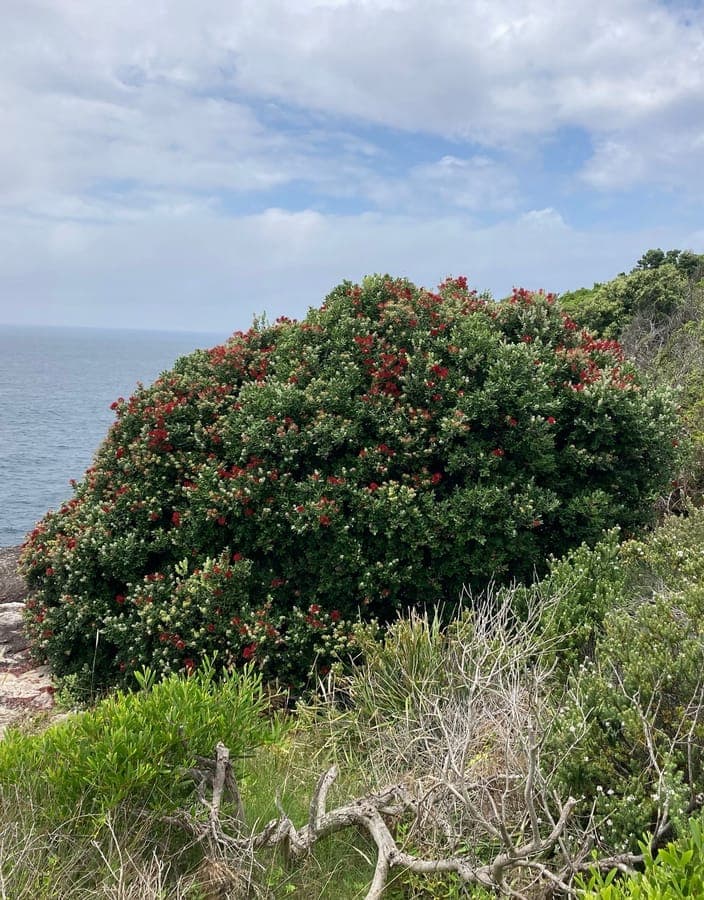
Thomas Mesaglio / CC BY 4.0, via Wikimedia Commons
Kermadec pohutukawa: complete guide
Metrosideros kermadecensis
Want to see Kermadec pohutukawa: complete guide in your garden?
1 minute, no credit card
Overview
Metrosideros kermadecensis, commonly known as Kermadec pohutukawa, is a striking evergreen tree in the myrtle family (Myrtaceae). Its natural range is restricted to the Kermadec Islands, a small archipelago in the South Pacific roughly 1,000 kilometres north of New Zealand. In its native habitat the tree dominates coastal cliffs and volcanic rock faces, growing in full oceanic wind and intense sunlight directly above the sea. This extreme coastal resilience, combined with spectacular scarlet bloom, has made it a prized ornamental wherever the climate allows.
The closely related Metrosideros excelsa is the more famous New Zealand pohutukawa, traditionally associated with the Maori Christmas celebration. Metrosideros kermadecensis is botanically distinct but offers virtually identical ornamental qualities, making it an excellent alternative for coastal gardens in mild climates. At gardenworld.app you can browse inspiration for gardens featuring bold, flowering trees like this one.
In its endemic homeland the tree is found growing alongside a handful of other hardy coastal species, clinging to the volcanic cliffs of Raoul Island, the largest of the Kermadec group. Its ability to survive salt spray, wind, and lean volcanic soils sets it apart from almost any other large flowering tree. Introduced to the Chatham Islands and Tristan da Cunha, it has demonstrated its adaptability across a wide range of Southern Hemisphere coastal environments.
Appearance and bloom cycle
Metrosideros kermadecensis is a medium to large evergreen tree, reaching 15 to 25 metres in its native habitat but typically staying in the 6 to 12 metre range in garden cultivation. The growth habit is broad and spreading, with stout, often contorted branches that create a picturesque silhouette. The trunk and older branches bear grey-brown, rough bark that peels in irregular plates, adding ornamental interest year-round.
The leaves are leathery, oval, dark glossy green above and pale grey-green below. They are covered with fine hairs that help the tree cope with salt-laden wind. Young leaves are sometimes notably more felted in texture, giving the new growth a silvery sheen before it hardens off.
The flowers are the showstopper. They appear in large, dense clusters at the branch tips and consist primarily of long, vivid scarlet stamens that produce a spectacular pompon or brush-like effect. In its native Southern Hemisphere setting blooming occurs from November to January, but in Northern Hemisphere cultivation the main flush typically falls in summer, from June to August. The flowers are highly attractive to pollinators, including bees and butterflies in European gardens.
Ideal location
This tree thrives in a warm, sunny, and reasonably sheltered position. Full sun is ideal. Its most remarkable quality is exceptional tolerance of coastal salt winds - it outperforms nearly any other large flowering tree in exposed seaside situations. In fact, mild coastal areas are where it genuinely excels, as the oceanic influence moderates winter temperatures and provides the humidity the tree enjoys.
Choose a position against a south- or southwest-facing wall in cooler climates, or in the open in truly mild coastal regions. In continental climates with hard winters it is not reliably hardy outdoors without significant protection. In the UK it grows well in southwest England, Wales, and Ireland. In Belgium and the Netherlands it is restricted to the most sheltered coastal towns in mild years.
Soil
In nature Metrosideros kermadecensis grows on volcanic rock in poor, acid soils with a pH of 4.3 to 5.7. It has no need for chalk or lime and dislikes alkaline conditions. However, its soil requirements are otherwise quite adaptable: any reasonably well-drained, acid to neutral soil will support healthy growth.
Improve heavy clay soils with coarse sand and organic matter before planting. Avoid any liming of the soil. Near the coast the tree tolerates a degree of soil salinity that would damage most other large trees, which makes it uniquely suited to beachfront garden situations. Mulch the root zone to conserve moisture and keep the soil temperature stable, especially during the first few years.
Free design
Want to see Kermadec pohutukawa: complete guide in your garden? Make a free design now.
Watering
Young trees need regular watering during their first two to three years while root systems establish. Water thoroughly once a week during dry periods, allowing the soil to partially dry between sessions. Established trees are considerably more drought-tolerant and can manage short dry spells without supplemental irrigation.
In wet winters, ensure drainage is adequate to prevent prolonged waterlogging of the roots. In dry summers, occasional deep watering is welcome, particularly for trees growing in containers or against walls. Mature trees in oceanic coastal climates rarely need regular irrigation once established, as rainfall and atmospheric humidity generally meet their needs.
Pruning
Metrosideros kermadecensis requires minimal pruning. It naturally develops a handsome, broad canopy without intervention. In early spring, remove any dead, diseased, or crossing branches. If the tree outgrows its allotted space, it can be carefully shaped after flowering in late summer.
The tree tolerates moderate pruning but recovers more slowly than fast-growing species. Never remove more than one third of the canopy at once. Trained specimens in sheltered town gardens can be maintained at a manageable size with light annual pruning. Always use sharp, clean tools to minimise the risk of fungal infection through pruning wounds.
Maintenance calendar
January-February: rest period; protect from frost if in a marginal climate. March: remove dead wood; apply a mulch of bark or compost around the root zone. April-May: new growth begins; apply an acid-loving plant feed. June-August: peak flowering in the Northern Hemisphere; enjoy and leave undisturbed. September: seeds ripen; lightly prune after flowering if reshaping is needed. October-November: final frost-protection check; add extra mulch in cold areas. December: dormancy; protect young trees with fleece during hard frost spells.
Winter hardiness
Metrosideros kermadecensis is less frost-hardy than some of its relatives. It is reliably hardy in USDA zones 9 to 11, tolerating minimum temperatures of around -6 to -1°C. In the mildest coastal areas of northwest Europe - Cornwall, the Scilly Isles, coastal Brittany, the Canary Islands - it survives outdoors without protection. In colder inland areas it needs a sheltered wall and winter fleece protection.
A thick mulch over the root zone, a sheltered south-facing wall position, and fleece protection for young plants during hard frosts are the key winter management strategies. In containers, move the plant into a cool, frost-free space before the first hard frost. Check gardenworld.app for tailored advice on frost-protecting exotic trees in your specific garden climate.
Companion plants
Metrosideros kermadecensis pairs beautifully with other bold coastal and subtropical plants. Agapanthus in blue or white provides stunning colour contrast with the scarlet flowers. Phormium species add structural contrast with their sword-like foliage. Cordyline australis reinforces the tropical coastal atmosphere.
In milder gardens, Echium pininana with its towering blue spikes makes a dramatic companion. Libertia grandiflora and ornamental grasses soften the composition at ground level. Aloe and Beschorneria work as ground-layer companions in warmer settings. As a specimen tree on a lawn or above a rock wall, the pohutukawa is unsurpassed for drama, its contorted branches adding year-round sculptural interest.
Closing
Metrosideros kermadecensis is a tree of genuine drama and character, rewarding its grower with an extraordinary display of scarlet bloom that stops passers-by in their tracks. Its ability to thrive in salty, windy coastal positions where many trees struggle makes it a truly practical choice as well as a beautiful one. For gardeners in mild coastal climates looking for a specimen tree with real presence and year-round appeal, the Kermadec pohutukawa is worth every effort spent on finding it the right spot.
Want to see Kermadec pohutukawa: complete guide in your garden? Make a free design now.
Upload a photo, pick a style, and get a photorealistic design with plant list in under a minute.
10,000+ gardens designed already
No credit card required


Similar plants
Flooded gum (Eucalyptus grandis): complete guide
Eucalyptus grandis
Everything about the flooded gum: fast growth, impressive stature and silvery bark. How to plant and care for this eucalyptus in your garden.
Yellow gum (Eucalyptus leucoxylon): complete guide
Eucalyptus leucoxylon
Everything about the yellow gum: showy flowers in winter, compact form and drought tolerance. How to grow and care for this eucalyptus in your garden.
Sydney blue gum (Eucalyptus saligna): complete guide
Eucalyptus saligna
Everything about the Sydney blue gum: extraordinary growth rate, beautiful grey-blue bark and impressive stature. How to plant and care for this eucalyptus.