
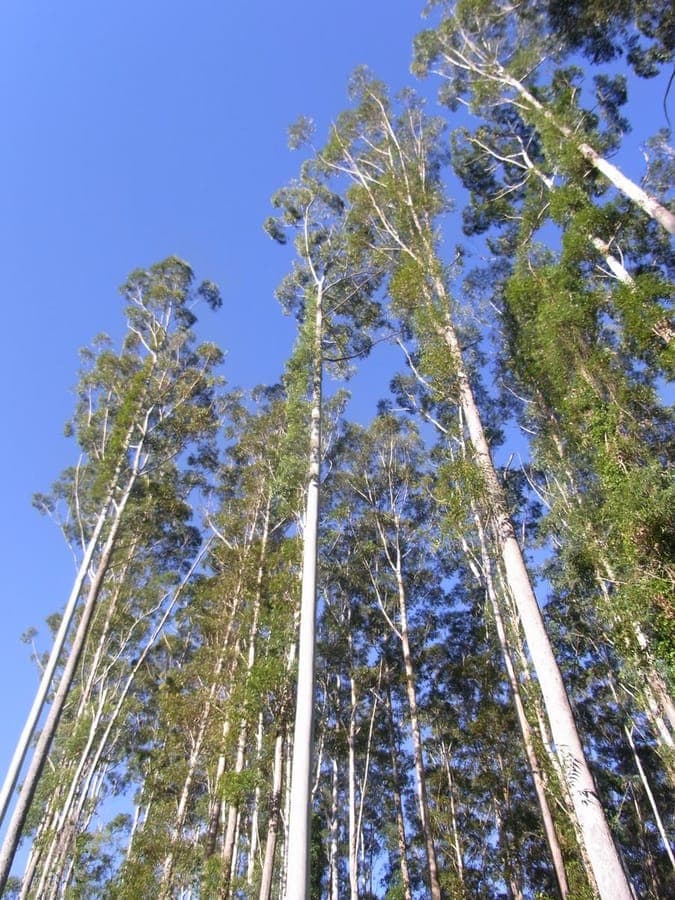
Poyt448 Peter Woodard / CC BY-SA 3.0, via Wikimedia Commons
Flooded gum (Eucalyptus grandis): complete guide
Eucalyptus grandis
Want to see Flooded gum (Eucalyptus grandis): complete guide in your garden?
1 minute, no credit card
Overview
The flooded gum (Eucalyptus grandis), also known as rose gum or grand eucalyptus, is one of the most impressive eucalyptus species in existence. Native to eastern Australia - primarily New South Wales and Queensland - it takes its English name from the moist, seasonally flooded river valleys and lowland forests where it grows wild. In its natural habitat, the flooded gum regularly reaches heights of 55 metres or more, with trunk diameters exceeding 2 metres. Outside Australia it has been widely planted across tropical and subtropical regions, from Africa to South America and parts of Asia, mainly for timber and plantation forestry. For garden use, the flooded gum is a striking choice that demands plenty of space but rewards with a spectacular visual presence. You can explore how large specimen trees like this fit into garden layouts at gardenworld.app.
Appearance and bloom cycle
Eucalyptus grandis is a single-stemmed tree with a tall, straight trunk that is characteristically smooth and powdery, cycling through shades of white, grey, and blue-green as the bark sheds annually. This annual bark-shedding process is one of the most decorative features of the species - the tree seems to renew itself each year, revealing fresh pastel-tinted surfaces beneath the peeling strips. At the tree's base, a small amount of rough, greyish-brown bark often persists. The leaves are lance-shaped to slightly sickle-shaped, blue-green to grey-green in colour, and hang in graceful pendulous clusters. Juvenile leaves are rounder and more intensely blue than adult foliage. Like all eucalypts, the leaves contain high concentrations of essential oils responsible for the species' signature aromatic fragrance. The flowers are white, held in clusters of seven on each stalk, and consist largely of stamens rather than petals - a hallmark of the genus. In its homeland, flowering occurs year-round with a peak from August to December. In European gardens, flowers are rarely seen as the tree seldom reaches maturity in the local climate. Fruits are small, goblet-shaped capsules containing dark seeds.
Ideal location
The flooded gum needs full sunlight for vigorous growth. In nature it occupies warm, humid lowland zones with mild winters and wet summers. In Western European gardens - the Netherlands, Belgium, western Germany, and the coastal areas of France - it can be tried in sheltered, frost-free spots, but sustained winter hardiness cannot be guaranteed in most regions. Young trees are most vulnerable to frost; older, established specimens handle brief cold snaps better. Choose a site protected from cold, drying winds. A south-facing wall or a dense windbreak of conifers or pleached trees can make a meaningful difference. Allow generous space, accounting for a potential height of 20 to 40 metres at maturity in a favourable climate outside its native range.
Soil
The ideal soil for Eucalyptus grandis is deep, free-draining and mildly acid to neutral (pH 4 to 6). In its native range it favours rich alluvial soils along watercourses, but it adapts to various soil types as long as excess water drains away promptly after heavy rain. Clay-heavy soils that retain moisture for long periods are unsuitable and can cause root rot. Sandy or lightly loamy soils, enriched with some organic matter, give the best results. The tree is relatively tolerant of poorer ground provided drainage is good. Avoid calcareous or chalky soils - the species copes poorly with alkalinity and will show chlorosis (yellowing). At planting time, mixing a modest amount of compost into the planting hole improves soil structure without over-feeding, encouraging the roots to explore widely and deeply.
Free design
Want to see Flooded gum (Eucalyptus grandis): complete guide in your garden? Make a free design now.
Watering
In the first two growing seasons after planting, the flooded gum benefits from regular watering, especially during dry spells. The soil should never completely dry out, but equally should not remain waterlogged. Apply a generous layer of mulch around the base - leaf compost, wood chips, or bark - to retain soil moisture and suppress weeds. Once established, a mature tree becomes surprisingly drought-tolerant thanks to its wide-ranging root system and rarely needs supplemental watering during periods of normal rainfall. In prolonged dry summers, a thorough deep watering every two to three weeks is helpful. Always water deeply and generously so the entire root zone is moistened, rather than frequent shallow applications. This promotes deep root development. Avoid watering late in the evening, particularly when fungal disease risk is elevated.
Pruning
Eucalyptus grandis requires minimal pruning when grown as a specimen tree. The tree naturally forms a straight central leader and develops a well-proportioned crown without intervention. Remove dead, damaged, or crossing branches in early spring (February to March) before new growth starts. Wounds on eucalypts heal reasonably well, but applying a wound sealant to larger cuts is a sensible precaution. Eucalypts can also be coppiced - cut back to near ground level - and will vigorously re-sprout from the stump or root collar. This is occasionally practised in gardens to keep the tree smaller or to renovate frost-damaged specimens. After frost damage, wait until June before assessing the extent of the injury and then prune to live wood.
Maintenance calendar
January - February: the tree is dormant; no major intervention needed. Check protective coverings on young trees during sustained cold spells. March: light spring pruning - remove dead and damaged branches. Apply fresh mulch around the base. April - May: first growth flush; monitor soil moisture and begin supplemental watering if conditions are dry. June - August: peak summer growth. Deep watering every two to three weeks in dry conditions. Check for pests (leaf spot, scale insects). September: growth slows. Apply a modest potassium-rich feed to harden growth before winter. October - November: collect fallen leaves from around the base. Protect young trees with fleece or windbreak netting. December: winter rest. Ensure soil is not waterlogged after prolonged rain.
Winter hardiness
Eucalyptus grandis is not reliably winter-hardy in the Low Countries or most of Germany and northern France. The species is rated for USDA hardiness zones 9 to 10, meaning it tolerates night frosts down to about -6 to -7 degrees Celsius. Young trees are more vulnerable than established ones. Coastal areas of Belgium, the south-west of the Netherlands, and the Atlantic coastline of France offer the best chances outdoors in a sheltered position. In continental climates the risk of winter kill is too high for long-term outdoor success. Container growing is the most popular approach in cooler regions: bring the pot under glass before the first frost, overwintering in a cool, light space (garage, greenhouse or orangery) at 2 to 8 degrees Celsius. Wrap young outdoor specimens in October with horticultural fleece.
Companion plants
The flooded gum combines well with other Mediterranean or Australian plants that share its preference for full sun and good drainage. Agapanthus provides a colourful underplanting with blue or white flowers through summer. Stipa tenuissima and other ornamental grasses echo the tree's light, airy quality. Gaura (Oenothera lindheimeri) with its swaying white or pink flower spikes suits the elegant character of the planting. Lavandula, Salvia and Rosmarinus make a fragrant herbal understorey that tolerates the same dry conditions. Acacia dealbata (silver wattle), a close relative, adds brilliant yellow blossom in late winter and early spring. Avoid moisture-loving perennials directly beneath the crown, as the tree's root system is highly competitive.
Closing thoughts
The flooded gum is an outstanding choice for gardeners who have the space, live in a favourable climate, or are willing to overwinter the plant indoors during cold months. Its rapid growth rate, ornamental bark and powerfully fragrant foliage give it an exotic presence matched by very few trees. If you want to see how a dramatic specimen tree could transform your garden, visit gardenworld.app to explore visualisations and planting ideas. Look for young container specimens at specialist nurseries and garden centres.
Want to see Flooded gum (Eucalyptus grandis): complete guide in your garden? Make a free design now.
Upload a photo, pick a style, and get a photorealistic design with plant list in under a minute.
10,000+ gardens designed already
No credit card required


Similar plants
Sydney blue gum (Eucalyptus saligna): complete guide
Eucalyptus saligna
Everything about the Sydney blue gum: extraordinary growth rate, beautiful grey-blue bark and impressive stature. How to plant and care for this eucalyptus.
Yellow gum (Eucalyptus leucoxylon): complete guide
Eucalyptus leucoxylon
Everything about the yellow gum: showy flowers in winter, compact form and drought tolerance. How to grow and care for this eucalyptus in your garden.