
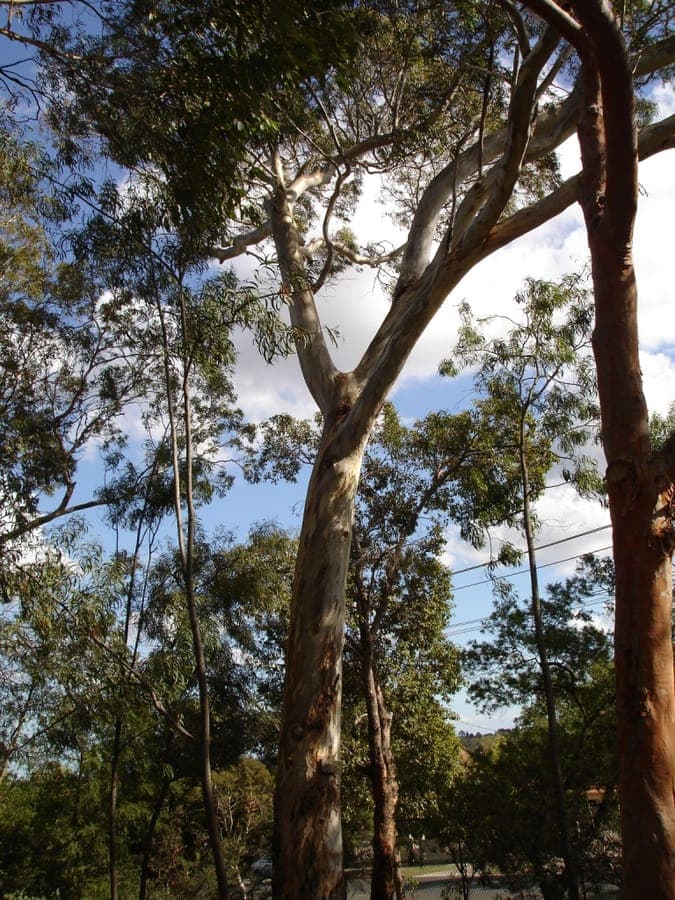
HelloMojo at English Wikipedia / Public domain, via Wikimedia Commons
Yellow gum (Eucalyptus leucoxylon): complete guide
Eucalyptus leucoxylon
Want to see Yellow gum (Eucalyptus leucoxylon): complete guide in your garden?
1 minute, no credit card
Overview
The yellow gum (Eucalyptus leucoxylon), also known as white ironbark or South Australian blue gum, is one of the most popular ornamental eucalyptus species in cultivation worldwide. Native to south-eastern Australia - New South Wales, Victoria and South Australia - it stands out from its often colossal relatives by being a more moderate-sized tree that fits comfortably into larger garden settings. Its widespread popularity as an ornamental plant stems from its outstanding flowers, which range from white through pink to deep crimson depending on the cultivar, and which bloom through the cooler months of the year. This makes the yellow gum exceptionally valuable as a winter-flowering tree in areas with mild winters. At gardenworld.app you will find inspiring garden design ideas featuring showstopper flowering trees like this one as focal points. Outside Australia the species has been introduced to Kenya and Tanzania, where it is planted in parks and reforestation schemes.
Appearance and bloom cycle
Eucalyptus leucoxylon is a medium to large tree with a single stem, typically reaching 6 to 15 metres in garden conditions, though it can reach 30 metres in its natural habitat. The bark is partly rough and grey-brown at the base, transitioning upward to smooth, peeling surfaces in white, cream or grey. This two-tone bark pattern is one of its distinguishing visual features. The leaves are lance-shaped, blue-green and pleasantly aromatic when crushed. Juvenile leaves are rounder and more intensely blue than mature foliage. The real showpiece is the flowers: buds open into large, fluffy blooms consisting almost entirely of stamens, since petals are minimal or absent - characteristic of all eucalypts. Depending on the cultivar, flowers are white, cream, pink, red or bicoloured. The most popular garden cultivars include 'Rosea' (warm pink), 'Purpurea' (deep red-purple) and 'Rosea Major' (large pink flowers). In its native range, flowering runs from April to September; in European gardens the main flowering period typically occurs in autumn and winter under mild conditions, or extends into spring. Fruits are goblet-shaped capsules similar to other eucalypts.
Ideal location
Eucalyptus leucoxylon thrives in a fully sunny, open position. It is less frost-sensitive than many other eucalyptus species and tolerates brief periods of mild frost better than most. Its tolerance for drought and poor soils makes it suitable for less hospitable garden spots, provided drainage is good. In its native range it grows on dry, poor, rocky slopes and open scrubland. In Western Europe - particularly in coastal regions of Belgium, south-western Netherlands and the French Atlantic coast - the best results come from a sheltered, south-facing position protected from cold north and east winds. The tree looks excellent as a solitary specimen or in a loose group of two or three. It is also popular as a privacy screen or windbreak in larger gardens. Allow at least 6 metres clearance from other large trees.
Soil
The yellow gum is remarkably flexible about soil type. In nature it grows on dry, poor, mildly acid to mildly alkaline soils (pH 6 to 8.5) in South Australia and Victoria, where rainfall is unpredictable. It adapts to sandy, loamy and moderately clayey soils, as long as water drains away readily. Waterlogging is its greatest enemy: never allow the soil to remain soggy for extended periods, as this leads to root rot. On heavy clay soils, improve drainage by creating a layer of coarse grit or lava stone beneath the planting hole, or by mounding the soil to form a raised planting position. At planting time add a modest amount of compost for good soil structure, but avoid over-fertilising: on poorer soils the yellow gum grows more compact and begins flowering earlier.
Free design
Want to see Yellow gum (Eucalyptus leucoxylon): complete guide in your garden? Make a free design now.
Watering
In the first growing season after planting, regular watering is needed to help establish the root system. Once settled - generally after one full growing season - the species becomes notably drought-tolerant and rarely needs supplemental irrigation during normal rainfall periods. In prolonged summer dry spells, a thorough deep watering every two to three weeks is sufficient. Apply mulch at the base of the tree - wood chips, bark or leaf litter - to retain moisture and moderate soil temperature. Always water deeply and generously rather than frequently and shallowly. This pushes roots deeper and substantially increases drought tolerance. Avoid watering in full midday sun; early morning or late afternoon is better.
Pruning
Pruning is rarely necessary for the yellow gum if it has space to develop naturally. Once a year in early spring (February to March), remove dead, damaged or overcrowded branches. Eucalyptus leucoxylon can also be lightly trimmed after flowering to manage size, but time this carefully to avoid losing the following season's blooms. Avoid heavy one-off pruning; several light sessions are far better. Like other eucalypts, it can be coppiced - cut back hard to near ground level - and will sprout vigorously from the stump or root collar. After frost damage, wait until June to assess which wood is still alive before cutting back to living tissue. Apply wound sealant to larger pruning cuts.
Maintenance calendar
January - February: check winter protection. In mild coastal winters, enjoy the flowers in bloom. March: light pruning - remove dead and damaged branches. Replenish mulch layer. April - May: first growth flush begins. Start supplemental watering if dry. Check for scale insects or leaf spot. June - August: summer peak. Minimal watering needed during normal rainfall. In drought: deep watering every two to three weeks. September: growth slows. Optional: light potassium-rich feed to harden growth ahead of winter. October - November: clear fallen eucalyptus leaves from around the base. Protect young trees with fleece; wrap container plants if temperatures drop sharply. December: dormancy. Ensure soil is not waterlogged after sustained rain.
Winter hardiness
Eucalyptus leucoxylon is among the more cold-hardy eucalyptus species and is generally placed in USDA hardiness zones 8 to 9, tolerating night frosts down to approximately -9 to -12 degrees Celsius. This makes it considerably more suitable for garden use in Belgium, the Netherlands and north-western France than many of its relatives. That said, reliable overwinter survival cannot be guaranteed in most parts of the Low Countries. Young trees are more vulnerable than established specimens; protect them through the first two winters with horticultural fleece and a generous mulch of wood chips over the root zone. In mild coastal areas the tree has a good track record of survival in sheltered positions. Container growing is also possible: overwinter in a cool, frost-free, bright space at 2 to 8 degrees Celsius.
Companion plants
The yellow gum pairs beautifully with plants that share its preference for dry, sunny conditions. Cistus (rock rose) and Phlomis work well in terms of texture and drought tolerance. Agapanthus provides a striking blue accent through summer. Stipa gigantea adds airy golden plumes in late summer light. Grevillea species - fellow Australians from the Proteaceae family - match the yellow gum both in cultural requirements and visual character. Salvia, Westringia and Callistemon (bottlebrush) complete an Australian-inspired border. Avoid moisture-lovers such as hostas directly beneath the crown, as they will struggle with root competition. Visit gardenworld.app to explore how combinations of drought-tolerant trees and flowering companions might look in your own garden.
Closing thoughts
The yellow gum is a remarkably versatile ornamental tree that sets itself apart with spectacular winter flowers, distinctive bark and the ability to thrive in drier, poorer conditions where many trees struggle. Its relatively modest size - compared to giants like E. grandis - makes it accessible to a wider range of gardeners. If you want to explore garden design ideas featuring flowering, drought-tolerant trees, visit gardenworld.app for visualisations and planting inspiration. Young container plants are available at specialist nurseries and garden centres.
Want to see Yellow gum (Eucalyptus leucoxylon): complete guide in your garden? Make a free design now.
Upload a photo, pick a style, and get a photorealistic design with plant list in under a minute.
10,000+ gardens designed already
No credit card required


Similar plants
Flooded gum (Eucalyptus grandis): complete guide
Eucalyptus grandis
Everything about the flooded gum: fast growth, impressive stature and silvery bark. How to plant and care for this eucalyptus in your garden.
Sydney blue gum (Eucalyptus saligna): complete guide
Eucalyptus saligna
Everything about the Sydney blue gum: extraordinary growth rate, beautiful grey-blue bark and impressive stature. How to plant and care for this eucalyptus.