
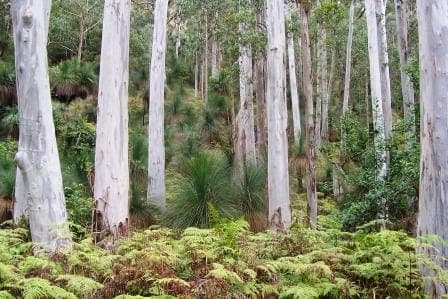
Poyt448 Peter Woodard / Public domain, via Wikimedia Commons
Sydney blue gum (Eucalyptus saligna): complete guide
Eucalyptus saligna
Want to see Sydney blue gum (Eucalyptus saligna): complete guide in your garden?
1 minute, no credit card
Overview
The Sydney blue gum (Eucalyptus saligna), also known as silky gum, blue gum or saligna eucalyptus, is a majestic eucalyptus species native to the coastal regions of eastern Australia - primarily New South Wales and Queensland. It takes its name partly from the city of Sydney, near which it grows in large numbers, and partly from the striking blue-grey colour of its bark. In its natural habitat the Sydney blue gum easily reaches 40 to 65 metres in height, ranking it among the tallest broadleaved trees in Australia. Its phenomenal growth rate - up to 2 metres per year under favourable conditions - makes it highly valued globally for timber plantations and fast-growing windbreaks. The species has naturalised in numerous countries, from Morocco and Ethiopia to Hawaii and Taiwan. As a garden tree in cooler climates it is a specialist choice demanding plenty of space, but in mild regions it delivers a spectacular visual impact. You can explore how imposing specimen trees like this might look in your garden design at gardenworld.app.
Appearance and bloom cycle
Eucalyptus saligna is a slender, upright tree with a strikingly straight trunk covered in young specimens by smooth, blue-grey bark that sheds annually in long strips. On the upper sections of the trunk this regular shedding creates a beautiful mottled effect in white, grey, blue and light brown. At the base of the trunk rough, dark bark typically persists for 1 to 3 metres. The leaves of mature trees are lance-shaped to slightly sickle-shaped, narrow, and bright to blue-green in colour, hanging gracefully downward. Juvenile leaves are broader, rounder and often a pronounced blue-green - a decorative quality that some gardeners deliberately exploit by coppicing the tree and encouraging fresh young growth. The flowers are yellow, held in clusters of seven to eleven per stalk, and consist mainly of long stamens with minimal or no petals. In Australia the tree flowers for much of the year. In Europe flowers are rarely seen outside subtropical zones. Fruits are hemispherical to cup-shaped capsules containing dark seeds.
Ideal location
The Sydney blue gum needs a fully sun-exposed position with minimal shade throughout the day. In its native range it grows along the mild, moist coastline of New South Wales in open forest and on slopes, in both flat and undulating terrain. In Western Europe the best chances of success are in maritime coastal regions: the Belgian coast, south-western Netherlands, the Breton and Atlantic coast of France. Only in those areas are nights mild enough to carry young trees through winter without extensive protection. A sheltered, south-facing position - against a large wall or between dense hedging plants - helps in the first winters. The tree appreciates space: site it where it can grow freely upward without interference from buildings or other trees. Maintain at least 10 to 15 metres clearance from buildings and underground services, given the extensive and aggressive root system.
Soil
Eucalyptus saligna thrives best on deep, free-draining, mildly acid soils (pH 4 to 6). In its native range it grows on rich, moist alluvial soils along coastal strips as well as on sandy and loamy hillsides. It tolerates a broad range of soil types - from sand to loam to moderately clay-rich - provided excess water drains away promptly. Prolonged waterlogging is fatal, leading to root rot and gradual decline. Avoid calcareous or chalky soils, as the species handles alkalinity poorly and will show chlorosis at high pH values. At planting time, mix a bucket of well-rotted compost into the planting hole to improve soil structure. Do not add concentrated fertiliser in the first year; let the roots explore the surrounding soil naturally. In subsequent years, a light nitrogen feed in spring supports healthy growth.
Watering
In the first two growing seasons after planting, regular watering is essential, particularly during dry summers. The young plant has a still-limited root system and can dry out quickly if soil moisture drops too low. Apply a generous mulch layer - 8 to 10 centimetres of wood chips or bark - to retain soil moisture and moderate soil temperature. Once well established, the Sydney blue gum is surprisingly resilient in dry periods, thanks to its deep taproot and wide lateral root network. In dry summers, deep watering every two to three weeks is sufficient. Always water deeply and in large quantities rather than frequently in small amounts - this substantially promotes deep root development. In winters with prolonged wet periods, ensure drainage is adequate to prevent waterlogging at root level.
Free design
Want to see Sydney blue gum (Eucalyptus saligna): complete guide in your garden? Make a free design now.
Pruning
The Sydney blue gum needs minimal pruning when given a free-standing position. The tree naturally forms a straight, slender silhouette with few crossing branches. Once a year in early spring - February to March - remove dead, damaged and inward-growing branches. Also remove branches that are set too low on the trunk if you want clear headroom beneath the crown. Larger pruning interventions are best done during dry weather to reduce the risk of fungal infection. Eucalypts respond well to coppicing: the trunk is cut back near ground level and vigorous new shoots emerge from the root collar. This technique can be used to keep the tree smaller or to recover after frost damage. After frost damage always wait until June before pruning, so you can assess which wood is still viable. Apply a certified wound sealant to large pruning cuts.
Maintenance calendar
January - February: winter dormancy. Check protection measures around young trees. Apply extra fleece before forecast hard frost. March: start of the growing season. Light pruning - remove dead branches. Replenish mulch layer around the trunk. April - May: rapid spring growth begins. Monitor soil moisture and start supplemental watering if conditions are dry. Optional light nitrogen feed. June - August: peak growth rate of the season. With normal rainfall, little supplemental watering is needed. In dry periods, deep watering every two to three weeks. September: growth slows. A modest potassium-rich feed supports frost resistance ahead of winter. October - November: remove fallen leaves from around the trunk. Put winter protection in place for young trees. December: full dormancy. Check that the soil is not waterlogged after sustained rain.
Winter hardiness
Eucalyptus saligna is rated for USDA hardiness zones 9 to 10, meaning it tolerates night frosts down to about -6 to -7 degrees Celsius. This places it in roughly the same range as Eucalyptus grandis in terms of cold tolerance, making it suitable for permanent outdoor growing only in the mildest coastal regions of Western Europe. Inland in the Netherlands, Belgium and Germany the risk of severe frost damage is too high for reliable long-term outdoor success. Young trees are most vulnerable; provide good winter protection in the first two winters: wrap with horticultural fleece, mulch to a depth of at least 10 centimetres over the root zone and shelter with a windbreak. Older, larger trees handle brief mild frosts better. Container growing is also possible: overwinter the pot in a cool, bright, frost-free room at 2 to 8 degrees Celsius. Move the container outdoors only after the last frost date has passed.
Companion plants
The Sydney blue gum is a dominant tree that shades out neighbours and competes strongly via an extensive root system. Choose companions that are drought- and shade-tolerant and not too sensitive to the mildly allelopathic properties of eucalyptus leaf litter. Agapanthus functions well as an underplanting - blue-flowered and drought-tolerant. Acacia dealbata (silver wattle), a close relative, brings golden-yellow spring blossom and shares the same cultural requirements. Stipa tenuissima and other feathery ornamental grasses enhance the airy quality of the eucalyptus. Rosmarinus, Lavandula and Callistemon (bottlebrush) complete an Australian-Mediterranean picture. Avoid moisture-demanding plants such as hostas, astilbes or ligularias in the immediate vicinity of the trunk - eucalyptus root competition will displace them. At gardenworld.app you can quickly visualise how drought-tolerant companions around a large specimen tree might look in your own garden.
Closing thoughts
The Sydney blue gum is a phenomenal tree for gardeners who think on a large scale and have the space to match. Its extraordinary growth rate, striking blue-grey trunk and distinctively Australian character make it unique in the garden landscape of north-western Europe. In the right conditions - a large plot, a mild maritime climate and a sheltered position - it can grow into a genuine landmark within ten years. Want to see whether an impressive specimen tree like the Sydney blue gum suits your garden design? Visit gardenworld.app for a visual exploration. Look for young container specimens at specialist nurseries and garden centres.
Want to see Sydney blue gum (Eucalyptus saligna): complete guide in your garden? Make a free design now.
Upload a photo, pick a style, and get a photorealistic design with plant list in under a minute.
10,000+ gardens designed already
No credit card required


Similar plants
Flooded gum (Eucalyptus grandis): complete guide
Eucalyptus grandis
Everything about the flooded gum: fast growth, impressive stature and silvery bark. How to plant and care for this eucalyptus in your garden.
Yellow gum (Eucalyptus leucoxylon): complete guide
Eucalyptus leucoxylon
Everything about the yellow gum: showy flowers in winter, compact form and drought tolerance. How to grow and care for this eucalyptus in your garden.