SEWilco / CC BY-SA 3.0, via Wikimedia Commons
Ginger mint: growing Mentha × gracilis without the takeover
Mentha × gracilis
Want to see Ginger mint: growing Mentha × gracilis without the takeover in your garden?
Full design in HD: €7.99
Look after your Ginger mint with the GardenWorld app
Identify plants with your camera and get a care calendar with reminders for this plant.


Overview
Mentha × gracilis, usually sold as ginger mint, is a natural hybrid between corn mint (Mentha arvensis) and spearmint (Mentha spicata). It combines the best of both parents: the fresh, sweet flavour of spearmint with a warmer, fruity undertone. To be honest, there is not much real ginger in the taste; the name refers more to that gentle, spicy warmth and to the gold-striped form sold as ginger mint. Green forms are also known as Scotch spearmint, a mint grown on a large scale in North America for its oil.
Like every mint, it is a perennial of the Lamiaceae that spreads quickly by underground and surface runners. That makes it easy to grow but also hard to keep in check. Plant it loose in a border and within two years you will find it everywhere. A few simple measures keep it neatly where you want it.
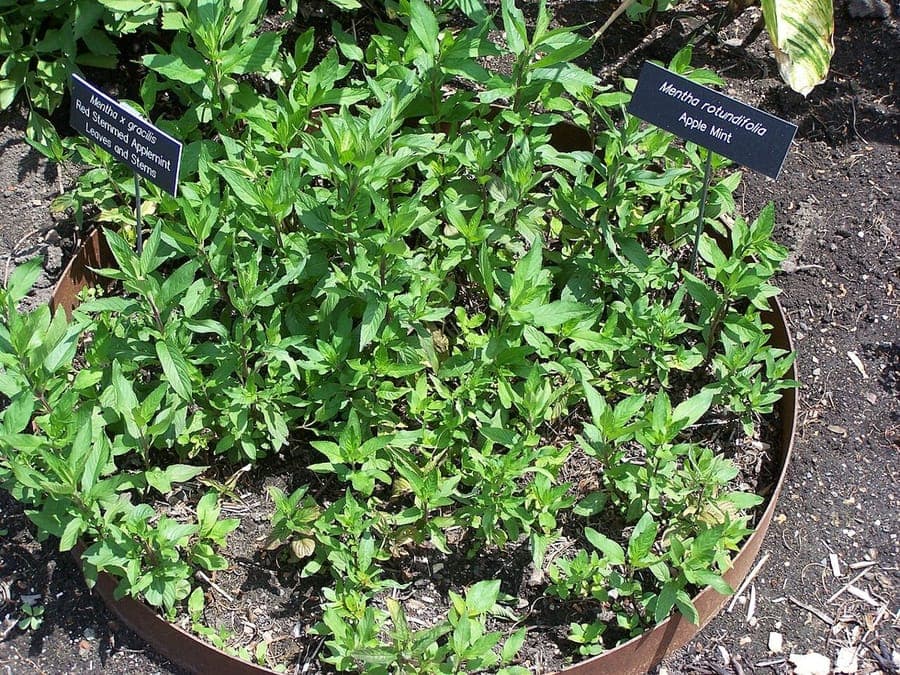
Plants reach 30 to 60 cm and often have reddish stems, which makes them more decorative than many other mints. It belongs in every herb garden, vegetable plot or kitchen container. If you would like to know where a herb corner would work best in your garden, gardenworld.app can create a garden design that already takes account of sun, soil and paths.
Appearance and bloom cycle
The leaves sit in opposite pairs and are oval to lance-shaped, 3 to 7 cm long, smooth or barely hairy and finely toothed. In green forms they are bright green; in the variegated 'Variegata' golden-yellow stripes run along the veins. The stems are square and in sun often turn reddish brown to purplish red. Rubbed leaves smell sweet and fresh, with less bite than peppermint.
Unlike spearmint, the flowers do not form spikes at the stem tips but sit in whorls in the leaf axils, as in corn mint. They are small lilac to pale purple lipped flowers, appearing from July to September. They are modest but much loved by bees, hoverflies and butterflies. Being a hybrid, the plant rarely sets viable seed and spreads almost entirely by vegetative means.
Ideal location
Ginger mint grows best in sun to partial shade. In full sun the stems turn redder, the leaves become more aromatic and the variegated form is most strongly marked, provided the soil stays moist enough. In partial shade, such as a spot with only morning sun, the leaves stay juicier and softer, which is ideal for tea and cooking.
A spot close to the kitchen makes sense: you pick most from what is easiest to reach. Do not plant mint in the middle of a mixed border, nor next to other mints if you want to keep the flavours apart, as different mints soon become intertwined.
Soil requirements
Mint likes moisture-retentive, humus-rich soil. Loam, clay and sandy soils with plenty of organic matter are all fine. A pH between 6 and 7.5 is ideal. On poor, dry sand, dig a few spadefuls of compost into the top 20 cm before planting.
In containers use good multi-purpose compost with some garden compost mixed in. A pot at least 25 cm across and 25 cm deep produces a generous plant. A layer of compost or a little organic granular feed each spring keeps growth going; too much nitrogen makes stems soft and more prone to rust.
Watering
Mint should never dry out for long. In open ground, water thoroughly once or twice a week during dry spells, especially on sandy soil. Check containers daily in summer; on hot days watering every day is normal. Water at the base rather than over the leaves, because wet foliage combined with warm nights encourages mint rust.
A mulch of compost or chopped straw keeps the soil cool and moist. In winter no watering is needed in open ground; keep pots just moist.
Free preview
Want to see Ginger mint: growing Mentha × gracilis without the takeover in your garden? Make a free preview of your design.
Keeping it in check
This is the most important lesson with any mint. The runners can creep up to half a metre a year in every direction, including under paths and paving. There are three good ways to stop that.
The simplest is a container. Grow ginger mint in a roomy pot or trough on the patio, and do not stand it on bare soil, because runners escape through the drainage hole. If you want mint in the ground, sink a bucket or large plastic pot with the base cut out, at least 30 to 40 cm deep, with the rim 3 to 5 cm above soil level. The roots stay inside the ring and you will see any surface runners creeping over the edge straight away. A sturdy metal or plastic edging around a herb bed works the same way; the photo shows just such a metal ring around a mint bed.
In addition, snip off every runner that crosses the rim during summer. Every two or three years lift the plant from its pot or ring, cut away the old woody centre and replant a few young pieces in fresh soil. That keeps the mint young, healthy and in its place.
Pruning
With mint, pruning and harvesting go together. In June, just before flowering, cut the stems back by half. The plant soon regrows and gives a second crop. After flowering in September cut everything down to a few centimetres above the ground; the plant overwinters as short shoots.
If you see orange-brown pustules on the undersides of the leaves in summer, that is mint rust. Cut affected stems down to the ground straight away and do not put them on the compost heap. The new growth that follows is usually healthy.
Harvesting and uses
You can pick from April to October. Always take the tips with a few pairs of leaves so the plant branches and stays compact. Flavour is at its richest just before flowering, in the morning once the dew has dried.
Ginger mint is lovely in fresh mint tea, fruit salads, with watermelon, in tabbouleh, over peas or new potatoes, and in summer drinks such as lemonade or a mojito. The variegated leaves make a pretty garnish for desserts. To dry it, tie stems in bunches and hang them in an airy, dark place; store the dried leaves in a closed jar. You can also freeze chopped leaves with a little water in ice-cube trays.
Take care with pets: mint is listed as toxic to dogs, cats and horses. A few leaves rarely cause more than mild stomach upset, but larger amounts can bring on vomiting and diarrhoea. Mint oil is especially dangerous for cats, so never use neat essential oil near your cat.
Maintenance calendar
March–April: Remove old stems. Divide or rejuvenate the plant. Add a layer of compost.
May: Start picking. Check the rim of the pot or ring for escaped runners.
June: Cut stems back by half for a second crop. Harvest generously for drying.
July–August: Flowering. Water regularly. Watch out for mint rust.
September–October: Cut back to the ground after flowering. Root cuttings in water for a windowsill plant.
November–February: Dormant period. No protection needed in open ground.
Winter hardiness
Mentha × gracilis is fully hardy throughout Britain and tolerates frost down to roughly -25 °C. Most of the top growth dies back in winter; the rhizomes reshoot in March or April. Plants in the ground need no protection.
Containers are a little more vulnerable because the root ball can freeze solid. Move them against a wall in winter or sink the pot into the ground. A cutting in a glass of water or a small pot on the windowsill will also give you a few fresh leaves through winter.
Companion plants
In the herb garden, ginger mint is best kept in its own pot or ring among other kitchen herbs. Chives (Allium schoenoprasum), parsley (Petroselinum crispum) and lemon balm (Melissa officinalis) like similar moist, fertile soil. Pot marigold (Calendula officinalis) adds colour and draws in beneficial insects.
If you want to grow several mints, such as spearmint (Mentha spicata) next to ginger mint, give each its own pot. That keeps the flavours pure and lets you compare them.
Final thoughts
Mentha × gracilis is a rewarding, attractive mint with a soft, fruity flavour and handsome reddish stems. Give it moist soil, some sun and above all a clear boundary, and you will have fresh mint to hand from spring to autumn.
The plant calendar on gardenworld.app shows the jobs for each month, so you will not forget the June cut or checking for runners. This spring, sink a bottomless bucket beside the kitchen door and plant a ginger mint in it.
Frequently asked questions about Ginger mint
Is Ginger mint winter hardy?
Mentha × gracilis is fully hardy throughout Britain and tolerates frost down to roughly -25 °C. Most of the top growth dies back in winter; the rhizomes reshoot in March or April.
When and how do you prune Ginger mint?
With mint, pruning and harvesting go together. In June, just before flowering, cut the stems back by half.
How much water does Ginger mint need?
Mint should never dry out for long. In open ground, water thoroughly once or twice a week during dry spells, especially on sandy soil.
Where does Ginger mint grow best?
Ginger mint grows best in sun to partial shade. In full sun the stems turn redder, the leaves become more aromatic and the variegated form is most strongly marked, provided the soil stays moist enough.
What soil does Ginger mint need?
Mint likes moisture-retentive, humus-rich soil. Loam, clay and sandy soils with plenty of organic matter are all fine.

See it in your garden
See Ginger mint in your garden
One photo of your garden and a few questions. You see the result in about a minute.
Try it with a photoIdentify this plant in your own garden. Identify a plant
Similar plants
Spearmint: complete guide
Mentha spicata
Learn how to grow and care for Spearmint (Mentha spicata) in your garden. Full details on light, soil, pruning, and companion planting.
Lemon balm: complete guide
Melissa officinalis
Lemon balm is a frost-hardy perennial with lemon-scented leaves. Ideal for tea gardens, bee-friendly gardens, and medicinal uses. Easy to grow and maintain.
Chives: complete guide
Allium schoenoprasum
Allium schoenoprasum, commonly known as chives, is a hardy perennial herb ideal for sunny gardens and containers. Easy to grow and harvest year after year.
