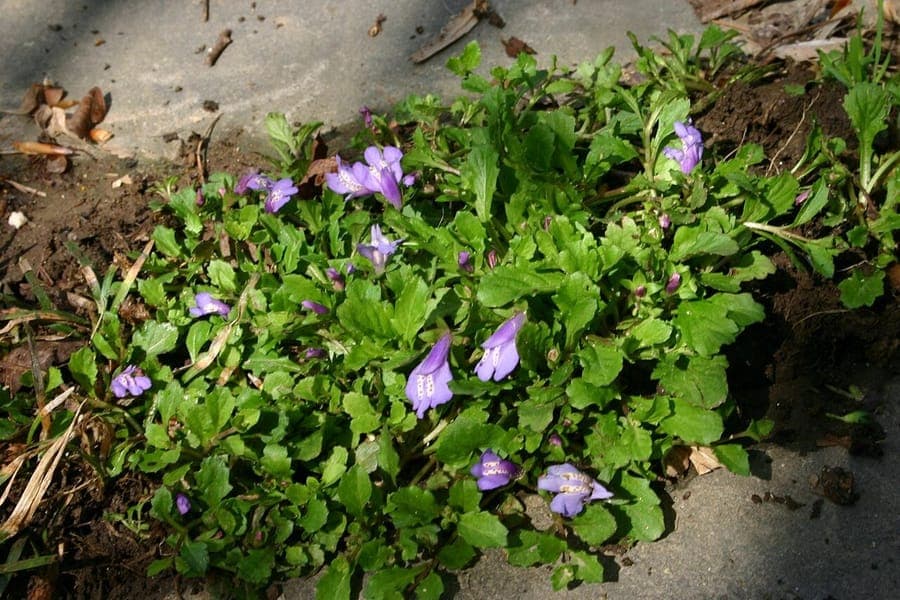
User:SB_Johnny / CC BY-SA 3.0, via Wikimedia Commons
Creeping mazus (Mazus reptans): care guide
Mazus reptans
Want to see Creeping mazus (Mazus reptans): care guide in your garden?
Full design in HD: €7.99
Look after your Creeping mazus with the GardenWorld app
Identify plants with your camera and get a care calendar with reminders for this plant.


Overview
Mazus reptans, usually sold as creeping mazus, is a tiny, creeping perennial that covers itself in lavender to purple-blue flowers in late spring. At barely 5 cm tall, it is one of the lowest flowering ground covers you can grow. It is at home between stepping stones, in the joints of a patio, at the edge of a pond or at the front of a moist border.
The plant belongs to the small family Mazaceae, once included in the figwort family. Its origin and name are a little confusing. Older sources describe Mazus reptans as a Himalayan species, but recent taxonomic work treats the plants grown under that name as the same species as Mazus miquelii from Japan and China. Labels still mostly say Mazus reptans, and that is the name we use here. Do not confuse it with Mazus pumilus, an annual garden weed with much smaller flowers.
Besides the lavender form, white-flowered plants are available, often sold as 'Albus'. If you would like to know where a low bloomer like this would look best in your garden, gardenworld.app can create a garden design for you.
Appearance and bloom cycle
Creeping mazus forms a dense mat of trailing stems that root at the nodes. The leaves are fresh green, oblong to lance-shaped, 1 to 3 cm long and coarsely toothed. In mild winters some foliage persists; after a hard frost the top growth dies back and the plant reshoots in spring.
Flowering starts in May and runs into June, with the odd later flush in summer. The flowers are about 1.5 cm long and two-lipped, rather like a small snapdragon. The upper lip is narrow and the lower lip broad and three-lobed, marked in the centre with white and yellow spots and small ridges. The colour ranges from lavender to purple-blue. In full bloom the flowers almost hide the leaves, creating a lilac carpet. The photo shows a young mat with the typical two-lipped flowers among toothed leaves, at the edge of a paved path. Bees and bumblebees visit the flowers.
Ideal location
Give creeping mazus a spot in sun or partial shade. It flowers most freely in sun, but there the soil must stay moist. In partial shade, for instance with morning sun and afternoon shade, the mat looks better through dry summers. Deep shade means few flowers.
It tolerates light foot traffic, which makes it ideal between stepping stones or in wide joints in paving. As a lawn substitute on a busy route it is too delicate. It also does very well along the edge of a pond or stream, in a spot that is never waterlogged but always slightly damp.
Plant about 20 to 25 cm apart, and the plants will usually knit together into a closed mat within a single season. Between stepping stones, set a small plant or a rooted piece in each gap, after filling the gap with a mix of garden soil and compost so the roots can establish easily.
Soil requirements
Mazus likes humus-rich soil that holds moisture without becoming boggy. Ordinary good garden soil with some compost worked in is fine. On light, sandy soil it dries out quickly in summer, so add extra compost or leaf mould to the top layer. Heavy, wet clay where water sits is too much of a good thing, and the roots will rot.
pH is not critical; slightly acidic to neutral is ideal, though mildly alkaline soil is tolerated too. A little compost or organic fertiliser in spring keeps the mat vigorous.
Free preview
Want to see Creeping mazus (Mazus reptans): care guide in your garden? Make a free preview of your design.
Watering
This is the key point. Creeping mazus has shallow roots and copes poorly with prolonged drought. In a dry summer, water regularly, especially in sunny spots and between stones, where the soil warms up faster. Water thoroughly once or twice a week rather than a little every day.
In spring and autumn extra water is rarely needed. In winter the soil should not stay saturated for long. In a pot or trough the compost dries out faster, so check every other day in summer.
Pruning
Pruning is hardly necessary. After flowering you can trim off the spent stems with shears or a mower on a high setting to keep the mat tidy. If it creeps over a path or into a neighbouring border, cut or pull out the runners. Because the stems root, those pieces can go straight into a new spot.
In spring, rake or clip away the dead foliage left from winter. After a few years the centre of the mat may thin out; rejuvenate it by dividing and replanting the young pieces.
It is only fair to mention its spreading habit. In gardens mazus is usually easy to manage, but it can settle into a damp lawn. In the north-eastern United States the same species, under the name Mazus miquelii, is regarded as a troublesome lawn weed. In Belgium it has been found as a rare escape, including in 2015 on a pond margin in a garden in Olen. So do not plant it right next to a lawn or a natural bank, and keep an eye on its edges.
Maintenance calendar
March and April: Clear away dead foliage. Plant new plants or divide old mats to rejuvenate them.
May and June: Full bloom. Water in dry spells, especially in sunny spots.
July and August: Trim off spent flower stems. Keep the soil lightly moist and cut back runners that go too far.
September and October: A good time to divide and replant. Spread a thin layer of compost.
November to February: Dormant period. Do not let fallen tree leaves lie on the mat.
The plant calendar on gardenworld.app reminds you of these jobs month by month.
Winter hardiness
Creeping mazus is pretty hardy. It is generally placed in USDA zones 5 to 8, so in practice it copes with frost of -20 °C and below. In Britain it survives virtually every winter. The top growth may die back in hard frost, but the plant reshoots in spring. Cold, waterlogged soil is a greater danger than frost itself.
No data are available on toxicity to people or pets. There are no reports of poisoning, but reliable toxicological studies are lacking, so do not let children or animals eat it.
Companion plants
Mazus reptans sits well beside other low plants that like some moisture. Bugle (Ajuga reptans) flowers at about the same time with blue spikes, and creeping Jenny (Lysimachia nummularia) follows with yellow flowers and a bright green carpet. Leptinella squalida and Corsican mint (Mentha requienii) fill the gaps between stones with a fine green cover.
In a moist, partly shaded border, creeping mazus makes a lovely underplanting for hostas such as Hosta sieboldiana, whose large blue leaves contrast nicely with its small, bright green foliage. Avoid planting it next to strongly spreading species, as the strongest will win.
Final thoughts
Mazus reptans is a charming, tiny ground cover for moist spots in sun or partial shade. Between stepping stones, beside a pond or at the front of a border, it conjures up a carpet of lilac flowers in May and June. It needs humus-rich soil, water in dry periods and an occasional trim to stay within bounds. Keep it away from lawns and natural banks, and it will give you years of pleasure.
Frequently asked questions about Creeping mazus
Is Creeping mazus winter hardy?
Creeping mazus is pretty hardy. It is generally placed in USDA zones 5 to 8, so in practice it copes with frost of -20 °C and below.
When and how do you prune Creeping mazus?
Pruning is hardly necessary. After flowering you can trim off the spent stems with shears or a mower on a high setting to keep the mat tidy.
How much water does Creeping mazus need?
This is the key point. Creeping mazus has shallow roots and copes poorly with prolonged drought.
Where does Creeping mazus grow best?
Give creeping mazus a spot in sun or partial shade. It flowers most freely in sun, but there the soil must stay moist.
What soil does Creeping mazus need?
Mazus likes humus-rich soil that holds moisture without becoming boggy. Ordinary good garden soil with some compost worked in is fine.

See it in your garden
See Creeping mazus in your garden
One photo of your garden and a few questions. You see the result in about a minute.
Try it with a photoIdentify this plant in your own garden. Identify a plant
Similar plants
Ajuga: complete guide
Ajuga reptans
A comprehensive guide to Ajuga reptans: growing conditions, care tips, soil needs, and ideal planting locations for this hardy ground cover.
Creeping Jenny: complete guide
Lysimachia nummularia
Discover everything about creeping Jenny (Lysimachia nummularia): growth, location, moisture needs, care and winter hardiness guide.
Leptinella: complete guide
Leptinella squalida
Leptinella squalida, the New Zealand brass-buttons, is a low-growing garden plant. Discover how to cultivate this exotic ground cover.
