
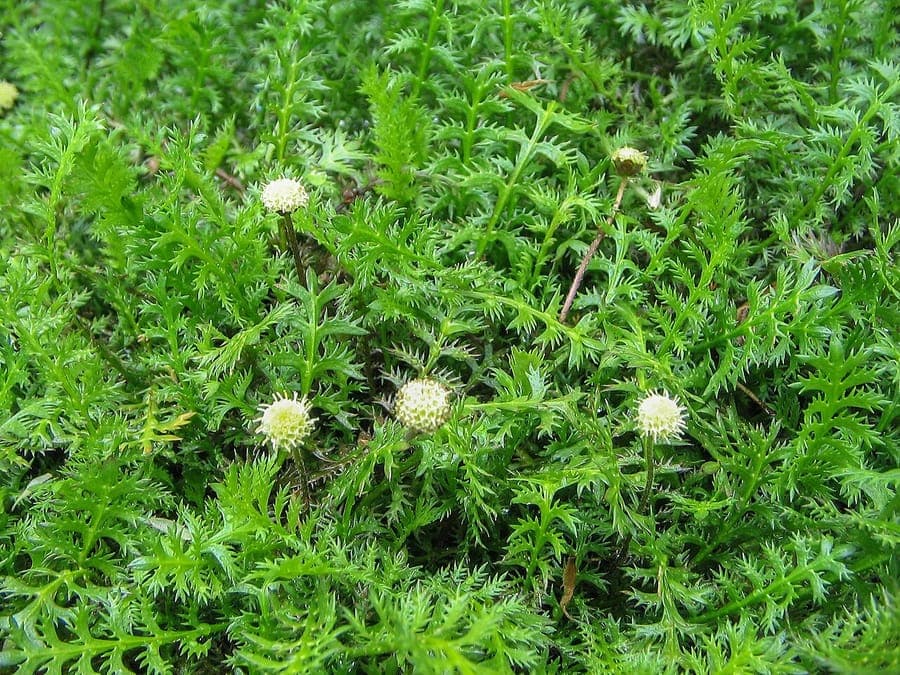
Meneerke bloem / CC BY-SA 3.0, via Wikimedia Commons
Leptinella: complete guide
Leptinella squalida
Want to see Leptinella: complete guide in your garden?
1 minute, no credit card
Overview
Leptinella squalida, commonly known as New Zealand brass-buttons, is a charming ground cover originating from New Zealand. This hardy evergreen plant has become increasingly popular in modern gardens for its elegant appearance and exceptional winter hardiness. The plant forms dense, velvety mats of fine foliage and produces countless small, brass-colored flowers that add that extra touch of elegance to your border.
If you're looking for a rewarding low-growing plant that can handle rougher conditions, Leptinella squalida is definitely worth considering. In this guide, you'll learn everything you need to successfully integrate this exotic treasure into your front yard.
Appearance and Bloom
Leptinella squalida is an extremely low-growing perennial that usually doesn't exceed 5 to 10 centimeters in height. The plant grows horizontally and forms beautiful compact mats of green foliage. The leaves are extremely finely cut and feathered, giving the plant an airy and delicate appearance.
The flowers are small but remarkable - they have a shiny brass coloring that is particularly attractive. These flowers appear during the summer months and attract pollinators to your garden. Although the individual flowers are small, the numerous flowers together create a striking visual effect.
The plant retains its foliage year-round, meaning your garden benefits from this beautiful ground cover even in winter. This makes Leptinella squalida excellent for year-round interest in your border.
Ideal Location
Leptinella squalida thrives best in locations with full sun to light shade conditions. The plant is very flexible and can adapt to various light situations, though more sunlight typically leads to better blooming and denser, more compact growth.
This plant is ideal for stone borders, garden paths, or between tiles. The low growth makes it perfect for small spaces, front yard designs, or even container gardens. You can also place Leptinella along edges or on slopes where traditional planting would be difficult.
The plant is excellent for tight corners or hard-to-reach spots. Thanks to its hardy nature, it can withstand some neglect and is very low-maintenance once established.
Soil
Leptinella squalida has no special soil requirements and is very adaptable. The plant thrives in average, well-draining soil. Heavy clay soils should be improved with sand or organic material to ensure proper drainage.
The plant doesn't need much nutrition - in fact, they grow better in poor, non-enriched soils. Too much nitrogen can result in the plant becoming too lush at the expense of blooming.
A neutral to slightly acidic soil (pH 6.0 to 7.0) is ideal. If your soil is extremely acidic or alkaline, you can adjust this by incorporating organic material or lime. In any case, make sure water can drain easily - waterlogging is this plant's greatest enemy.
Free design
Want to see Leptinella: complete guide in your garden? Make a free design now.
Watering
Once Leptinella squalida is established, it is particularly drought-tolerant and won't need much additional water. However, make sure the plant receives regular water in the first year until it is deeply rooted.
During growing periods (spring and summer), you can keep the plant moderately moist, but avoid waterlogging. If it continues to rain, you don't need to provide extra water. In dry periods, a weekly watering is sufficient.
In winter, watering can be significantly reduced. Just make sure the soil doesn't dry out completely, but avoid excess moisture.
The best way to check if your plant needs water is to stick your finger in the soil - if the top 2 centimeters feel dry, it's time to water.
Pruning
Leptinella squalida is a very low-maintenance plant that requires little pruning. The plant grows compactly and stays naturally neat. You hardly ever need to prune this plant.
If your plant does become too large or grows out of bounds, you can apply light pruning at the end of winter, just before new growth begins. Simply remove any dead or damaged leaves or stems.
Make sure to only prune as needed - excessive pruning can be harmful and may limit blooming.
Maintenance Calendar
January-March: Check for winter damage. Gently remove dead leaves.
April-May: Growing season begins. Ensure regular watering as temperatures rise.
June-August: Peak blooming period. Enjoy the brass-colored flowers. Ensure regular watering during dry periods.
September-October: Preparation for winter. Gradually reduce watering.
November-December: Winter mode. Minimal care needed. Protect against extreme frost.
Winter Hardiness
Leptinella squalida is exceptionally winter-hardy and can comfortably withstand temperatures down to minus 15 degrees Celsius. In most parts of the Netherlands, this is not reached, so the plant overwinters outdoors without any protection.
The plant can, however, suffer from extreme frost, especially when combined with heavy rain. In such cases, it may be useful to apply some mulch around the plant in late autumn, which provides some extra protection.
Even after harsh winters, Leptinella squalida will usually bounce back completely - it may sometimes seem dead, but if you water it as it warms up, you'll likely see new growth in early spring.
Companion Plants
Leptinella squalida works exceptionally well with other low-growing plants. It pairs well with other ground covers like sedum, sempervivum, or thyme. This plant also combines well with larger rock garden plants like lavender or salvia.
If you want more color, you can surround Leptinella with some colorful flowers - for example, dwarf tulips in spring. The brass coloring of Leptinella creates a beautiful contrast with blue flowers.
Leptinella is also excellent for alpine troughs or rock gardens where it displays its elegant structure without being overwhelmed by larger plants.
Closing Thoughts
Leptinella squalida is undoubtedly one of the most low-maintenance and reliable ground covers for gardens. With minimal care, this plant will produce beautiful brass-colored flowers year after year and form a dense, green mat. Whether you have a small front yard or a large border, Leptinella squalida will certainly be a valuable addition. Available at gardenworld.app.
Want to see Leptinella: complete guide in your garden? Make a free design now.
Upload a photo, pick a style, and get a photorealistic design with plant list in under a minute.
No credit card required


Similar plants
Calendula stellata: complete guide
Calendula stellata
Complete guide to Calendula stellata, the star-flowered marigold from Sicily: location, soil, watering and companion planting tips.
Korean chrysanthemum: complete guide
Chrysanthemum x rubellum
Chrysanthemum x rubellum is a hardy autumn perennial with single pink to copper flowers from August to November. Care and combinations.
Helianthus divaricatus: complete guide
Helianthus divaricatus
Helianthus divaricatus is a North American woodland sunflower with yellow summer blooms, ideal for naturalistic borders and shady edges.