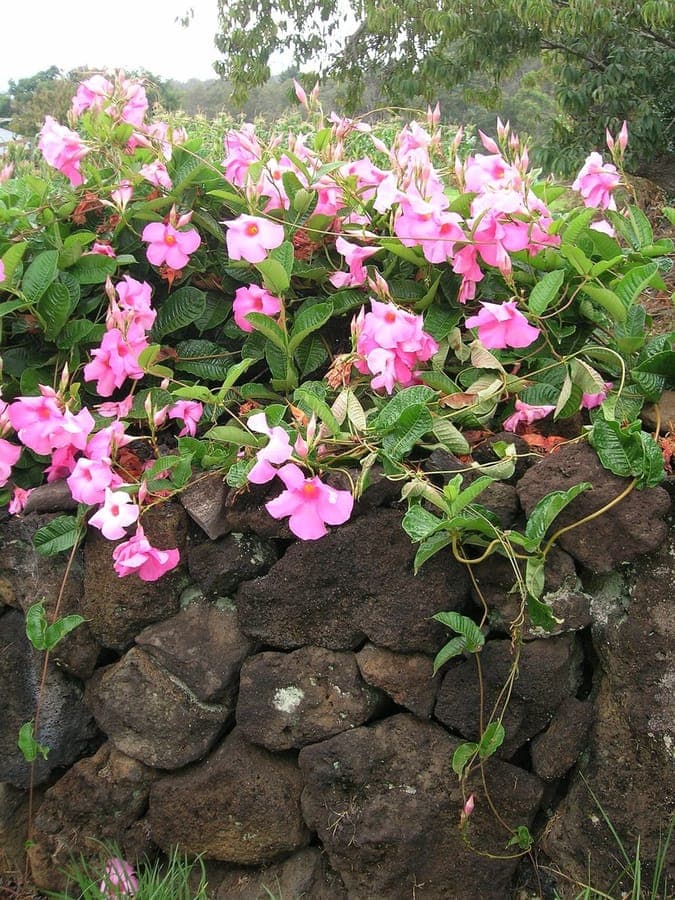
Forest & Kim Starr / CC BY 3.0, via Wikimedia Commons
Mandevilla (Mandevilla × amabilis): complete guide
Mandevilla × amabilis
Want to see Mandevilla (Mandevilla × amabilis): complete guide in your garden?
Full design in HD: €7.99
Look after your Mandevilla with the GardenWorld app
Identify plants with your camera and get a care calendar with reminders for this plant.


Overview
Few patio plants flower as long or as generously as mandevilla. From June well into October this twining climber carries large pink trumpets against dark, glossy foliage. Mandevilla × amabilis is a hybrid of South American parents in the Apocynaceae, the same family as oleander and periwinkle. Its best-known cultivar is 'Alice du Pont', named after the American Alice du Pont and still one of the most widely sold container climbers today.
The genus honours Henry John Mandeville, a British diplomat in Buenos Aires who sent the first plants back to England. In garden centres you will also see the name dipladenia, which is usually applied to the more compact, small-leaved Mandevilla sanderi and its hybrids. Mandevilla × amabilis is more vigorous: it twines 2 to 3 m in a single season and has larger, strongly veined leaves. In the tropics it climbs to 5 m or more.
In northern Europe mandevilla is a container plant that must spend winter indoors. On gardenworld.app you can have a garden design drawn up in which a sunny pergola or patio wall with container climbers such as mandevilla really comes into its own.
Appearance and bloom cycle
The flowers of Mandevilla × amabilis are funnel-shaped, with five broad, slightly twisted lobes, and measure 8 to 10 cm across. In 'Alice du Pont' they are clear pink with a deeper pink to yellow-orange throat, as in the photo, where the plant tumbles over a lava-stone wall. They appear in clusters on young shoots and each one lasts a week or more. Flowering from June to October is normal, and in a warm summer it may start in May.
The leaves are elliptic, 10 to 20 cm long and glossy dark green with deeply impressed veins that give them a slightly quilted look. The stems twine around any support they can find. Break a leaf or stem and a milky white sap appears.
Position indoors and out
Outdoors, mandevilla wants a warm spot in sun or light shade. Four to six hours of sun a day gives the best display; on a south-facing wall in full afternoon sun the leaves may pale slightly in a heatwave. A sheltered patio out of cold wind is ideal. Wait until after mid-May, when nights no longer drop below 12 °C, before moving it outside: cold nights check growth and turn the leaves red or yellow.
Indoors it does well in a conservatory or on a bright south- or west-facing windowsill. Give it something to twine around: an arch, an obelisk, a trellis or tensioned wires. Without support it flops and the stems trail over the pot.
Compost and containers
Use an open, fertile compost for flowering container plants, mixed with a fifth of perlite or clay granules for extra drainage. A pH of around 6 to 6.5 is ideal. Add a layer of clay granules at the bottom and choose a pot with a drainage hole.
A mature plant is happy in a pot 30 to 40 cm across. Repot every other year in March, or when roots start growing out of the drainage hole. An oversized pot holds too much water and quickly leads to root rot. Fit the trellis or obelisk at repotting time so you do not damage roots later on.
Watering and feeding
In summer mandevilla needs plenty of water but hates wet feet. Water as soon as the top 2 cm of compost is dry, which on hot days may mean daily. Its thick, fleshy roots store some moisture, so the plant copes better with a day's delay than with a day standing in a full saucer. Use rainwater at room temperature where you can.
From April to the end of August, feed weekly with a liquid fertiliser for flowering plants at half strength, or fortnightly at full strength. A feed relatively high in potassium keeps the flowers coming. Stop in September so the plant can slow down before winter.
Free preview
Want to see Mandevilla (Mandevilla × amabilis): complete guide in your garden? Make a free preview of your design.
Pruning
Mandevilla flowers on the current year's growth, so prune in February or March, just before new growth begins. Cut the stems back to about a third of their length and remove weak or dead growth. The result is a compact plant with plenty of new flowering shoots.
During the season there is little to do. Wind new stems around the support and shorten any that run too far. Before bringing the plant in for winter you can cut it back to a manageable size. Wear gloves: the milky sap can irritate skin and leaves sticky marks on clothing.
Maintenance calendar
January and February: Overwinter cool and bright, with little water. Prune in late February.
March: Repot if needed and move to a slightly warmer spot to encourage growth.
April: Start feeding again. Train young shoots around the support.
May: Move outside after mid-May, once nights stay above 12 °C, and let it adjust to the sun gradually.
June to August: Full flower. Water regularly and give a light feed every week.
September: Stop feeding. Check for red spider mite and mealybug.
October: Bring indoors before nights fall below 10 °C.
November and December: Keep cool and bright and water sparingly.
Overwintering
Mandevilla × amabilis is a tropical plant and cannot take frost. It suffers damage at anything below 7 to 8 °C. Overwinter it indoors in a bright place at 12 to 15 °C, such as a cool conservatory, a light spare bedroom or a stairwell with a large window. In these cooler conditions it barely grows, and you should water only when the root ball is almost dry.
In a warm living room it may keep growing and even flower now and then, but winter air there is dry, which invites red spider mite, mealybug and whitefly. Mist the leaves regularly with tepid water and check the undersides. Some leaf drop over winter is normal as long as the stems stay firm.
Toxicity for pets
Like many members of the Apocynaceae, mandevilla contains a milky sap. The ASPCA does not list mandevilla as toxic to dogs or cats, but the sap can irritate the mouth, stomach and gut if a pet chews leaves or stems. Drooling, vomiting or diarrhoea are possible. Serious poisoning has not been reported.
In people the sap may cause skin irritation, particularly on sensitive skin or if it gets into the eyes. Keep the plant out of reach of curious cats and young dogs, and wash your hands after pruning. If your pet has eaten part of the plant and seems unwell, contact your vet.
Companion plants
On the patio, mandevilla pairs well with other warmth-loving container plants. Cape leadwort (Plumbago auriculata) offers sky-blue flowers that stand out against the pink. Star jasmine (Trachelospermum jasminoides) brings scent and stays green all year, while African lily (Agapanthus africanus) adds blue globes on tall stems. Blue marguerite (Felicia amelloides) and potato vine (Solanum laxum) can fill lower pots or the other side of an arch.
A white mandevilla cultivar next to 'Alice du Pont' gives a fresh, romantic feel. Avoid planting vigorous climbers in the same pot, as they compete for root space.
Final thoughts
Mandevilla is a rewarding container plant: give it plenty of light, regular water without waterlogging and a cool, bright place for winter, and it will flower every year from June into autumn. A sturdy support and a spring prune keep it compact and floriferous. Do bear the milky sap in mind if you have cats or young children.
The plant calendar on gardenworld.app tells you month by month when to bring mandevilla in, prune it and move it back outside. This spring, set a Mandevilla × amabilis against a sunny pergola and enjoy its pink trumpets all summer long.
Frequently asked questions about Mandevilla
When and how do you prune Mandevilla?
Mandevilla flowers on the current year's growth, so prune in February or March, just before new growth begins. Cut the stems back to about a third of their length and remove weak or dead growth.
How much water does Mandevilla need?
In summer mandevilla needs plenty of water but hates wet feet. Water as soon as the top 2 cm of compost is dry, which on hot days may mean daily.

See it in your garden
See Mandevilla in your garden
One photo of your garden and a few questions. You see the result in about a minute.
Try it with a photoIdentify this plant in your own garden. Identify a plant
Similar plants
Plumbago: complete guide
Plumbago auriculata
Discover everything about Plumbago auriculata: care instructions, growth habits, appearance, and how to successfully grow this stunning climbing plant in your garden.
Star jasmine: complete guide
Trachelospermum jasminoides
Everything about Star Jasmine (Trachelospermum jasminoides): planting, care, pruning and winter protection. Expert tips for a fragrant evergreen climber.
Lily-of-the-Nile: complete guide
Agapanthus africanus
Everything you need to grow Agapanthus africanus: ideal conditions, watering, winter care, and companion planting for UK and US gardens.
