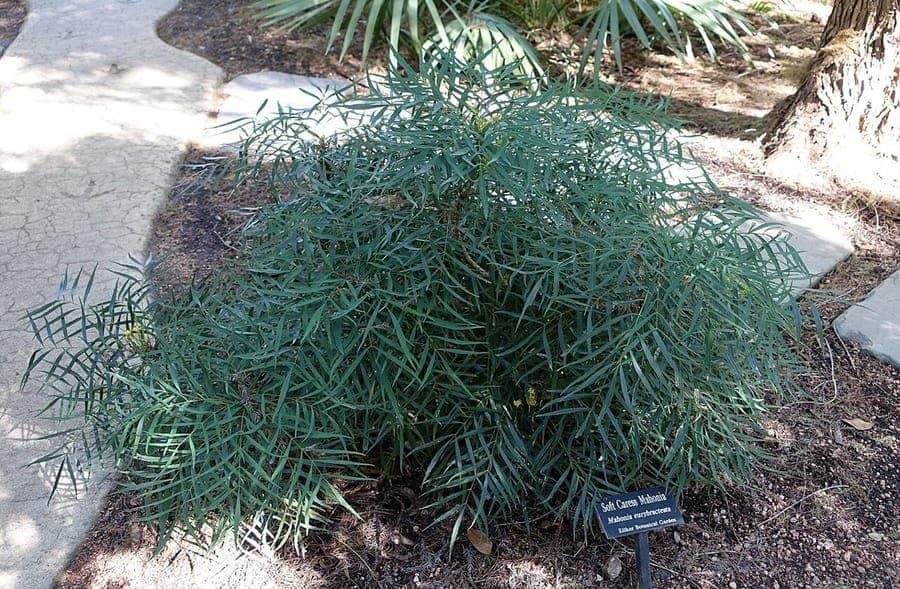
Daderot / CC0, via Wikimedia Commons
Mahonia eurybracteata: complete guide
Mahonia eurybracteata
Want to see Mahonia eurybracteata: complete guide in your garden?
Full design in HD: €7.99
Look after your Mahonia eurybracteata with the GardenWorld app
Identify plants with your camera and get a care calendar with reminders for this plant.


Overview
If the word mahonia brings to mind stiff, prickly leaves that scratch your hands, Mahonia eurybracteata will come as a pleasant surprise. This evergreen shrub from central and south-west China has narrow, soft leaflets without sharp teeth. The overall effect is closer to a bamboo or a fine fern than to the tough mahonias of supermarket car parks.
It became widely known through the cultivar 'Soft Caress', launched early this century and quickly a garden-centre favourite. The name says it all: you can stroke it without getting pricked. Other cultivars such as 'Sweet Winter' and 'Meteor' exist, but 'Soft Caress' is by far the easiest to find. Botanists now often place mahonias in the genus Berberis, so you may also see Berberis eurybracteata on labels. In gardening circles Mahonia remains the familiar name.
The plant stays compact, roughly 1 to 1.5 m tall and wide, and grows slowly. That makes it suitable for small gardens, narrow borders and large containers. It is especially valuable for shady corners under trees or on the north side of a house. On gardenworld.app you can have a garden design made in which Mahonia eurybracteata joins ferns and other shade lovers to create a calm green corner that looks good all year.
Appearance and bloom cycle
The leaves are pinnate: each one consists of a long central stalk with a row of narrow, lance-shaped leaflets 6 to 12 cm long on either side. They are dark to bluish green and glossy. New growth can emerge bronze or reddish in spring, and in cold winters the foliage sometimes takes on a purple tint in sun. The fine, slightly arching leaves give the shrub a soft, almost exotic look.
Flowering comes in late summer and autumn, from September into November and, in mild weather, sometimes into December. Upright spikes of small, bright yellow flowers appear at the tops of the stems. They are not as large as those of the winter-flowering mahonias, but they arrive when few other shrubs are in bloom. Bumblebees and late flies visit them readily.
The flowers are followed by round, blue-black berries with a white bloom, which birds eat in winter. Like all mahonias the plant contains berberine, mainly in the roots and bark. The berries are not regarded as seriously poisonous, but they are not meant to be eaten raw in quantity either; in people and pets they can cause stomach upsets.
Ideal location
Mahonia eurybracteata is a plant for partial to full shade. In the wild it grows along woodland edges and on sheltered slopes. A spot with morning sun and afternoon shade is ideal, but it also copes well with deeper shade beneath trees, although it flowers a little less there.
Avoid full sun, particularly in a hot, dry position, where the leaves may yellow or scorch. Shelter from cold, drying easterly winds in winter matters even more, as they dry out the evergreen foliage. A position against a wall, among other shrubs or under a tree gives that protection.
Its compact habit also makes it ideal for a container on a shady patio or by the front door. Choose a pot of at least 30 to 40 litres with a drainage hole. When planting several as a low group or informal hedge, space them 70 to 90 cm apart.
Soil requirements
The plant grows best in humus-rich, moisture-retentive soil that still drains well. It is not fussy about pH and is happy on both slightly acidic and slightly alkaline ground. Ordinary garden soil improved with compost or leaf mould suits it perfectly.
On heavy clay, improve the structure with compost and some coarse grit, because it dislikes standing water in winter. On dry, sandy soil, mix plenty of compost into the planting hole and keep the ground moist with a mulch of leaf mould or bark. Plant at the same depth as in the pot and firm the soil well.
For containers, use a good multipurpose or shrub compost with a handful of garden compost added. Refresh the top layer every spring and move the plant into a slightly larger pot every three or four years.
Free preview
Want to see Mahonia eurybracteata: complete guide in your garden? Make a free preview of your design.
Watering
During the first growing season, keep the soil around the root ball evenly moist. In dry weeks give 5 to 10 litres once or twice a week, depending on the size of the plant. After that the mahonia becomes fairly tolerant, and an established plant gets by on rainfall in most summers.
During prolonged drought and heat, do give extra water, especially under trees, where their roots take much of the moisture. Evergreens can also dry out in winter when the ground stays frozen and the sun falls on the leaves, so water on a frost-free day during a dry winter.
Never let container plants dry out: check every other day in summer and water as soon as the top few centimetres feel dry. Do not leave water standing in the saucer.
Pruning
Pruning is hardly necessary. Mahonia eurybracteata naturally grows compact and keeps a neat shape. After flowering or in early spring, cut off the spent flower stems if you do not want to keep the berries.
If an older plant grows too tall or bare at the base, cut one or two of the longest stems back to about 30 cm above the ground in April. They will reshoot lower down and the plant becomes fuller again. Also remove dead or frost-damaged leaves in spring.
Maintenance calendar
March to April: Remove winter damage and old flower stems. Add a layer of compost or some organic shrub feed. Renewal pruning if needed.
May to June: New shoots emerge, often with a bronze tint. A good time to plant.
July to August: Water during dry spells, especially young plants and those in containers. Top up the mulch.
September to November: Flowering. A good moment to plan any new planting nearby.
December to February: Berries for the birds. Protect containers in hard frost and water a little during dry, frost-free spells.
If you would rather not keep track of all this, the plant calendar on gardenworld.app sets out these tasks for you month by month.
Winter hardiness
Mahonia eurybracteata is reasonably hardy. The Royal Horticultural Society rates 'Soft Caress' H4, which means it tolerates temperatures down to about -10 to -15 °C. In most of Britain and Ireland it survives in open ground without trouble, particularly in a sheltered spot.
Hard frost or cold wind can brown the leaves, but the plant usually reshoots normally in spring. In colder areas or in an open, exposed position, spread a layer of leaves around the base and drape fleece over the shrub when temperatures drop below -10 °C.
Container plants are more vulnerable. In winter, stand them against a wall on pot feet and wrap the container in hessian or bubble wrap.
Companion plants
Mahonia eurybracteata looks best among plants with a different leaf shape. Japanese aralia (Fatsia japonica) gives a striking contrast with its large, glossy leaves. Ferns such as the autumn fern (Dryopteris erythrosora), whose fronds unfurl a coppery colour, add a soft woodland feel.
For colour in the colder months, combine the mahonia with skimmia (Skimmia japonica), Christmas rose (Helleborus niger) and ivy-leaved cyclamen (Cyclamen hederifolium), which flowers in autumn and then keeps its beautifully marbled leaves. Japanese forest grass and low ground cover such as pachysandra also fit well in this shady corner.
Final thoughts
Mahonia eurybracteata proves that a mahonia does not have to be prickly. It is compact, evergreen, flowers in autumn and feels at home in the shade where many other shrubs struggle. Give it humus-rich soil, shelter from cold winds and some water in dry spells, and it will stay attractive for years with very little work.
Frequently asked questions about Mahonia eurybracteata
Is Mahonia eurybracteata winter hardy?
Mahonia eurybracteata is reasonably hardy. The Royal Horticultural Society rates 'Soft Caress' H4, which means it tolerates temperatures down to about -10 to -15 °C.
When and how do you prune Mahonia eurybracteata?
Pruning is hardly necessary. Mahonia eurybracteata naturally grows compact and keeps a neat shape.
How much water does Mahonia eurybracteata need?
During the first growing season, keep the soil around the root ball evenly moist. In dry weeks give 5 to 10 litres once or twice a week, depending on the size of the plant.
Where does Mahonia eurybracteata grow best?
Mahonia eurybracteata is a plant for partial to full shade. In the wild it grows along woodland edges and on sheltered slopes.
What soil does Mahonia eurybracteata need?
The plant grows best in humus-rich, moisture-retentive soil that still drains well. It is not fussy about pH and is happy on both slightly acidic and slightly alkaline ground.

See it in your garden
See Mahonia eurybracteata in your garden
One photo of your garden and a few questions. You see the result in about a minute.
Try it with a photoIdentify this plant in your own garden. Identify a plant
Similar plants
Japanese fatsia: complete guide
Fatsia japonica
Discover the Japanese fatsia, a tropical houseplant with large, hand-shaped leaves. This guide covers cultivation, care, and creating a tropical atmosphere.
Skimmia japonica: complete guide
Skimmia japonica
Evergreen shrub with red berries and fragrant leaves that remain visible long. Winter hardy to -10C, perfect for shade.
Autumn fern: complete guide
Dryopteris erythrosora
A semi-evergreen fern with copper-red young fronds perfect for shady gardens. Ideal for ground cover applications. Very low maintenance and sustainable.
