
Velella / CC BY-SA 3.0, via Wikimedia Commons
Bog pimpernel: complete guide
Lysimachia tenella
Want to see Bog pimpernel: complete guide in your garden?
1 minute, no credit card
Overview
Lysimachia tenella - commonly known as bog pimpernel - is a delicate, creeping perennial herb in the family Primulaceae. Previously classified under the name Anagallis tenella (L.) L., it has been reclassified into the genus Lysimachia following molecular studies that established the monophyly of the group. Its native distribution covers western and southern Europe and north-western Africa: it occurs naturally in the Netherlands, Belgium, Germany, Great Britain, Ireland, France, Switzerland, Austria, Spain, Portugal, Italy, Greece, Crete, Sardinia, the Azores, Morocco, Algeria and Tunisia.
Ecologically, bog pimpernel is a specialist of wet, nutrient-poor habitats: fens, flushes, wet heathland, damp dune slacks and the margins of acid flushes and springs. It thrives where the soil remains permanently moist and where competition from more vigorous plants is limited by the nutrient poverty of the substrate. In garden settings it is increasingly valued as a dainty, low-growing ground cover for pond margins, bog gardens, rain gardens and naturalistic wet borders. At gardenworld.app you will find inspiring planting designs that incorporate small, specialist moisture-lovers like this species into cohesive, wildlife-friendly garden schemes.
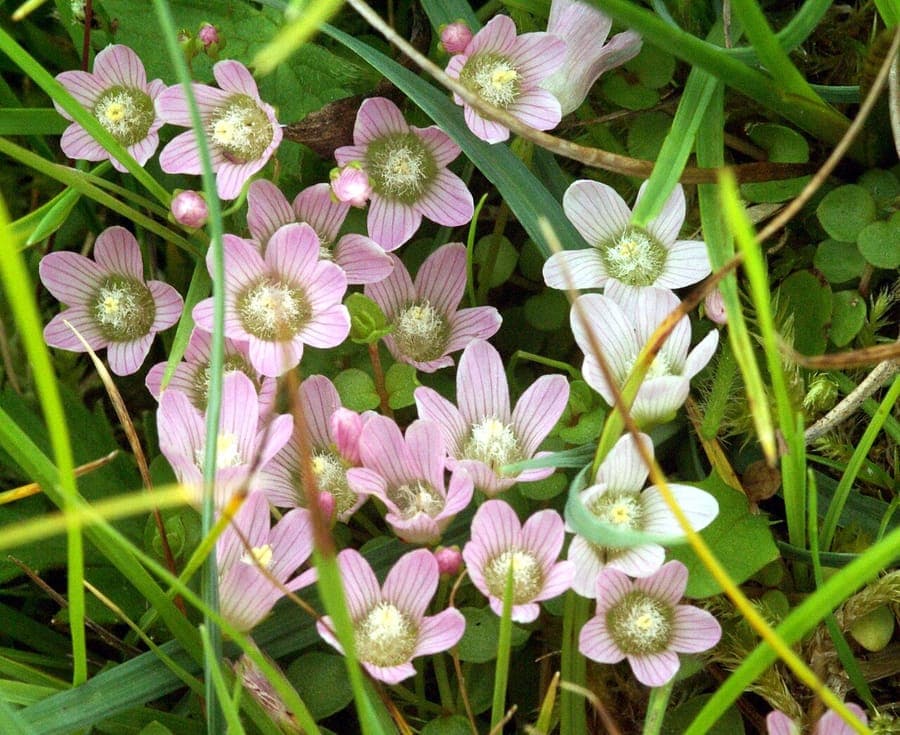
The plant's greatest charm lies in its flowers: small, five-petalled, warm pink to pale lilac blooms, 5 to 8 mm across, borne singly on thread-like stalks in the leaf axils from May through September. Despite their diminutive size, the flowers are produced in such abundance on a well-established plant that they create a soft carpet of colour that is highly attractive to small native bees and hoverflies.
Appearance and bloom cycle
Bog pimpernel is a diminutive plant by any measure. The stems are slender, 2 to 6 mm in diameter, and creep along the ground or ascend weakly, rooting at nodes where they touch damp soil. Individual stems reach 5 to 20 cm in length, spreading gradually to form a low mat. The leaves are small, broadly oval, 3 to 8 mm long, opposite or sometimes in whorls of three, slightly fleshy and bright green.
The solitary flowers are produced in the leaf axils on slender pedicels 5 to 15 mm long. The five petals are joined at the base and spread to form a flat-faced, wheel-like flower in warm pink to pale lilac, often with faint purple veining. The centre holds five stamens with orange-tipped anthers that add a subtle contrast. The bloom period runs from May through September, with peak flowering in June and July. In consistently moist conditions the plant can flower almost continuously for four months without any deadheading.
After flowering, small spherical capsules develop, splitting open when ripe to release the tiny seeds. Dispersal occurs via water, small invertebrates and incidentally via bird and mammal activity. In suitable garden conditions the plant will self-seed slowly onto adjacent moist, bare soil.
Ideal location
Bog pimpernel prefers dappled shade to partial sun. Its light requirement scores 7 out of 10 in standard botanical classifications, meaning it tolerates a reasonably wide range of light conditions - from full sun in cool, perpetually moist conditions to fairly deep shade under open tree canopies - but the ideal is gentle, filtered light or morning sun with afternoon shade.
In its natural habitat, the plant grows in open, wet vegetation such as the lawns of valley mires, the damp margins of peat bogs and the waterlogged edges of flushes where groundwater seeps to the surface. In the garden this translates to: the shaded margins of ornamental ponds, bog garden edges, the damp sides of stream features and any reliably moist, slightly shaded corner.
The species cannot tolerate prolonged drought or direct hot sun, particularly on free-draining soils. In exposed, sunny positions on well-drained soils it quickly withers. Conversely, it is equally unsuitable for deep, stagnant water - it needs moisture without anoxic waterlogging. The transition zone between open water and damp ground is often its optimum position in a garden.
Soil requirements
Soil requirements are precise and rather unusual for a garden plant. Bog pimpernel demands low to moderately low nutrient levels, scoring only 2 out of 10 for soil nutriment requirements in botanical classifications. This is one of the lowest values among cultivated plants, and it means the species genuinely performs best on poor, unfertilised soil. In nutrient-rich, well-cultivated garden soil it is typically outcompeted within one or two seasons by more vigorous neighbours.
The preferred pH range is 5.5 to 6.5, firmly in the slightly to moderately acid zone. On calcareous, high-pH soils the plant grows poorly or not at all. Peaty, fen or wet heath soils with low pH are ideal. If your garden soil is neutral to alkaline, create a planting pocket filled with a mix of lime-free horticultural grit and peat (or peat substitute) to achieve the right conditions.
Never apply general-purpose fertilisers to this plant. Even modest levels of added nitrogen, phosphorus or potassium will favour competing grasses and broad-leaved plants that will smother the bog pimpernel within a season. If anything, the incorporation of acid peat substitute or lime-free grit into a neutral soil will help bring conditions closer to the plant's preference.
Free design
Want to see Bog pimpernel: complete guide in your garden? Make a free design now.
Watering
Consistent moisture is the single most important requirement for Lysimachia tenella. The atmospheric humidity requirement scores 8 out of 10 in botanical classifications, and the plant's natural habitat - peat bogs, flushes and wet heathland - is by definition wet. In the garden the soil around the plant must never completely dry out between May and October.
During warm, dry spells - particularly above 22°C - water every one to two days to maintain soil moisture. The plant wilts quickly when dry and, while it often recovers after watering, repeated drying episodes reduce vigour and can cause stem die-back. In a prolonged drought without watering, plants may die entirely.
The ideal planting situation is one where constant moisture is provided naturally - on a north-facing pond bank, at the edge of a seeping slope or in a rain garden filled with moisture-retentive compost. If relying on manual watering, use rainwater or soft water rather than hard, alkaline tap water, which over time will raise the soil pH beyond the plant's tolerance. A shallow layer of live sphagnum moss over the root zone is an excellent moisture-retaining mulch.
Pruning
Bog pimpernel requires minimal pruning. As a low, creeping ground cover it spreads naturally by rooting at stem nodes and by slow self-seeding. If growth extends into unwanted areas, simply snip back the outermost stems with scissors or pull them gently from the soil.
The spent flowerheads are tiny and barely noticeable, so deadheading is not necessary for aesthetic reasons. If you wish to encourage self-seeding, leave the capsules undisturbed until they split and release seeds in late summer. If self-seeding is unwanted in a formal setting, remove the spent flower stems before the capsules ripen, typically in August.
In autumn, as temperatures drop, the plant naturally reduces its above-ground growth. The old stems can be left in place through winter, as they provide some frost insulation to the roots and create a micro-habitat for small invertebrates. Remove the old stems in early spring, in March or early April, just before new growth begins.
Maintenance calendar
March to April: Remove old stems from the previous season. Check that root crowns are still moist and alive. Resume watering if the soil has dried during winter. Apply a top-dressing of lime-free, peaty compost around (not over) the crown.
May: Growth begins actively. Ensure consistent moisture. Remove any competing weeds carefully by hand - avoid using hoes or cultivators near the shallow roots.
June to July: Peak flowering. Water every one to two days in dry weather. Enjoy the flower display. Remove any vigorously spreading neighbours.
August to September: Flowering continues but diminishes. Allow seeds to form if self-seeding is welcome. Reduce watering slightly as temperatures cool.
October to February: Dormancy. Keep soil lightly moist. No feeding, no pruning. In severe frost zones, apply a thin protective layer of straw or bracken.
Winter hardiness
Lysimachia tenella is a fully hardy perennial across its native European range, corresponding to USDA hardiness zones 5 to 8. The root system survives winter cold in the soil, and new shoots emerge each spring as soil temperatures rise above 8°C. In its natural habitat in the Netherlands and Belgium, the plant endures typical maritime winters without difficulty.
Extreme cold without snow cover on exposed, dry soils can damage the roots, but in a consistently moist, peaty substrate the plant shows good winter survival even through temperatures of -10°C or below. Prolonged cold with frozen soil is more of a risk on free-draining soils than on the wet, insulating peat the plant naturally prefers.
In practice, gardeners in western and central Europe experience very few problems with winter survival of this species. The main winter risk is not cold but drying out - a paradox given the plant's wet-loving nature, but a real risk on certain substrates that freeze and then dry without being replenished by rain. Ensure the planting area never dries completely in winter.
Companion plants
The most natural companions for Lysimachia tenella are the other specialists of wet, acid, nutrient-poor habitats. In a bog garden or wet heathland planting, cross-leaved heath (Erica tetralix), sundew (Drosera rotundifolia), purple moor grass (Molinia caerulea) and bog asphodel (Narthecium ossifragum) create a miniature ecosystem that mirrors the plant's natural habitat. All share the same acid, poor, wet substrate requirements.
For a garden pond margin where conditions are somewhat less extreme, combine bog pimpernel with marsh violet (Viola palustris), lesser spearwort (Ranunculus flammula), water forget-me-not (Myosotis scorpioides) and bog-bean (Menyanthes trifoliata). These form a beautiful, low-growing tapestry of foliage and flower across spring and summer. The water forget-me-not and spearwort can be found at most specialist aquatic plant nurseries and many good general garden centres.
Sphagnum mosses used as a living mulch around the plant not only retain moisture beautifully but also act as natural companions, creating the acid, wet conditions in which bog pimpernel thrives. For planting plans that seamlessly integrate specialist wet-habitat plants alongside more common garden varieties, visit gardenworld.app for professionally designed layouts.
Closing
Lysimachia tenella is a small plant with a large ecological significance. In the wild it is an indicator of ancient, undisturbed wet habitats of high conservation value. In the garden it brings those same qualities - delicacy, precision, ecological purpose - to carefully designed wet-habitat planting schemes.
Its requirements are demanding: acid, poor, consistently moist soil and at least partial shade. But for the gardener willing to provide those conditions, the reward is a long-lived, self-sustaining ground cover that flowers from May to September and provides subtle, jewel-like colour in places where little else would grow. Combined with other wet-habitat specialists, it creates a planting of genuine ecological value and lasting beauty.
Want to see Bog pimpernel: complete guide in your garden? Make a free design now.
Upload a photo, pick a style, and get a photorealistic design with plant list in under a minute.
10,000+ gardens designed already
No credit card required


Similar plants
Primula incana: complete guide to silvery alpine primrose
Primula incana
Silvery primrose (Primula incana), a delicate alpine flower with white blooms and powdered grey-green leaves. Growing, care, and cultivation guide.
Mealy cowslip: complete guide
Primula pulverulenta
Grow the Mealy cowslip (Primula pulverulenta): striking candelabra flowers in red and purple tones, moisture-loving and ideal for shady, damp garden corners.
Cliff dwarf-primrose: complete guide
Androsace laevigata
Full guide to growing Androsace laevigata, a rare Pacific Northwest alpine cushion plant. Planting, care, and garden design tips explained.