
Alex Popovkin / CC BY 2.0, via Wikimedia Commons
Chaffweed: complete guide
Lysimachia minima
Want to see Chaffweed: complete guide in your garden?
1 minute, no credit card
Overview
Lysimachia minima, commonly known as chaffweed or false pimpernel, is a tiny annual or short-lived plant belonging to the family Primulaceae. Formerly classified as Centunculus minimus or Anagallis minima, it was reclassified into Lysimachia in 2009 following molecular phylogenetic research by U. Manns & Anderb. Despite its minuscule size - rarely exceeding 5 to 10 cm in height - it has a remarkably cosmopolitan distribution, occurring natively across Europe (including the Netherlands, Belgium, France, and the UK), the Mediterranean basin, parts of Africa, India, and both North and South America.
In the British Isles, chaffweed is classified as a nationally scarce plant, restricted to open, damp, disturbed soils on heathlands, the drawdown zones of ponds and reservoirs, and wet paths through acid grassland. In the Netherlands and Belgium it is similarly tied to pioneer communities on wet, nutrient-poor, acidic substrates: the margins of moorland pools, damp sandy tracks through heathland, and temporarily flooded fields on sandy acid soils. It is a plant that demands open ground - it cannot compete with taller vegetation and disappears quickly when vegetation closes over.
For gardeners interested in native plants, bog gardens, heath gardens, or the naturalisation of rare native species in a sympathetic setting, chaffweed is a genuine botanical treasure. Its white flowers, though only 2 to 3 mm across, are exquisitely formed and produced continuously from May through September. The plant's natural rarity makes it all the more rewarding to cultivate successfully in the right conditions.
For garden design inspiration that incorporates specialist native and wetland plants, visit gardenworld.app to explore planting schemes for wet or acidic garden zones.
Appearance & bloom cycle
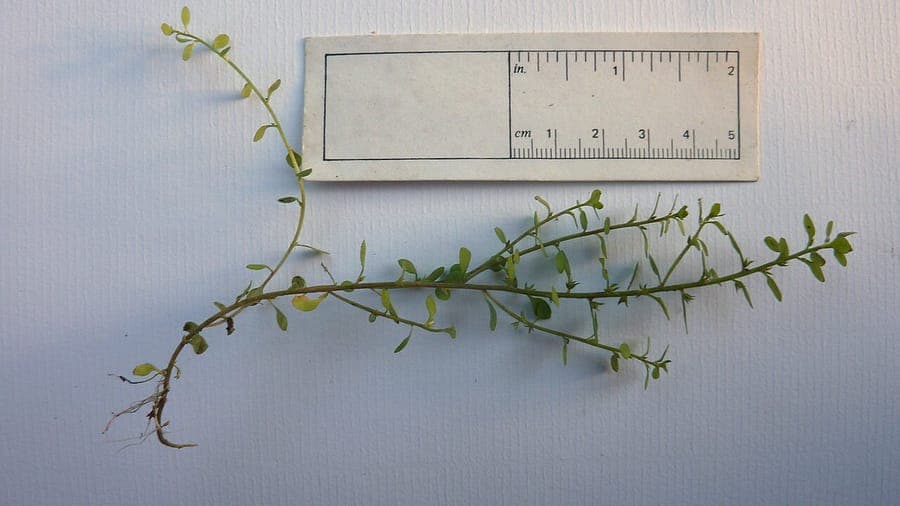
Chaffweed is one of the smallest flowering plants in the European flora. The stems are slender, ascending or spreading, just 1 to 5 cm tall (rarely to 10 cm). The leaves are tiny - 3 to 8 mm long - oval to spoon-shaped, pale to mid-green, stalkless or very shortly stalked, arranged alternately along the stem. The plant forms a loose, low mat or scattered patches on bare, moist ground.
The flowers appear in the leaf axils and are white, 4 to 5-petalled, only 2 to 3 mm in diameter. Though small, they are perfectly formed: symmetrical, with a pale centre and subtle petal texture visible under magnification. Bloom time runs from May through September - a long season for such a diminutive plant. After flowering, small spherical capsules form and split to release numerous tiny seeds.
The plant is typically annual, germinating in spring from a persistent soil seed bank and completing its life cycle within the growing season. Under favourable conditions - open, bare, wet, acidic ground - it can form dense low carpets covering several square decimetres. It requires open ground; any closure of vegetation quickly smothers it.
The species' ability to occur in such geographically diverse locations - from European heathlands to subtropical American wetlands - reflects its remarkable ecological flexibility within its specific niche of open, nutrient-poor, wet substrates.
Ideal location
Chaffweed requires an open, sunny to lightly shaded position on consistently moist to wet ground. In its natural habitats it occupies bare, unshaded or lightly shaded patches where taller vegetation has been suppressed - pond margins, heathland paths, wet sandy tracks, and the drawdown zones of reservoirs where exposed mud is colonised each season.
In the garden, suitable positions include the wet margins of a wildlife pond, open patches in a bog garden, damp joints in paving close to a water feature, or specially prepared low-nutrient wet beds. The key requirement is bare or sparsely vegetated ground - any competition from taller plants will eliminate it within a season.
A light value of 8 (out of 10 in the Trefle data) confirms its preference for full sun to light shade. The atmospheric humidity value of 7 indicates a moderate to high humidity preference - consistent with its native habitats around water and in damp, sheltered hollows.
Soil requirements
Chaffweed is strictly a plant of nutrient-poor, acidic, moist soils. The recorded pH range is 5.0 to 5.5 - significantly more acidic than most garden soils. Neutral or alkaline soils are unsuitable, as is any fertile, well-composted garden soil where competing plants outgrow chaffweed within weeks.
To create suitable conditions in the garden, prepare a special bed using a mix of ericaceous compost or peat, coarse horticultural sand, and a small amount of acid loam. Target a pH of 5.0 to 5.5, verified with a simple pH test kit. Do not add garden compost, manure, or general fertiliser to this bed - elevated nutrient levels favour competitive species and eliminate chaffweed.
The soil nutriment score of 3 (out of 10) confirms its extreme preference for low-fertility conditions. Think of the lean, washed substrates of bare pond margins and moorland paths - not the enriched beds of a typical vegetable or flower garden.
Free design
Want to see Chaffweed: complete guide in your garden? Make a free design now.
Watering
Chaffweed is moisture-demanding. In nature it occupies wet to periodically flooded ground and does not tolerate drought. In the garden, the growing position must remain consistently moist throughout the growing season. Allow the surface to dry out and the plant will quickly perish.
From May through September, when the plant is actively growing and flowering, check soil moisture daily during dry spells. On warm days with no rain, watering once or twice a day may be needed in exposed positions. A light covering of moss or fine sand on the bed surface helps retain moisture between waterings.
The atmospheric humidity value of 7 also indicates a preference for sheltered, moderately humid microclimates. Avoid exposed, wind-swept positions that dry out rapidly. The sheltered, humid margins of a pond or a naturally low-lying damp area in the garden are ideal.
Pruning
Chaffweed is a tiny annual that requires no pruning whatsoever. The key management task is maintaining open, competition-free conditions around the plants: hand-weed carefully with fingers or a fine weeding tool, removing any encroaching mosses, taller annuals, or perennial weeds that might shade or crowd the chaffweed. Raking or hoeing is too coarse and will uproot the plant.
In late summer to early autumn, allow the plants to set and drop seed naturally before removing any spent material. The seeds enter the soil seed bank and will germinate the following spring if conditions remain suitable. On well-managed sites, chaffweed re-establishes year after year without replanting.
Mark the growing position clearly each autumn so that winter tidying operations do not disturb the seed bank. A small stake or label is sufficient.
Maintenance calendar
January–February: Plant overwinters as seed in the soil; protect growing site from compaction or disturbance; leave any covering organic material in place.
March: Soil warms above 10 °C; first seedlings emerge; begin checking for competing vegetation; keep site moist.
April: Seedlings grow rapidly; maintain consistent moisture; hand-remove any competing plants carefully.
May–July: Flowering begins; plants are at their ornamental best; water daily in dry weather; enjoy the delicate white flowers.
August–September: Continued flowering and seed set; leave plants undisturbed to shed seed; maintain moisture.
October: Plants die back; seed falls; mark site; do not disturb the seed bank.
November–December: Dormant period; seed in soil; no active management needed; protect from extreme desiccation.
Winter hardiness
As an annual, chaffweed does not overwinter as a plant above ground - it survives the winter as dormant seed in the soil. The seed bank is reliably frost-hardy in the Netherlands, Belgium, and the UK (USDA zones 7 to 8), germinating when spring temperatures exceed 10 °C and soil moisture is adequate. It is a native species in these zones, fully adapted to local winter conditions.
In colder zones (USDA 5 to 6), prolonged freezing combined with drought may reduce seed viability. A light protective dressing of 3 to 5 cm of fine sand over the seed bank site during extreme cold spells can provide a degree of insulation. In average UK and Benelux winters, no such protection is needed.
The species has become scarce in parts of its European range due to habitat loss - drainage of heathland pools, agricultural intensification, and vegetation succession on previously open ground. Cultivating it in a sympathetic garden setting contributes to the conservation of this rare native species.
Companion plants
The most compatible companion plants share chaffweed's requirements for wet, acidic, nutrient-poor conditions:
- Juncus bufonius (toad rush): similar annual of wet, open acidic ground; natural community associate
- Carex echinata (star sedge): small native sedge for wet, acidic soils; structural companion in bog plantings
- Ranunculus flammula (lesser spearwort): native perennial of wet, acidic stream and pond margins
- Hypericum elodes (marsh St. John's wort): creeping native of wet, acidic bogs in western Europe
- Littorella uniflora (shoreweed): rosette plant of wet, acidic shore zones; closely matched habitat
- Drosera rotundifolia (round-leaved sundew): carnivorous native of wet, acid peat bogs; the most spectacular companion
Together, these species form an authentic native community of wet acidic ground that supports specialist invertebrates and offers high conservation value in the garden.
Conclusion
Chaffweed is not a plant for gardeners seeking bold, showy blooms. It is a plant for those who appreciate botanical rarity, the beauty of small things, and the satisfaction of recreating a genuine native plant community in a garden setting. Successfully cultivating this diminutive native in the right conditions - open, wet, acidic, nutrient-poor ground - is a real horticultural achievement.
For help designing a specialist native or bog garden that incorporates plants like chaffweed, visit gardenworld.app and create a customised planting plan tailored to your site's specific soil and moisture conditions.
Want to see Chaffweed: complete guide in your garden? Make a free design now.
Upload a photo, pick a style, and get a photorealistic design with plant list in under a minute.
10,000+ gardens designed already
No credit card required


Similar plants
Primula incana: complete guide to silvery alpine primrose
Primula incana
Silvery primrose (Primula incana), a delicate alpine flower with white blooms and powdered grey-green leaves. Growing, care, and cultivation guide.
Mealy cowslip: complete guide
Primula pulverulenta
Grow the Mealy cowslip (Primula pulverulenta): striking candelabra flowers in red and purple tones, moisture-loving and ideal for shady, damp garden corners.
Cliff dwarf-primrose: complete guide
Androsace laevigata
Full guide to growing Androsace laevigata, a rare Pacific Northwest alpine cushion plant. Planting, care, and garden design tips explained.