
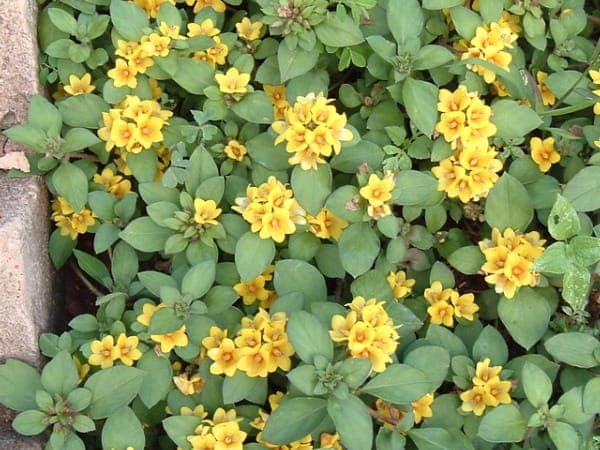
Wikimedia Commons / CC BY-SA 3.0, via Wikimedia Commons
Dense-flowered loosestrife: complete guide
Lysimachia congestiflora
Want to see Dense-flowered loosestrife: complete guide in your garden?
1 minute, no credit card
Overview
Lysimachia congestiflora, known as dense-flowered loosestrife, is an elegant low-growing perennial from the mountainous regions of Nepal, China, and the Himalayas. Belonging to the Primulaceae family, this compact groundcover is valued for its abundant yellow flower spikes that appear throughout the growing season. With a creeping growth habit, the plant typically reaches just 10 to 30 centimeters tall, making it ideal for borders, rock gardens, and container planting.
While relatively uncommon in European gardens, this plant deserves wider cultivation for its reliable flowering, minimal maintenance requirements, and attractive foliage. The distinctive leaves with red veins provide ornamental value even outside the blooming period.
Appearance and blooming
The leaves of Lysimachia congestiflora are small, oval to elliptical, with interesting texture and visible red veins, especially on the undersides. The leaf color is mid-green, and in cool weather or low light, the foliage may develop a reddish tinge. The plant remains largely evergreen in mild winters.
Flowering is this plant's strongest feature. From May through September, dense, sticky flower spikes emerge in a brilliant sunshine yellow. Individual flowers are small, about 1 centimeter in diameter, but clustered so tightly they create a spectacular yellow cloud. The blooms attract bees and butterflies and last for an extended period, particularly in partial shade where flowering stretches longer.
Ideal location
Lysimachia congestiflora thrives best in partial shade. This can range from light morning sun to filtered afternoon light. Full shade results in more foliage and fewer flowers. Full sun is acceptable as long as the soil does not completely dry out during summer months.
The plant is frost hardy to -15 degrees Celsius. In the Dutch climate, well-established garden specimens overwinter without protection. Shielding new spring growth from hard frosts helps, as young shoots can be sensitive.
Soil
The plant is not fussy about soil type. It grows best in loose, moisture-retentive soils with good drainage. Heavy clay soils can be amended with peat or compost. A pH between 6 and 7 is ideal, but the plant adapts to neutral and slightly acidic soils.
For container cultivation, use a well-draining potting mix enriched with extra peat moss. This ensures better water availability without waterlogging.
Free design
Want to see Dense-flowered loosestrife: complete guide in your garden? Make a free design now.
Watering
During the growing season (March through October), keep the soil consistently moist but not waterlogged. Regular misting encourages growth and flowering, especially during dry spells. In hot summers, daily watering may be needed for container plants.
In winter, when growth slows, reduce watering. However, ensure the roots never completely dry out, even during dormancy.
Rainwater is preferable to tap water due to its softness, reducing lime deposits on foliage.
Pruning
Pruning is not essential but encourages more compact, fuller growth. Remove dead stems in early spring. Pinch out the tips of young shoots in May for increased branching and a denser plant.
After flowering, old flower spikes can be removed to maintain appearance and potentially encourage a second flush of blooms.
Maintenance calendar
March: Feed after winter, remove dead growth, repot if needed. April: Begin biweekly feeding, mist in dry weather. May to September: Regular watering, feed every 3 weeks, prune as needed. October: Reduce feeding, prepare for winter. November to February: Minimal feeding, keep drier, protect against hard frost.
Winter hardiness
Lysimachia congestiflora is hardy to approximately minus 15 degrees Celsius. In the Netherlands, well-established garden plants overwinter without protection in most regions. In harsher areas, a winter mulch of leaves or prunings provides extra protection.
Container plants are more frost-vulnerable as the soil freezes more readily. Move pots to a sheltered location against the house wall during severe cold, or wrap them with bubble plastic.
Companion plants
Lysimachia congestiflora combines beautifully with other compact groundcovers:
- Silver deadnettle (Lamium argentatum) for silvery foliage contrast
- Ivy varieties for green background and structure
- Sedums and other succulents for form and burgundy tones
- Delicate grass species in containers for texture
In mixed borders, pair with other shade-loving perennials like hellebores or epimedium for layered interest.
Final thoughts
Lysimachia congestiflora is an underrated groundcover that every gardener should consider. With its long yellow flowering period, low growth habit, and frost hardiness, it fits virtually any garden style, from naturalistic to classical. This plant provides years of reliable pleasure once established.
Consider adding this charming alpine specialist to your garden-your front borders will surely benefit from its sunny display throughout the season.
Want to see Dense-flowered loosestrife: complete guide in your garden? Make a free design now.
Upload a photo, pick a style, and get a photorealistic design with plant list in under a minute.
No credit card required


Similar plants
Primula incana: complete guide to silvery alpine primrose
Primula incana
Silvery primrose (Primula incana), a delicate alpine flower with white blooms and powdered grey-green leaves. Growing, care, and cultivation guide.
Mealy cowslip: complete guide
Primula pulverulenta
Grow the Mealy cowslip (Primula pulverulenta): striking candelabra flowers in red and purple tones, moisture-loving and ideal for shady, damp garden corners.
Cliff dwarf-primrose: complete guide
Androsace laevigata
Full guide to growing Androsace laevigata, a rare Pacific Northwest alpine cushion plant. Planting, care, and garden design tips explained.