
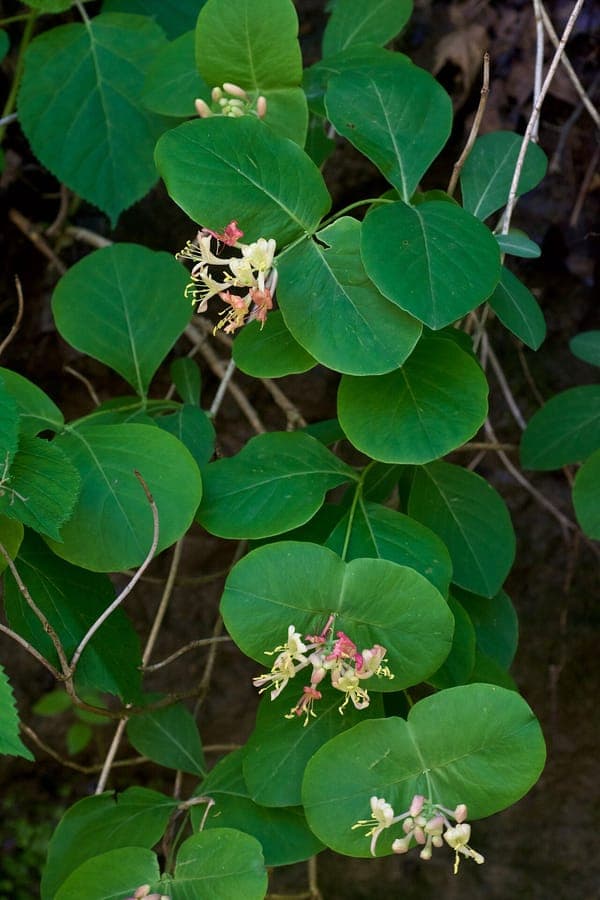
Eric Hunt / CC BY-SA 4.0, via Wikimedia Commons
Grape honeysuckle: complete guide
Lonicera reticulata
Want to see Grape honeysuckle: complete guide in your garden?
1 minute, no credit card
Lonicera reticulata, commonly known as grape honeysuckle, is a graceful twining climber belonging to the Caprifoliaceae family. Sometimes called proliferous honeysuckle or the grape-leaved honeysuckle, this species is native to a broad stretch of central and eastern North America - from Arkansas and Indiana through Wisconsin and Minnesota - as well as parts of south-eastern China. Its wide natural range across temperate climates makes it exceptionally well-suited to Northern European gardens, where it rewards careful placement with years of sweetly scented summer blooms.
Overview
As a deciduous woody climber, Lonicera reticulata reaches a mature height of 3 to 5 meters, depending on the structure it climbs. The stems wind elegantly around fences, pergolas, walls and obelisks without the aggressive smothering tendency of its Japanese cousin Lonicera japonica. This makes it a more manageable choice for smaller gardens or for situations where precision matters - alongside a delicate trellis or a wrought-iron arch, for example.
Beyond its ornamental appeal, grape honeysuckle is an important plant for wildlife. The tubular flowers produce nectar that attracts bumblebees, honeybees, hawk-moths and butterflies, while the small red berries that follow are quickly taken by thrushes and other garden birds. Planting Lonicera reticulata alongside other climbers such as Lonicera periclymenum or Lonicera sempervirens creates a staggered flowering sequence from May through September, keeping pollinators supplied throughout the season. If you are planning a wildlife-friendly front garden, gardenworld.app can help you design a planting scheme that makes the most of native and near-native climbers like this one.
The species name 'reticulata' - from the Latin for 'net-like' - refers to the distinctive reticulate venation on the underside of the leaves, a feature that sets this species apart from many of its relatives and gives the foliage an interesting textural quality even when the plant is not in flower.
Appearance and bloom cycle
The leaves are oval to oblong, glossy dark green above and pale grey-green beneath, with the prominent net-like veining that gives the plant its name. One of the most distinctive features is the way the uppermost pairs of leaves fuse into a disc-like structure around the flowering stem - a characteristic known as connate-perfoliate leaves. This creates a neat, architectural detail at the growing tips that is particularly noticeable in late spring before the flowers open.
Flowering begins in June and continues through July, with occasional repeat blooms in August. The tubular flowers emerge cream-white to pale yellow and gradually deepen to orange-yellow or salmon-pink as they age, so a single plant can display two or three shades simultaneously. Fragrance is most pronounced in the evening, making Lonicera reticulata an excellent choice for a seating area or open window. The flowers are held in whorled clusters at the shoot tips.
By late summer, round, translucent-red berries appear in small clusters. These are mildly toxic to humans and should not be eaten, but birds find them irresistible. The foliage turns a quiet golden-yellow in autumn before the plant sheds its leaves in November, leaving an attractive tracery of slender stems through the winter months.
Ideal location
Grape honeysuckle performs best in a sunny to partially shaded position. Full sun encourages the richest and most abundant flowering, but the plant tolerates 3 to 4 hours of shade per day without losing too much of its display. Heavy permanent shade leads to sparse flowering and increases the risk of powdery mildew - one of the more common problems with honeysuckles in general.
Choose a site that is sheltered from desiccating winds but still has good air circulation around the foliage. Stagnant humid air promotes fungal disease. A south- or west-facing wall that receives afternoon sun and is sheltered by a nearby hedge or fence is ideal. The classic advice for honeysuckles - cool roots, warm shoots - holds true here: if the base of the plant is shaded or mulched while the upper stems reach into sunlight, the plant will thrive.
Suitable supports include pergolas, wooden fencing, wire panels, steel arches and bamboo obelisks. The plant's twining stems grip supports up to about 2 cm in diameter; thicker posts or solid walls need horizontal wires or a lattice fixed across them.
Soil
Lonicera reticulata is not fussy about soil type, but does best in fertile, well-drained ground with a pH between 6.0 and 7.0. Heavy clay is acceptable provided it drains reasonably well and water does not pool around the roots. Sandy soils work too, but will need more frequent watering and regular mulching to conserve moisture during dry spells.
At planting time, incorporate a generous amount of well-rotted garden compost or farmyard manure into the planting hole. This improves soil structure, feeds the developing root system and helps retain moisture during the plant's establishment phase. A mulch layer of 7 to 10 cm of bark or wood chip around the base - kept a few centimetres clear of the stem - is highly beneficial during the first two summers.
Once established - usually after two growing seasons - the plant becomes noticeably drought tolerant. Chalky or lime-rich soils are tolerated but may cause some yellowing of the leaves due to lime-induced chlorosis; a dose of seaweed-based liquid feed in mid-spring usually corrects this.
Free design
Want to see Grape honeysuckle: complete guide in your garden? Make a free design now.
Watering
For the first full growing season after planting, water consistently and generously: aim to thoroughly wet the soil to a depth of at least 30 cm once a week during dry periods, rather than giving frequent shallow applications. Deep watering encourages the roots to grow downward, producing a more resilient and drought-resistant plant over time.
Once established, Lonicera reticulata manages well on natural rainfall in most UK and Northern European conditions. During heat waves - several consecutive days above 30 degrees Celsius - provide supplementary irrigation, preferably early in the morning so that the foliage dries quickly. Wet leaves overnight increase the risk of powdery mildew and leaf spot.
A drip line or soaker hose laid along the base of the plant and buried under mulch is the most efficient watering solution for climbers on a pergola or against a wall, as the overhang often creates a rain shadow. Avoid overhead watering with a sprinkler wherever possible.
Pruning
Lonicera reticulata flowers on new wood produced in the current season, so the timing and method of pruning is important. Avoid heavy spring pruning, which would remove the shoots that will carry the current year's flowers.
The best approach is a light tidying immediately after flowering in late July or early August: remove dead, damaged or crossing stems, shorten any shoots that have grown beyond the intended boundary of the plant and lightly thin dense areas to improve air circulation. This annual light prune keeps the plant shapely and helps prevent the buildup of dead wood at the base.
If the plant has become congested and woody after many years without pruning, it can be renovated in late February or early March by cutting all stems back hard to 50 to 80 cm from the ground. The plant will regenerate vigorously from the base, though flowering will be sparse in the first season after renovation. Always use clean, sharp tools and make cuts at a 45-degree angle just above a bud or side shoot.
Maintenance calendar
February-March: Inspect for frost damage and remove any dead or diseased wood. Apply a balanced slow-release fertiliser around the base.
April-May: Guide new shoots onto their support. Begin watering if the spring is dry. Watch for the first aphid colonies on young shoot tips.
June-July: Full flowering season. Enjoy the fragrant blooms. Monitor for powdery mildew and treat with a sulphur-based spray if spotted early.
August: Light post-flowering prune. Remove spent flowers and any weak or crossing stems. Water during hot spells.
September-October: Berries form. Reduce watering. Apply a layer of garden compost around the base.
November-December: Leaves fall. Tie in any loose stems to prevent wind damage. No fertiliser until spring.
Winter hardiness
Lonicera reticulata is reliably hardy to USDA zone 4, meaning it tolerates minimum temperatures of -29 to -23 degrees Celsius. For gardeners in the United Kingdom, Belgium, the Netherlands and northern France - where minimum temperatures rarely fall below -15 degrees Celsius - no winter protection is needed once the plant is established.
Young plants in their first winter may benefit from a loose layer of straw or horticultural fleece around the base in regions prone to harsh ground frosts, but this is rarely strictly necessary. The top growth may be killed back by severe or prolonged frost, but the root system and the base of the stems will regenerate strongly the following spring. The bare winter stems have their own quiet charm against a light-coloured wall or fence, tracing an intricate geometric pattern that reminds the garden of the life to come. Gardenworld.app includes Lonicera reticulata and many related climbers in its plant palette for garden design - try the planner and see how this honeysuckle could work on your front wall or garden boundary.
Companion plants
Grape honeysuckle pairs beautifully with a wide range of garden plants. Some particularly successful combinations include:
- Large-flowered clematis such as 'Jackmanii' or 'The President': the honeysuckle provides a fine-textured backdrop against which the bold clematis blooms stand out dramatically.
- Climbing roses such as 'New Dawn' or 'Compassion': the peachy-pink tones of these roses complement the orange-yellow of mature honeysuckle flowers perfectly.
- Salvia nemorosa in the foreground: purple flower spikes provide a vivid contrast with the warm tones of the honeysuckle.
- Low-growing perennials such as Geranium 'Rozanne' or Alchemilla mollis at the base keep the roots shaded and moist while providing additional colour and texture at ground level.
- Hedera (ivy) or Vinca minor as ground cover on the shaded side of a pergola or arch, allowing the honeysuckle to occupy the sunnier aspect.
Closing
Lonicera reticulata is a plant that deserves far wider use in European gardens. Its combination of elegant reticulate foliage, fragrant yellow-orange flowers, wildlife value and outstanding cold hardiness makes it one of the most rewarding climbing plants for a sunny wall or pergola. It asks for little in return: good drainage, reasonable soil, occasional pruning and the support of a sturdy structure. Whether your garden style is formal or naturalistic, this grape honeysuckle will bring movement, fragrance and life to whatever vertical surface you choose to plant it against. If you want to see how it could look on your own house, upload a photo at gardenworld.app and explore climbing plant options for your specific situation.
Want to see Grape honeysuckle: complete guide in your garden? Make a free design now.
Upload a photo, pick a style, and get a photorealistic design with plant list in under a minute.
10,000+ gardens designed already
No credit card required


Similar plants
Woodbine: complete guide
Lonicera periclymenum
Grow Lonicera periclymenum successfully: blooms June–September, thrives in partial shade, ideal for climbing fences and trees, attracts pollinators.
Perfoliate honeysuckle: complete guide
Lonicera caprifolium
Grow Lonicera caprifolium with confidence: ideal conditions, care tips, pruning, and companion plants for this fragrant, hardy climber in USDA zones 5-9.
Coral honeysuckle: complete guide to this vibrant evergreen climber
Lonicera sempervirens
Grow coral honeysuckle (Lonicera sempervirens) for brilliant red tubular flowers. A frost-hardy evergreen vine, perfect for trellises and walls.