
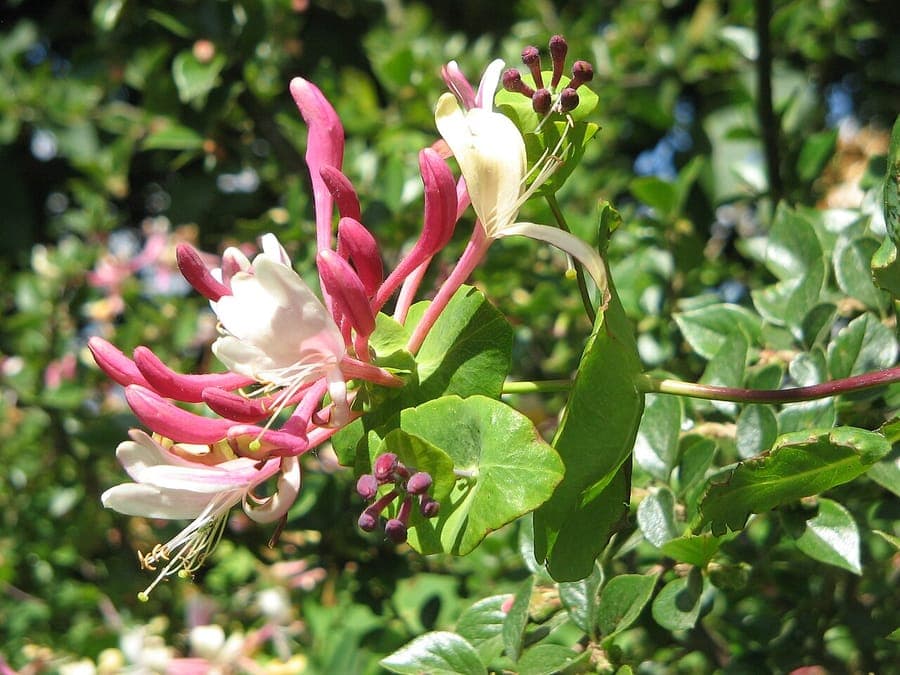
Meneerke bloem / CC BY-SA 3.0, via Wikimedia Commons
Perfoliate honeysuckle: complete guide
Lonicera caprifolium
Want to see Perfoliate honeysuckle: complete guide in your garden?
1 minute, no credit card
Overview
Lonicera caprifolium, commonly known as Perfoliate honeysuckle, is a graceful, twining climber that brings both beauty and fragrance to gardens across temperate zones. Native to southern and central Europe, this species thrives in gardens from Albania to Germany and is perfectly suited to UK and North American climates. Unlike some invasive honeysuckles, this one behaves - it grows steadily but isn't aggressive, making it a reliable choice for pergolas, fences, and arbours.
Hardy to USDA zones 5–9, it dies back partially in winter but returns each spring with fresh growth. The plant blooms in late spring to early summer, producing pairs of tubular flowers that release a powerful, sweet scent in the evening - a magnet for pollinators. If you're designing a wildlife-friendly garden, this is a top contender. On gardenworld.app, you can visualise how to place Perfoliate honeysuckle to maximise fragrance near patios or garden paths.
Appearance & bloom cycle
This honeysuckle climbs by twining - it doesn't cling with suckers or tendrils, so it needs support like a trellis, obelisk, or netting. Mature plants reach 4–5 metres in height, forming a loose, airy tangle of green stems. The leaves are oval, deep green, and have a distinctive feature: they appear to be perforated by the stem, giving the plant its 'perfoliate' name. This creates a neat, layered look along the stems.
Flowering begins in May and can last into July, depending on climate. The blooms start white and gradually turn soft pink, appearing in whorls at the leaf joints. The flowers are highly fragrant, especially after sunset, attracting moths, bees, and hoverflies. After flowering, small orange berries may form, but these are mildly toxic and should not be eaten. Keep that in mind if you have curious pets or small children.
Ideal location
For best results, plant Perfoliate honeysuckle in full sun to light shade. A south- or east-facing wall or fence is ideal. In full sun, you'll get the most flowers and strongest fragrance. In heavier shade, flowering will be sparse. Avoid cold, north-facing aspects - the plant won't thrive there.
This honeysuckle is perfect for softening hard structures. Try it on a wooden pergola, a rustic fence, or even a large obelisk in a mixed border. Because it needs support, don't expect it to climb bare brick or smooth stone without help. Train the young shoots gently through your chosen structure. On gardenworld.app, you can explore layout ideas that integrate honeysuckle as a vertical accent in cottage or informal gardens.
Soil requirements
Lonicera caprifolium isn't fussy about soil type, as long as it's well-drained. It grows well in loam, clay, or sandy soils, provided they're not waterlogged. The ideal pH range is 6.0 to 7.5 - neutral to slightly acidic. Heavy clay soils benefit from added organic matter to improve drainage, while sandy soils need compost to retain moisture.
Avoid overly rich soils with high nitrogen levels, as this can lead to lush foliage but fewer flowers. A moderate fertility is best. Before planting, dig in a bucket of well-rotted compost to give the roots a good start.
Free design
Want to see Perfoliate honeysuckle: complete guide in your garden? Make a free design now.
Watering
During the first growing season, water regularly - especially in dry spells. Once established, the plant is fairly drought-tolerant, but prolonged dry periods in summer can reduce flowering. Water deeply at the base, not overhead, to prevent fungal issues.
Applying a 5–8 cm layer of mulch in spring helps conserve moisture and suppress weeds. Use compost, leaf mould, or wood chips. Keep the mulch a few inches away from the main stem to prevent rot.
Pruning
Pruning isn't essential, but it helps maintain shape and encourage new growth. The best time to prune is right after flowering, in late July or early August. Avoid pruning in spring - you'll cut off the flower buds.
Use sharp, clean secateurs. Cut back long shoots by up to a third, removing any dead, damaged, or congested growth. This honeysuckle doesn't regenerate well from old wood, so avoid cutting into thick, bare stems. Light annual trimming is better than heavy renovation.
Maintenance calendar
- January: Check for frost damage. No pruning or feeding.
- February: Inspect support structures. Remove any winter debris.
- March: Clear dead growth. Apply mulch and a light compost top-dressing.
- April: Watch for aphids. Water if spring is dry.
- May: Flowers begin. Avoid pruning. Keep an eye on pests.
- June: Peak bloom. Fragrance is strongest at dusk. Water during dry spells.
- July: Bloom fades. Prune immediately after flowering.
- August: Light shaping if needed. Replenish mulch.
- September: Stop feeding. Let plant harden off for winter.
- October: Clear fallen leaves to reduce disease risk.
- November: No action needed. Protect young plants with mulch if severe winter expected.
- December: Check for bird nests before pruning.
Winter hardiness
Perfoliate honeysuckle is fully hardy in USDA zones 5–9. It can withstand temperatures down to -20°C. Mature plants need no protection, but young ones benefit from a 10 cm mulch layer around the base to insulate the roots. The plant is semi-evergreen in milder climates - some leaves may persist through winter.
Companion plants
Pair with other late-spring climbers like Clematis 'Perle d'Azur' or the rose 'The Generous Gardener'. At ground level, plant drought-tolerant perennials such as lavender, Nepeta, or Salvia - they share similar soil and sun needs. Avoid invasive groundcovers that might compete for root space.
For a layered effect, combine with upright plants like Verbena bonariensis or Echinacea. The pale pink and white flowers of the honeysuckle contrast beautifully with purple and blue tones.
Closing
Lonicera caprifolium is a low-maintenance, high-reward climber that earns its place in any garden. Its scent, reliability, and wildlife value make it a standout. Plant it near a seating area or window where you can enjoy the evening fragrance. You'll find it at garden centres across the UK and North America. Look for healthy plants in 3-litre pots. With proper support and a little care in the first year, it'll reward you with years of beauty. For layout inspiration, check gardenworld.app to see how this honeysuckle fits into your dream garden.
Want to see Perfoliate honeysuckle: complete guide in your garden? Make a free design now.
Upload a photo, pick a style, and get a photorealistic design with plant list in under a minute.
No credit card required


Similar plants
Yellow honeysuckle (Lonicera tragophylla): complete guide
Lonicera tragophylla
Meet yellow honeysuckle (Lonicera tragophylla): a Chinese climber with large golden flowers that thrives in partial shade.
Lonicera korolkowii: complete guide
Lonicera korolkowii Stapf
Discover blueleaf honeysuckle, a vigorous shrub with beautiful flowers. Guide on growing, shaping and why this Asian climbing plant is perfect for gardens.
Lonicera oblongifolia: complete guide
Lonicera oblongifolia Hook.
Discover swamp fly honeysuckle, a North American woodland plant. Guide on growing, caring and why this native species is valuable for gardens.