
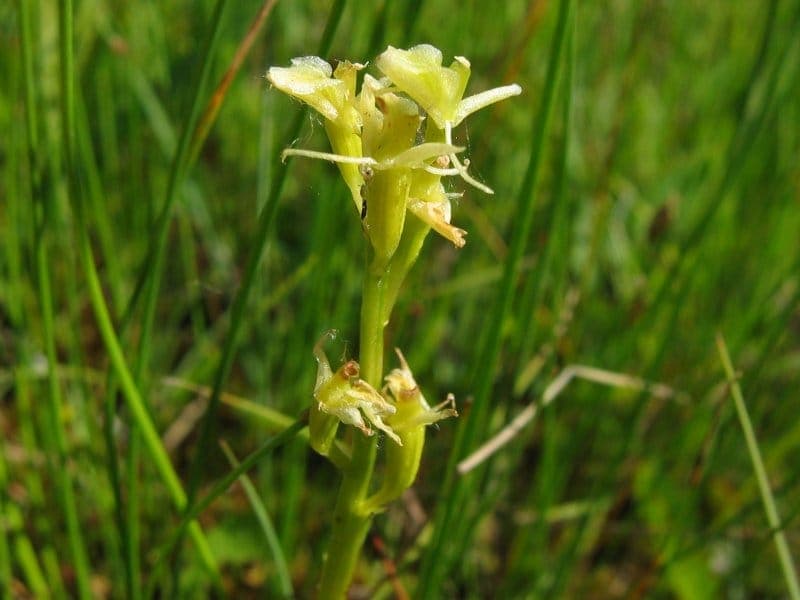
Kristian Peters -- Fabelfroh 07:12, 30 October 2006 (UTC) / CC BY-SA 3.0, via Wikimedia Commons
Loesel's Twayblade (Liparis loeselii): complete guide
Liparis loeselii
Want to see Loesel's Twayblade (Liparis loeselii): complete guide in your garden?
1 minute, no credit card
Overview
Loesel's twayblade (Liparis loeselii), known by many names - Sumpf-Glanzkraut (German), Liparis de Loesel (French), Fen orchid, Yellow wide-lip orchid (English) - is a rare, protected orchid from the family Orchidaceae. Distributed across Europe to Central Asia, North America, and Canada, this wetland orchid is a botanical jewel with delicate yellow flowers. Unfortunately, this plant is threatened in many regions by wetland drainage and habitat loss.
Appearance & Bloom
Loesel's twayblade is a small, subtle plant of 10-25 cm tall. The characteristic feature is two broad, shiny green leaves at the base of the plant. The flowers are tiny but elegant - 5-10 mm large - in shades of yellow to yellowish-green with purplish margins or stigmata. The flowering period extends from May to June. The flowers are self-pollinating and produced in a loose spike at the top of the stem. After blooming, seed capsules form.
Ideal Location
Loesel's twayblade requires a very specific habitat: wet, nutrient-poor wetlands, fens, and marshy habitats with acidic to neutral water. In gardens, this plant is almost impossible to grow successfully without special conditions. However, in botanical gardens and terrariums with controlled humidity levels and sterile seed-starting material, it can be attempted. This plant is NOT suitable for normal gardens.
Soil Requirements
The plant prefers highly acidic, nutrient-poor peat or pure sphagnum (peat moss) substrate. In the wild, it grows in fens with constant water flow and low nutrients. Normal garden compost is completely unsuitable. Soil conditions must be monitored weekly and anoxic (oxygen-poor) environment must be maintained. This plant requires special treatment.
Watering
Loesel's twayblade requires constantly high humidity - almost like water culture. The plant must have 'feet' always wet, but waterlogging is equally harmful. A delicate balance between humidity and air circulation is needed. This is not a normal houseplant. Rainwater or distilled water is essential (tap water contains too many minerals).
Free design
Want to see Loesel's Twayblade (Liparis loeselii): complete guide in your garden? Make a free design now.
Pruning
Pruning is not appropriate for this plant. Removal of dead leaves can be done, but active pruning damages the delicate growth pattern. The plant is small and requires no shaping.
Maintenance Calendar
April–May: Blooming period. Very careful watering. No plant movement.
June–August: Seed ripening. Continuous high humidity. Temperature should remain cool (10-15°C nights ideal).
September–October: Seed is ripe. Seed collection can be attempted (difficult) for propagation.
November–March: Dormancy. Humidity levels remain high. No fertilization.
Winter Hardiness
Loesel's twayblade is winter-hardy in USDA zones 4–7 (down to -20°C). The plant grows in situ in wetlands in temperate zones. However, in captivity, winter hardiness is less relevant because habitat requirements are so specific. NOT for normal gardens.
Companion Plants
In wetlands, Loesel's twayblade naturally grows with:
- Sphagnum (peat moss)
- Drosera (sundew)
- Pinguicula (butterwort)
- Carex species (sedge)
- Sundew variants
- Other wetland plants
This plant is not for normal gardens with companion plants.
Closing
Loesel's twayblade is a scientifically fascinating plant with enormous ecological value. Unfortunately, successful cultivation in gardens is unrealistic without professional facilities. The plant is strictly protected in many countries. Rather than attempting to grow this plant at home, support wetland habitat protection through local conservation initiatives. Visit gardenworld.app for more plants that can thrive in your normal garden and still have ecological value.
The distribution of Loesel's twayblade is threatened. NEVER buy seed from unreliable sources. Instead, support wetland protection in your area.
Want to see Loesel's Twayblade (Liparis loeselii): complete guide in your garden? Make a free design now.
Upload a photo, pick a style, and get a photorealistic design with plant list in under a minute.
No credit card required


Similar plants
Ram's-head lady's slipper: complete guide
Cypripedium arietinum
Everything you need to know about growing Cypripedium arietinum, a rare woodland orchid for cool, moist garden settings. Soil, care and planting tips.
Sparrow's-egg lady's slipper: complete guide
Cypripedium passerinum
Everything about growing Cypripedium passerinum, a cold-hardy subarctic orchid suited to cool, moist, shaded garden spots. Soil, care and companion plants.
Algerian Butterfly-orchid: complete guide
Platanthera algeriensis
Everything about Platanthera algeriensis, the rare Mediterranean orchid with greenish flowers native to Algeria, Morocco, Corsica and Spain.