
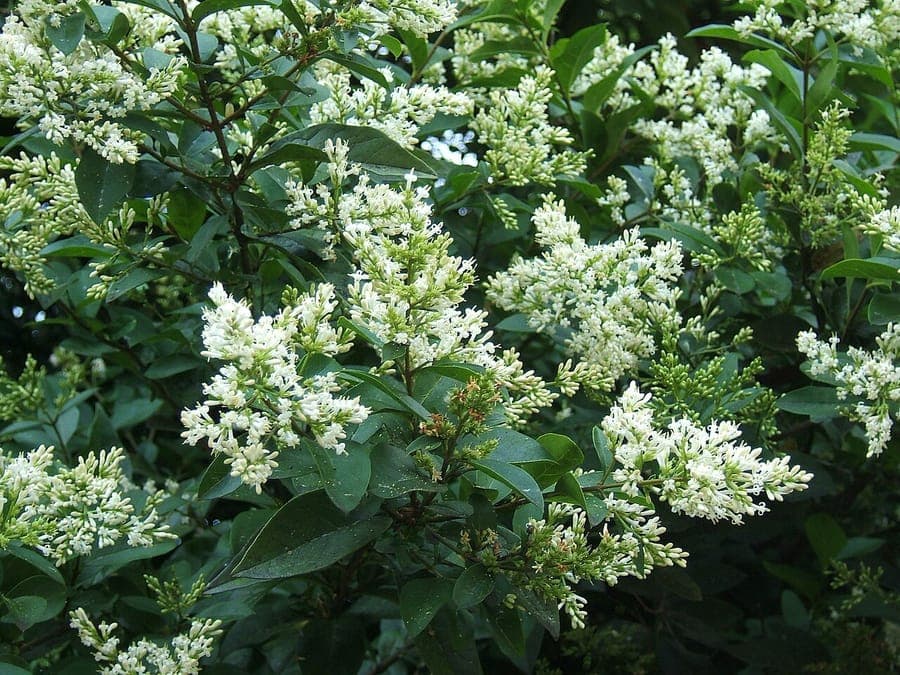
No machine-readable author provided. MPF assumed (based on copyright claims). / CC BY 2.5, via Wikimedia Commons
Privet: complete guide
Ligustrum ovalifolium
Want to see Privet: complete guide in your garden?
1 minute, no credit card
Overview
Privet (Ligustrum ovalifolium) is the undisputed king of hedge plants. Across the British Isles, the Netherlands, Belgium, and much of temperate Europe, this semi-evergreen shrub graces millions of gardens as one of the most widely planted hedging species. The reason for this success is as simple as it is convincing: privet grows fast, tolerates virtually any soil, takes hard clipping with grace, and retains its foliage deep into winter - or even year-round in mild climates. No other hedge plant delivers so much privacy for so little money and effort.
Ligustrum ovalifolium grows as a free-standing shrub to 3 to 5 metres, but is typically maintained at 1 to 2 metres as a hedge. On gardenworld.app you can create a garden design where a privet hedge serves as a structural element - as a boundary, as a backdrop for a border, or as a windbreak. The plant belongs to the family Oleaceae (olive family) and originates from Japan and Korea. The most popular cultivar is 'Aureum' (golden privet), with yellow-green variegated foliage that provides colour even in winter.
Appearance and bloom cycle
Privet has oval, glossy leaves 3 to 6 cm long that feel leathery to the touch. On the green form they are dark green; on 'Aureum' they are yellow-green with a golden margin. In mild winters privet retains most of its foliage; in severe winters (below -10 °C for prolonged periods) it may drop some leaves, but flushes rapidly in spring. This makes it technically semi-evergreen, though in practice in maritime climates it is nearly always green.
In June, privet flowers with short, dense panicles of creamy-white florets that emit a strong, sweet fragrance. The scent is perceived by some as pleasant, by others as somewhat cloying. The bloom attracts large numbers of bees and butterflies. After flowering, glossy black berries appear in clusters in autumn. Note: these berries are toxic to humans (especially children) but an important food source for birds, particularly blackbirds and thrushes.
Ideal location
Privet is extraordinarily tolerant regarding location. It grows in full sun, partial shade, and even shade, although foliage density in deep shade is lower than in sun. The golden cultivar 'Aureum' colours most brightly in full sun to light partial shade - in deep shade the foliage turns green. Privet tolerates wind excellently and is a popular choice for windbreaks, including in coastal areas with salt-laden air.
The plant is remarkably urban-resilient, tolerating air pollution, soil compaction, and limited root space better than most competitors. This makes it ideal for front gardens, pavement edges, and urban boundary hedges. For a hedge, space the plants 30 to 40 cm apart for a fast, dense result, or 50 cm for a more economical planting that takes slightly longer to fill in.
Soil requirements
Privet grows in virtually any soil: clay, loam, sand, chalk, acidic, and alkaline. The ideal soil is moisture-retentive and moderately fertile with a pH of 5.5 to 8.0, but privet adapts to almost anything. On extremely dry, poor sand it grows more slowly but survives without difficulty. On heavy, wet clay it performs better than many other hedging plants.
When planting a hedge, it is advisable to dig a trench 40 cm wide and 40 cm deep rather than individual planting holes. Mix the excavated soil with compost (one part compost to three parts soil) for a better start. Plant the shrubs at the same depth they were growing in the pot or nursery. Firm the soil well and water generously - 10 litres per running metre.
Watering
Privet is fairly drought-tolerant once established, but performs best with regular moisture, especially during the growing season. In the first year after planting, weekly watering during dry weather is essential - roughly 10 litres per running metre of hedge. This ensures the roots establish deeply and the hedge fills in quickly.
From the second year onward, supplementary watering is only needed during prolonged drought exceeding two weeks, particularly on sandy soil. A hedge that is regularly clipped needs more moisture than a free-growing shrub, because clipping removes foliage that must be replaced. A 5 cm mulch layer along the base of the hedge helps retain moisture and suppresses weeds. In containers, privet dries out faster - check every two to three days.
Pruning
Pruning is the core of privet maintenance. A well-clipped privet hedge is one of the most satisfying sights in the garden - crisp, dense, and deep green. Clip the hedge twice a year: the first time in June (after the longest day) and the second time in September. This twice-per-season rhythm keeps the hedge compact and tidy.
At the first clip (June), shape the hedge to the desired profile. Always clip to a slightly tapered form: wider at the base than at the top, so that light reaches the lower branches and the hedge does not go bare from the bottom up. At the second clip (September), remove regrowth and restore the shape for winter. Use powered hedge trimmers for long straight runs and hand shears for detail work.
Privet also tolerates drastic renovation pruning superbly. A neglected, overgrown hedge can be cut back to 30 cm above ground in late winter (February–March). The plants will fill in again within a single season. This is known as renovation pruning and is one of privet's great advantages over yew or box, which recover far more slowly.
Free design
Want to see Privet: complete guide in your garden? Make a free design now.
Planting a hedge: step by step
Planting a privet hedge is a rewarding job with fast results. The best planting time is autumn (October–November) for bare-root plants, or year-round for container-grown stock. Follow these steps for a successful hedge.
Step 1: Run a garden line along the desired hedge position. Dig a trench 40 cm wide and 40 cm deep along this line. Step 2: Mix the excavated soil with compost (1:3 ratio). Step 3: Place the plants 30 to 40 cm apart in the trench. Step 4: Backfill with the soil mixture and firm well. Step 5: Water generously - 10 litres per running metre. Step 6: Cut the plants back by one third immediately after planting - this stimulates branching at the base and ultimately produces a denser hedge.
In the first year after planting, clip the hedge two to three times lightly to promote branching. From the second year, switch to the regular twice-yearly schedule.
Maintenance calendar
February–March: Renovation pruning on neglected hedges if needed. Apply a layer of compost along the base.
April–May: Privet flushes rapidly with fresh green (or golden-yellow on 'Aureum') foliage. Check for aphids and scale insects - these occur occasionally but seldom cause serious damage.
June: First main clip. Shape the hedge. Privet also flowers - leave flowers on free-growing specimens for the bees.
July–August: Regrowth. The hedge may look slightly shaggy - this is normal.
September: Second clip. Restore the hedge to a tidy shape for winter.
October–November: Planting season for bare-root privet. The hedge may begin to lose some foliage in severe winters.
December–January: Dormancy. The semi-evergreen hedge still provides considerable privacy.
Winter hardiness
Ligustrum ovalifolium is winter-hardy to approximately -15 °C to -20 °C (USDA zones 5 to 8). Across the British Isles, the Netherlands, Belgium, and the rest of temperate Europe, privet overwinters without protection. In mild winters it retains virtually all its foliage; in severe winters it may lose some, but reliably flushes again in March–April. The golden cultivar 'Aureum' is slightly more sensitive to extreme frost than the green form but tolerates -15 °C without difficulty.
Prolonged frost combined with cold easterly winds can cause leaf drop, but this is cosmetic and has no consequences for the hedge's health. Newly planted hedges are slightly more vulnerable: protect them in their first winter with a mulch layer around the base and, if necessary, a burlap windscreen on the exposed side.
Privet versus other hedge plants
How does privet compare with other popular hedging plants? Compared with box (Buxus sempervirens), privet grows three to four times faster and is not susceptible to the dreaded box moth and box blight. Box, however, is evergreen and more compact. Compared with yew (Taxus baccata), privet is cheaper, faster, and tolerates more soil types, but yew is fully evergreen and requires less clipping. Compared with laurel (Prunus laurocerasus), privet is finer-leaved, clips better, and tolerates more shade, but laurel holds its foliage more reliably in severe winters.
The choice depends on your priorities: for the fastest, cheapest, and most resilient hedge, choose privet. For a fully evergreen, formal hedge, choose yew or laurel.
Wildlife value
Privet is ecologically more valuable than many gardeners realise. The flowers in June attract large numbers of bees, butterflies, and hoverflies. The black berries in autumn are an important food source for blackbirds, song thrushes, robins, and other birds. The dense branch structure provides nesting opportunities for small songbirds - dunnocks, wrens, and blackbirds readily nest in a privet hedge.
For maximum ecological value, allow part of the hedge to grow freely (skip the June clip so flowers have a chance to form) and clip only in September after the berries have set. This delivers flowers for pollinators and berries for birds while still giving the hedge a tidy winter form.
Companion plants
A privet hedge forms the perfect green backdrop for almost any border. The crisp, dark green foliage mass makes flowers and ornamental plants in front of it stand out beautifully. Classic foreground planting includes lavender, sage (Salvia nemorosa), catmint (Nepeta), roses, and hydrangeas. Golden privet 'Aureum' provides a warmer backdrop that combines particularly well with purple and blue flowers.
For a mixed hedge with greater biodiversity, alternate privet with hawthorn (Crataegus), dog rose (Rosa canina), and guelder rose (Viburnum opulus). In a formal garden, the privet hedge forms the structural framework within which box balls, espalier trees, and perennials come into their own.
Final thoughts
Privet is the unbeatable classic among hedge plants: fast, affordable, resilient, and elegant when well maintained. Two clips a year and an annual application of compost is all this plant asks for decades of crisp privacy and green structure.
Choose the green form for the densest hedge or 'Aureum' for a golden colour accent. On gardenworld.app you can create a garden design that integrates a privet hedge as a structural element in your garden. Plant a row of privet this autumn and enjoy a dense, green boundary as early as next year.
Want to see Privet: complete guide in your garden? Make a free design now.
Upload a photo, pick a style, and get a photorealistic design with plant list in under a minute.
No credit card required


Similar plants
English Yew: complete guide
Taxus baccata
Everything about English Yew (Taxus baccata): planting, clipping, topiary and care. Expert tips for a dense hedge or elegant sculptural form.
Common Boxwood: complete guide
Buxus sempervirens
Everything about Common Boxwood (Buxus sempervirens): planting, pruning, topiary and box moth control. Practical tips for healthy, green hedges and shapes.
Cherry Laurel: complete guide
Prunus laurocerasus
Everything about Cherry Laurel (Prunus laurocerasus): planting, pruning, cultivars and care. Expert tips for a fast-growing, dense evergreen hedge.