
Strobilomyces / CC BY-SA 3.0, via Wikimedia Commons
Lathraea clandestina: complete guide
Lathraea clandestina
Want to see Lathraea clandestina: complete guide in your garden?
1 minute, no credit card
Overview
Lathraea clandestina, commonly called 'purple toothwort' or 'hidden toothwort,' is a fascinating semi-parasitic plant from the Orobanchaceae family. This extraordinary plant grows naturally from Belgium to Northern Spain and Central Italy in forest areas. It is an underground parasite drawing nutrients from tree roots, particularly willows and other moisture-loving trees. The plant is renowned for its striking purple flowers appearing in early spring.
Appearance & bloom
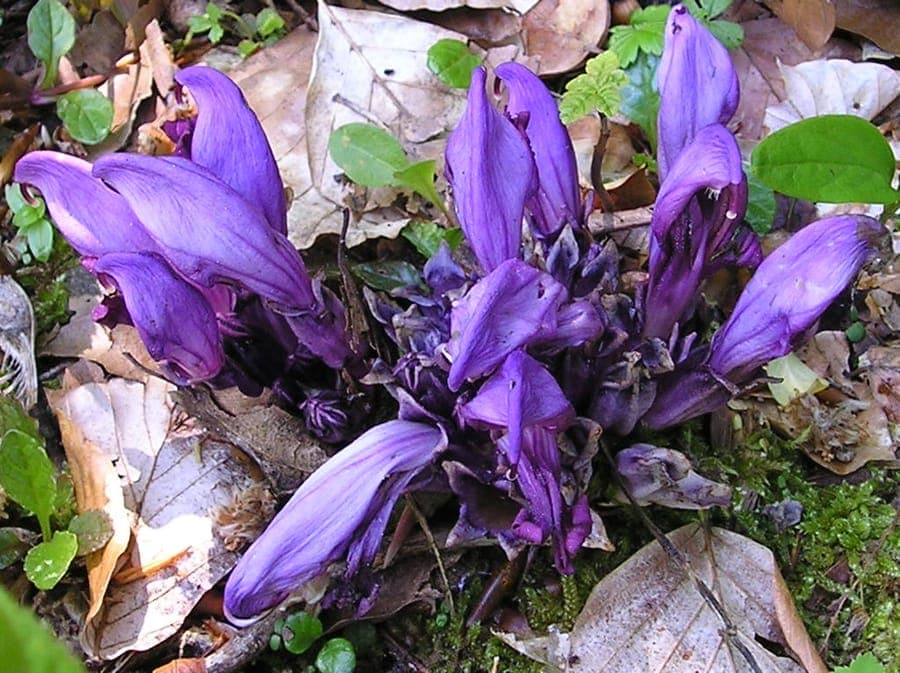
Lathraea clandestina is an extremely unusual plant growing underground as a mass of scale-like, whitish-yellow rhizomes. Above-ground parts appear only in early spring (March-May) as dense clusters of purplish-pink to violet two-lipped flowers. The flowers are highly conspicuous and attract pollinators. After blooming, the plant retreats underground.
Ideal location
Lathraea clandestina thrives in partial to full shade in woodland environments. The plant performs optimally in moist, shaded spots beneath willows and other broadleaf trees. Full shade is preferred. Sunny locations are unsuitable.
Free design
Want to see Lathraea clandestina: complete guide in your garden? Make a free design now.
Soil
The plant behaves flexibly regarding soil but prefers moist, humus-rich woodland soil. Neutral to acidic soil is ideal. The plant is highly dependent on host roots for nutrition.
Watering
Lathraea clandestina is entirely dependent on host roots for water and nutrients. It has no direct water requirements itself. However, the host plant must receive regular water.
Pruning
Pruning is not applicable as only the flowers emerge above ground. No maintenance is needed.
Maintenance calendar
Fall: Ensure host plant is well established. Spring: Enjoy blooms in March-May. Summer: Plant hides underground.
Winter hardiness
Lathraea clandestina is winter hardy (USDA 4-8) and tolerates European winters well. Underground parts survive frost without issue.
Companion plants
Host trees are crucial: Salix alba, Salix cinerea, Alnus glutinosa, Cornus alba, and other moisture-loving broadleaf trees. Ground covers like Helleborus foetidus and Asarum europaeum are suitable partners.
Closing
Lathraea clandestina is a botanical rarity offering unique interest. Available through specialized plant suppliers. Perfect for gardenworld.app/en designs with unique botanical character.
Want to see Lathraea clandestina: complete guide in your garden? Make a free design now.
Upload a photo, pick a style, and get a photorealistic design with plant list in under a minute.
No credit card required


Similar plants
Northwestern Indian paintbrush: complete guide
Castilleja angustifolia
All about Castilleja angustifolia, the northwestern Indian paintbrush from dry western US steppes. Growing, care, and companion plant advice.
Wavyleaf Indian paintbrush: complete guide
Castilleja applegatei
Everything about Castilleja applegatei, the wavyleaf paintbrush from Oregon and California. Host plants, care, location, and garden use covered.
Bushy bird's-beak: complete guide
Cordylanthus ramosus
Complete guide to Cordylanthus ramosus, the hemiparasitic annual of western US steppes: ecology, host plants, cultivation and uses.