
Alialb / CC BY-SA 4.0, via Wikimedia Commons
Latania verschaffeltii: complete guide
Latania verschaffeltii
Want to see Latania verschaffeltii: complete guide in your garden?
1 minute, no credit card
Overview
Latania verschaffeltii, commonly known as Yellow Latan or Yellow Latan Palm, is a rare and beautiful palm tree from the island of Rodrigues. This is one of three Latania species, and perhaps the most decorative due to its striking yellow-green colored fan leaves. This palm is relatively uncommon in cultivation, making it a true treasure for plant collectors.
Yellow Latan grows slowly and eventually reaches comparable sizes to its blue relative, Latania loddigesii. The distinction lies primarily in the striking yellow tint of the leaves, creating a highly distinctive visual impact in any garden.
Appearance and Bloom
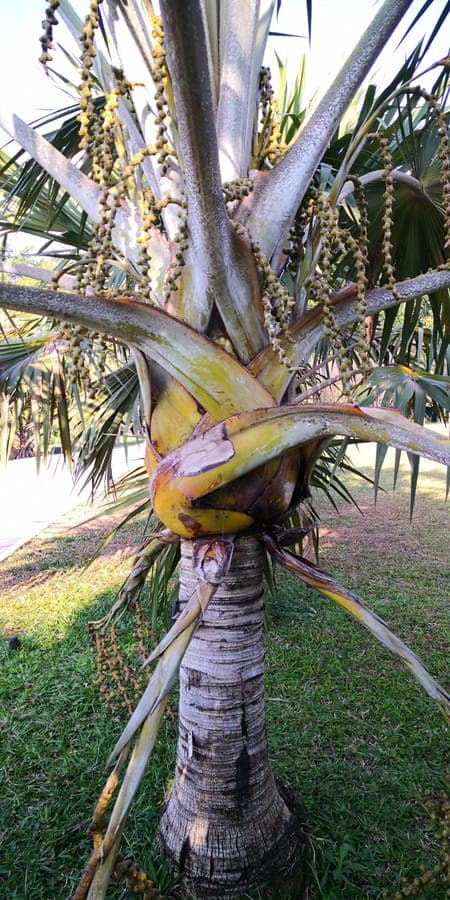
Yellow Latan has the same characteristic structure as other Latania species: a solid, formed trunk with distinct leaf scars. The most striking feature is the large fan-shaped leaves with unique yellow-green coloration.
The leaves shimmer in sunlight with golden and green tones, creating a remarkable effect. The palm grows gracefully with natural symmetry. Flowers are small and yellow, like other Latania species, followed by yellow to orange fruits.
Due to its rarity and unique color, this palm is truly a statement plant that commands attention.
Ideal Location
Yellow Latan thrives in full sun with at least 6-8 hours of direct sunlight daily. A south or southwest-facing exposure is highly recommended to maintain the beautiful yellow color in the leaves.
Position the palm in a sheltered location where strong winds cannot damage it, as large fan leaves can be fragile. Young plants may tolerate some light shade in their first year, but mature specimens perform better in full sun.
Ensure adequate space around the palm for air circulation and clear sightlines.
Soil
Latania verschaffeltii has the same soil requirements as other Latania species: well-draining sandy to sandy-loam soils. A pH between 6.0 and 7.5 is ideal. Excellent drainage is absolute requirement for this plant's wellbeing.
Ensure adequate organic matter by mixing compost and palm substrate. For pot culture, use equal parts garden soil, coco-peat, and perlite. The palm is fairly tolerant of various soil types as long as drainage remains optimal.
Watering
Yellow Latan has moderate water requirements. During the growing season (spring through fall), water regularly but allow soil to dry slightly between waterings. Avoid water stagnation and excessive moisture.
In winter, water considerably less. Always check soil moisture before watering - if the top 2-3 centimeters are dry, water again.
In dry environments, regularly mist the foliage in morning, as palms enjoy humid climates.
Free design
Want to see Latania verschaffeltii: complete guide in your garden? Make a free design now.
Pruning
Minimal pruning is needed for this palm. Remove only dead or severely damaged leaves by cutting them where they join the stem. Avoid pruning healthy green leaves.
Annual cleanup in spring helps remove dead leaves and debris. This also helps prevent diseases and pests.
Warning: Never prune the central growing tips of the palm, as this can be fatal.
Maintenance Calendar
Spring (March-May): Resume watering as temperatures rise. Begin monthly fertilization with balanced fertilizer. Remove dead leaves.
Summer (June-August): Maintain constantly moist soil without waterlogging. Fertilize weekly or bi-weekly. Monitor for insects.
Fall (September-November): Gradually reduce watering. Fertilize bi-weekly. Prepare for dormant season.
Winter (December-February): Minimal watering - let soil dry well. No fertilization. No pruning except dead material.
Winter Hardiness
Yellow Latan is cold-sensitive and tolerates temperatures below 10-15 degrees Celsius poorly. In Mediterranean and subtropical zones, they can grow outdoors with protection. In cooler climates, indoor cultivation in greenhouse or conservatory is essential.
Prefer winter temperatures of 12-18 degrees Celsius. Avoid sudden temperature fluctuations. Do not position near heating elements or air conditioning.
In mild zones, protection with mulch and cloths may help.
Companion Plants
Yellow Latan works beautifully with:
- Other Latania species for collection effect
- Hibiscus in pink or red tones
- Bougainvillea for color contrast
- Ornamental grasses at the base
- Evergreen shrubs for background
Ensure similar climate requirements. The yellow tint contrasts beautifully with deep green leaves of companions.
Closing
Latania verschaffeltii is a true rarity and a treasure for serious plant collectors. With its unique yellow-green colored fan leaves, this palm brings tropical luxury to any garden. Due to rarity, finding this specimen may be challenging, but it is certainly worth the effort.
With proper care and attention to right growing conditions, you will enjoy years of this remarkable palm. Search for this special palm at specialized nurseries or contact gardenworld.app.
Want to see Latania verschaffeltii: complete guide in your garden? Make a free design now.
Upload a photo, pick a style, and get a photorealistic design with plant list in under a minute.
No credit card required


Similar plants
Needle palm: complete guide
Rhapidophyllum hystrix
Everything about the needle palm: the world's hardiest palm, suitable for gardens in temperate climates down to USDA zone 7b.
Saw palmetto: complete guide
Serenoa repens
A complete guide to saw palmetto (Serenoa repens), the iconic fan palm from Florida and the southeastern United States, prized for its toughness.
Puerto Rican hat palm: complete guide
Sabal causiarum
Grow Puerto Rican hat palm successfully. A majestic fan palm with tropical presence suited to sheltered Mediterranean-style gardens.