
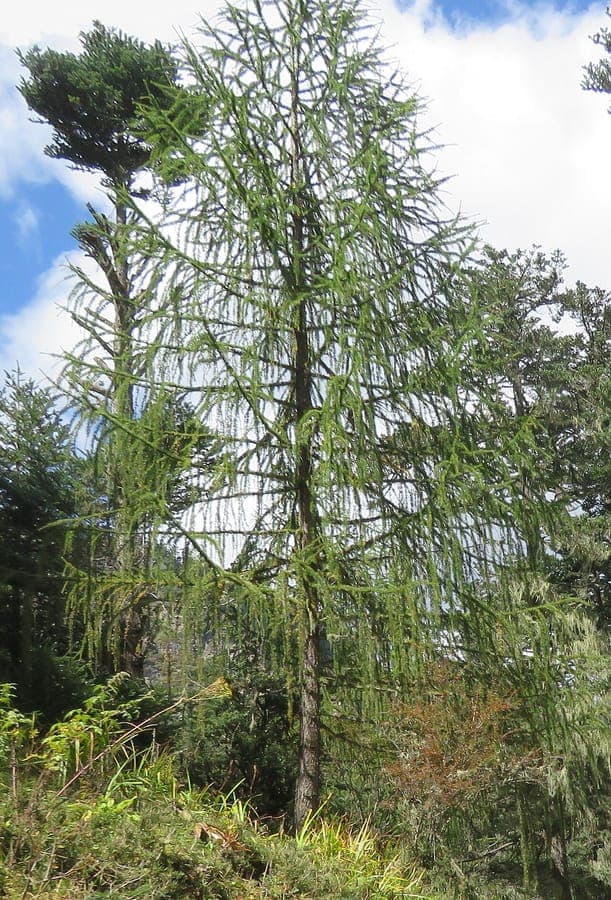
Original: Vinayaraj; this edit: MPF / CC BY-SA 4.0, via Wikimedia Commons
Himalayan Larch (Larix griffithii): complete guide
Larix griffithii
Want to see Himalayan Larch (Larix griffithii): complete guide in your garden?
1 minute, no credit card
Overview
The Himalayan Larch (Larix griffithii), also known as Sikkim Larch, is an elegant conifer from the eastern Himalayas. This tree grows in high mountain areas from eastern Nepal to northwestern China, at elevations between 2000-4000 meters. The tree belongs to the Pinaceae family (conifers) and distinguishes itself by a unique characteristic: it is deciduous, unlike many other conifers.
Himalayan Larch is a slow-growing tree perfectly adapted to cold, snowy mountain climates. With its characteristic needles, elegant form and brilliant autumn colors, it is an excellent choice for large gardens in cold regions.
Appearance and Growth
The Himalayan Larch is a slender, conical tree with a strict upright growth pattern. The tree can reach 15-25 meters tall but grows very slowly, usually only 10-15 cm per year. The bark is smooth and gray with a characteristic mottled pattern.
The needles are very fine and soft, approximately 2-3 cm long, and grow in clusters. In spring they are bright green, in summer darker green, and in autumn (August-October) they turn a beautiful golden-yellow before falling. This makes it a unique deciduous conifer with seasonal variation.
The cones are small, approximately 3-4 cm long, and have an elegant shape. They appear after several years of growth.
Ideal Location
Himalayan Larch grows best in sunny to partially shaded locations. Plant the tree where it receives at least 4-6 hours of direct sunlight daily. The tree tolerates partial shade better than many other conifers.
Critically important is that the tree grows in a cool climate. It does not thrive in warm, humid conditions. In temperate climates with cold winters it is ideal. In very warm regions it will likely perform poorly.
Soil
Himalayan Larch prefers well-draining, acidic soil. Plant it in acidic to neutral soil mixed with some sand for drainage. A pH of 5.5-6.5 is ideal. The tree tolerates poor soils, as it grows in mountain terrain naturally.
The tree can grow in containers but prefers soil in large gardens.
Watering
Once established, Himalayan Larch is fairly drought-tolerant in cold climates. Water regularly in the first growing season so the tree becomes well-established. After establishment you can drastically reduce watering.
In warm seasons the tree accepts moister soil, but waterlogging must be prevented. Good drainage is essential.
Free design
Want to see Himalayan Larch (Larix griffithii): complete guide in your garden? Make a free design now.
Pruning
Pruning is not much needed for Himalayan Larch. The tree grows naturally elegant and ornamental. Remove only dead, diseased or damaged branches. Pruning healthy branches is unnecessary and can damage the tree's beauty.
The tree can be lightly pruned in young years to train its form.
Maintenance Calendar
Spring (March-May): Growth begins. Water regularly as young trees become established. No feeding needed. Check for damage.
Summer (June-August): Minimal watering in normal rainfall areas. Enjoy the green needles. No feeding. Monitor for diseases or pests.
Autumn (September-November): Enjoy the golden autumn color. Standard watering. Needles fall off - this is normal and beautiful.
Winter (December-February): Minimal watering. No feeding. Protect from heavy snow load by carefully removing large snow masses.
Winter Hardiness
Himalayan Larch is extremely hardy to -40 degrees Celsius (zones 3-4). In fact it grows better in cold climates than warm zones. The tree is adapted to extreme mountain winters and heavy snowfall.
The tree is not suitable for warm climates (zones 8-9 and higher). In temperate zones (6-7) it can grow but will not perform optimally.
Plant Characteristics
Himalayan Larch is unique among conifers because it sheds its needles in autumn (deciduous). This gives spectacular golden colors before everything falls. This process is called 'needle drop' and is completely normal and healthy.
The tree does not attract many animals as a food source, making it suitable for areas where browse pressure is high.
Closing
Himalayan Larch is an excellent choice for large gardens in very cold climates. With its elegant form, fine needles and beautiful seasonal changes, it provides year-round interest. The tree is not suitable for warm or temperate climates, but for those in cold zones it is a true jewel.
If you are seeking an exotic conifer for cold mountain gardens, Himalayan Larch is an excellent choice. Find it through specialized tree nurseries. With gardenworld.app you can design the perfect spot for your conifers. With gardenworld.app you effortlessly create an alpine garden style.
Want to see Himalayan Larch (Larix griffithii): complete guide in your garden? Make a free design now.
Upload a photo, pick a style, and get a photorealistic design with plant list in under a minute.
No credit card required


Similar plants
Abies delavayi: complete guide
Abies delavayi
Delavayi fir is an elegant, medium-sized coniferous tree from the Pinaceae family with dark green needles. This Asian evergreen is perfect for alpine gardens and large landscapes.
Taiwan fir: complete guide
Abies kawakamii
Discover the magnificent Taiwan fir, a rare evergreen conifer from Taiwan's mountain regions. Learn growth requirements, care tips, and why this beautiful tree is perfect for collectors of unique garden specimens.
Farges fir: complete guide
Abies fargesii
Discover the majestic Farges fir, an impressive conifer from China's mountains with elegant foliage and columnar form. Ideal for large gardens.