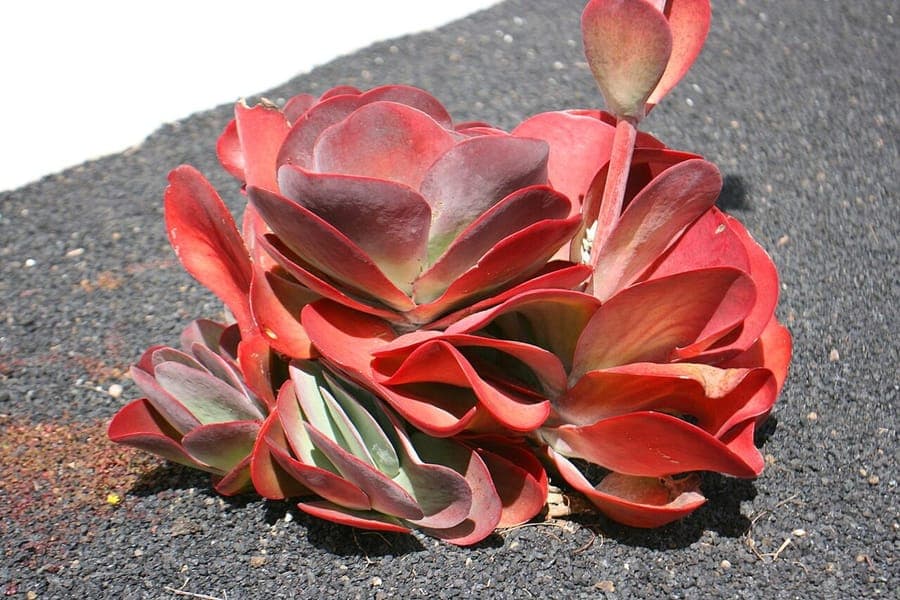
Frank Vincentz / CC BY-SA 3.0, via Wikimedia Commons
Paddle plant (Kalanchoe luciae): care guide
Kalanchoe luciae
Want to see Paddle plant (Kalanchoe luciae): care guide in your garden?
Full design in HD: €7.99
Look after your Paddle plant with the GardenWorld app
Identify plants with your camera and get a care calendar with reminders for this plant.


Overview
Kalanchoe luciae is a succulent that stops people in their tracks. Large, rounded, paddle-shaped leaves grow in tight pairs around a short stem, building up a chunky rosette. In shade they are blue-green under a white powdery coating, but in full sun the edges, and often the whole leaf, turn a warm wine red. Its common names, paddle plant and flapjacks, describe those broad, flat leaves stacked like pancakes.
The plant is native to southern Africa: north-eastern South Africa, Eswatini, Mozambique and Zimbabwe, where it grows on rocky slopes and ledges. It belongs to the stonecrop family, Crassulaceae. In the trade it is often confused with its close relative Kalanchoe thyrsiflora, and the difference only becomes obvious when they flower. Kalanchoe luciae has white, unscented flowers, while Kalanchoe thyrsiflora has yellow, fragrant ones. Many plants sold as thyrsiflora are in fact luciae.
The photo shows the plant at its most striking: in full sun on black volcanic gravel, with leaves flushed almost entirely red. On an ordinary indoor windowsill it will stay greener, but it remains a bold presence either way.
Appearance and flowering
A mature rosette reaches 30 to 60 cm across and roughly the same in height. The leaves grow up to about 15 cm long, thick and fleshy with a rounded tip, and carry a fine white bloom that protects them from intense light. The red colouring is a stress response to strong sun, cool nights and a degree of dryness. It is not a sign of illness but natural sun protection. If the plant turns green again, it is getting less light.
The single most important thing to know is that Kalanchoe luciae is monocarpic. Each rosette flowers once and then dies. Flowering usually takes several years to arrive and tends to happen in late winter or spring. A thick, white-powdered flower stem, often half a metre tall or more, rises from the centre of the rosette, carrying dense clusters of small, whitish tubular flowers. The rosette pours all its reserves into this display, and afterwards the leaves shrivel.
Fortunately the plant produces offsets around its base at about the same time, and sometimes small plantlets on the flower stem too, so it lives on. Cutting off the flower stem early can occasionally slow the decline of the rosette, but by then the process is usually under way.
Position and light
The paddle plant wants sun. Indoors, give it your sunniest windowsill, ideally south-facing. The more direct light it receives, the more compact the rosette and the richer the colour. In too dark a spot the stem stretches, the leaf pairs space out and the plant leans towards the glass, so turn the pot a quarter turn every few weeks.
From late May to late September it is happy outdoors on a patio, balcony or in a gravel garden, in its pot. That is where it colours best. Give it a week in light shade first, because plants coming from indoors scorch easily in midsummer sun. Position the pot so that it does not sit in the rain for days on end: heavy, wet compost quickly rots the roots.
Compost and repotting
Use a free-draining cactus and succulent compost, topped up with extra pumice or grit if you like. The rosette is fairly heavy, so a sturdy terracotta pot is a good choice: it is stable and dries out quickly. A drainage hole is essential.
Repot in spring every two to three years, or when roots appear through the drainage hole. Move up one pot size, keep the plant at the same depth as before and hold off watering for the first week. Feed once a month from April to August with a half-strength succulent fertiliser. Too much nitrogen makes the leaves large and soft and dulls the red colouring.
Free preview
Want to see Paddle plant (Kalanchoe luciae): care guide in your garden? Make a free preview of your design.
Watering and rest
Water only once the compost is completely dry, then water thoroughly. Let the pot drain and never leave it standing in a saucer of water. Aim at the compost rather than the heart of the rosette, because water trapped between the tightly packed leaves can cause rot. In summer that works out at roughly once every seven to ten days.
From November to February water much less. At a room temperature of 12 to 18 °C, a small drink every three weeks is enough. Overwatering in winter is the most common reason these plants rot. Limp, thin leaves mean the plant is thirsty; glassy leaves that are soft at the base mean it has had too much.
Propagation
The easiest way to propagate Kalanchoe luciae is from the offsets at its base. Cut away an offset at least 5 cm tall with a sharp knife, let the cut surface dry for a few days and pot it in dry succulent compost. Water for the first time a week later. Offsets that already have a few roots of their own establish fastest.
You can also re-root the head of a leggy plant: let the cut dry for a week before potting it. The remaining stump often sprouts new rosettes. Single leaves root far less reliably in this species than in many other succulents. Wear gloves when taking cuttings if you have sensitive skin, and wash your hands afterwards.
Toxicity
Like all kalanchoes, Kalanchoe luciae contains bufadienolides, compounds that act on the heart. That makes the plant toxic to cats and dogs. A few nibbles usually cause drooling, vomiting and diarrhoea, while larger amounts can lead to weakness and an abnormal heart rhythm. Livestock in southern Africa have been poisoned by related kalanchoes.
Keep the plant well out of reach of pets, especially cats that like to chew on greenery. If your animal has eaten some, contact your vet and give them the plant's name. The plant is not edible for people either, so keep it away from young children. Simply handling it during routine care is not a problem.
Maintenance calendar
March–April: Increase watering and start feeding gently. Repot and pot up offsets.
May–June: Move outdoors after the last frost, first into light shade and then into full sun.
July–August: Water when completely dry, half-strength feed once a month. The leaves colour most strongly now.
September–October: Stop feeding. Bring indoors before nights fall below 5 °C.
November–February: Cool and bright, little water. If a flower stem appears, it is often during this period.
On gardenworld.app you will find a planting calendar that sets out jobs like these month by month and reminds you when they are due.
Winter hardiness
Kalanchoe luciae is not hardy. Temperatures below 5 °C already cause damage and frost is fatal, so in Britain and north-west Europe it is a pot plant that lives indoors from October to May. A bright, cool room or a heated conservatory at 10 to 15 °C is ideal. It will also survive in a warm sitting room, but then it needs as much light as possible to avoid stretching.
Companion plants
In summer, group Kalanchoe luciae with other sun-loving container plants on the patio. Aeonium arboreum with its rosettes on stalks and Echeveria agavoides with pointed, red-rimmed leaves suit the mood perfectly. Aloe vera and Agave attenuata bring a different leaf shape and more height, and a jade plant, Crassula ovata, gives a green, shrubby backdrop. A top dressing of black or grey grit on the pots makes the red glow even more, just as in the photo.
If you want a permanent spot in the garden for your summer pots, with the right sun and a dry base, you can have a garden design made on gardenworld.app.
Final thoughts
Kalanchoe luciae is a succulent with real character: broad paddle leaves, a colour that shifts with the sun and a single flowering that ends one rosette while launching the next generation. Give it sun, dry roots and a frost-free winter, keep it away from pets and always hold on to a few offsets. Do that, and this red showpiece will reward you for years.
Frequently asked questions about Paddle plant
Is Paddle plant winter hardy?
Kalanchoe luciae is not hardy. Temperatures below 5 °C already cause damage and frost is fatal, so in Britain and north-west Europe it is a pot plant that lives indoors from October to May.
How much water does Paddle plant need?
Water only once the compost is completely dry, then water thoroughly. Let the pot drain and never leave it standing in a saucer of water.

See it in your garden
See Paddle plant in your garden
One photo of your garden and a few questions. You see the result in about a minute.
Try it with a photoIdentify this plant in your own garden. Identify a plant
Similar plants
Aeonium arboreum: complete guide
Aeonium arboreum
Learn all about tree aeonium. Cultivation advice for successful growing, maintenance tips and suitable for pots and dry borders. Subtropical accent.
Echeveria agavoides: complete guide
Echeveria agavoides
Molded-wax is an elegant succulent with pointed leaves arranged in tight rosettes. Learn about care, propagation, and creating beautiful groupings. Ideaal vo...
Aloe vera: complete guide
Aloe vera
Master aloe vera cultivation. Growing guide for placement, watering, and harvesting the precious medicinal gel.
