
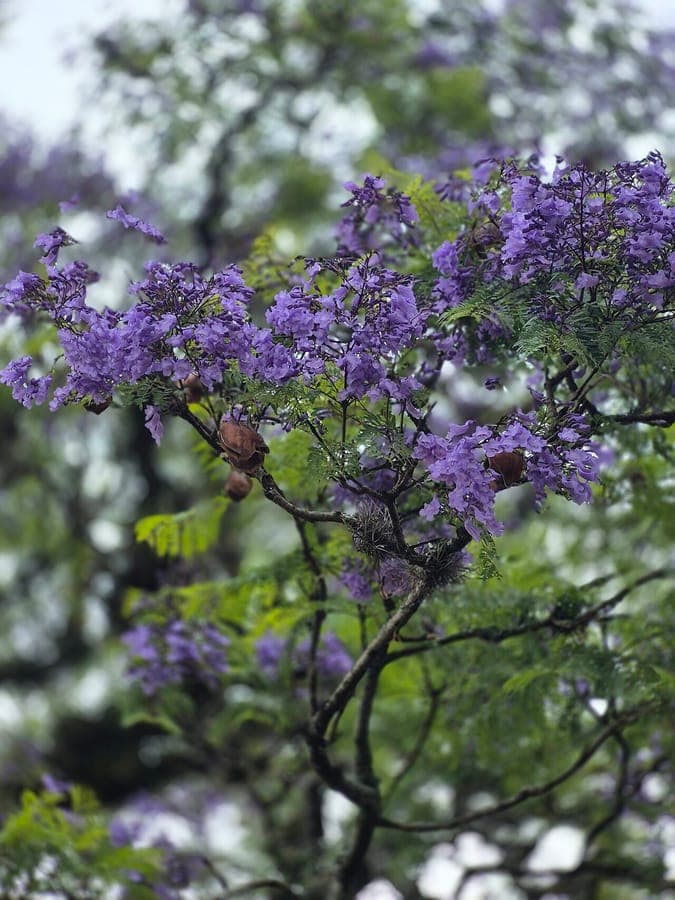
O Tupinólogo / CC BY 4.0, via Wikimedia Commons
Jacaranda mimosifolia: complete guide
Jacaranda mimosifolia
Want to see Jacaranda mimosifolia: complete guide in your garden?
1 minute, no credit card
Jacaranda mimosifolia, commonly known as Black Poui, Jacaranda, Fern-tree, or Green Ebony, is an impressive deciduous tree with tropical character and stunning blue-purple flowers. Originating from Bolivia, northwestern Argentina, and Paraguay in South America, this species belongs to the family Bignoniaceae and is a beloved ornamental throughout warm and temperate climates worldwide. The tree reaches significant proportions and provides spectacular flowering displays for decades.
Appearance and Bloom
Jacaranda mimosifolia grows into a handsome tree reaching 10 to 15 metres in height (often smaller in cultivation, 8-12 m), with a broad, spreading crown that casts substantial shade. The leaves are finely dissected, fern-like in appearance, and arranged alternately along the branches. Foliage colours from bright green in summer to golden yellow in autumn before dropping completely.
The primary attraction is undoubtedly the flowers. In May through June, depending on climate zone, established trees produce massive clusters of trumpet-shaped flowers in deep blue-violet to purple shades. Each flower measures approximately 5 centimetres in length and hangs in dense, architectural panicles. Blooms literally cover the tree's crown, creating a spectacular visual display. After flowering concludes, flat, disc-shaped seedpods develop, approximately 5 to 8 centimetres in diameter.
Young tree bark is smooth and brownish-grey; older specimens develop a rougher, flaking appearance.
Ideal Location
Jacaranda mimosifolia requires full sun for optimal growth and flowering. Position the tree where it receives minimum 8 hours direct sunlight daily. In partial or full shade, growth is poor, flowering diminishes, and form becomes unhealthy.
The tree requires space: allow sufficient distance from buildings, underground utilities, and neighbouring trees. The crown spreads widely (8-12 metres at maturity) and the root system is robust, sometimes shallow. Plant minimum 5 metres from houses and utilities.
Climate is critical. Jacaranda thrives in USDA zones 9 to 11 (minimum winter temperature -7°C to +4°C). In northern Europe, outdoor cultivation is impossible without protection; container cultivation with winter protection indoors is the only option. In Mediterranean regions (Spain, Italy, Greece) and around the Mediterranean coast, outdoor growth flourishes.
Soil Requirements
Jacaranda mimosifolia grows in virtually all soils but prefers well-drained, slightly acidic soil with pH 5.5 to 7.0. The tree is adaptable and even grows in leaner soils if drainage is adequate. Preventing waterlogging is important, particularly during active growing seasons.
When planting, amend heavy clay soil with coarse sand, compost, and perlite. The tree tolerates saltier soil and thus also grows near coastlines.
Watering Practices
Once established, Jacaranda mimosifolia is quite drought-tolerant and requires moderate, regular watering during the growing season (May to October). In warm months, water when the top 5 centimetres of soil feels dry. Avoid keeping soil constantly wet.
In winter, when the tree sheds leaves and enters dormancy, drastically reduce watering. Water only sporadically if soil becomes extremely dry. Excess water in winter causes root rot.
In containers, watering frequency may increase slightly, but always ensure excellent drainage.
Free design
Want to see Jacaranda mimosifolia: complete guide in your garden? Make a free design now.
Pruning and Maintenance
Jacaranda mimosifolia requires minimal routine pruning. Remove dead wood, crossing branches, and fallen leaf debris. Light pruning after flowering (June) maintains form, but aggressive pruning reduces flowering in subsequent years.
Young trees may need training if spreading too wide; ensure early shaping at the base for a straight trunk. Remove lower side branches to achieve a clear crown-on-stem form.
The plant produces numerous self-sown seedlings from its seeds; remove these promptly to prevent unwanted volunteers.
Maintenance Calendar
May-June: Flowering period. Enjoy the blooms. No additional care needed.
July-October: Active growth. Regular watering. Feeding every 4 weeks (10-10-10 NPK or similar).
November: Significantly reduce watering as leaf-drop occurs.
December-April: Winter/dormancy period. Minimal water. No feeding. In warm climates, growth continues; in cooler regions, dormancy predominates.
Winter Hardiness
Jacaranda mimosifolia is NOT frost-hardy in temperate climates and will lose leaves and twigs at temperatures below 0°C. In USDA zones below 9 (winter temperatures below -7°C), treat as a container plant and move indoors for winter.
In warm climates (USDA zones 9b to 11), outdoor cultivation is possible, though protection from harsh winter winds is beneficial.
In pots, the tree can be moved indoors to a greenhouse, conservatory, or cool bright room during winter with minimal watering.
Companion Plants
In warm gardens, Jacaranda mimosifolia pairs beautifully with other South American and tropical specimens. Ideal companions include acacias, other flowering trees (Lagerstroemia, Callistemon), Mediterranean shrubs, and dark-foliaged plants like Ficus for contrast.
Jacaranda's fine, delicate foliage creates lovely contrast with rounded leaf shapes of plants like magnolias. Ensure underplanting tolerates shade, as mature trees cast substantial shadow.
In Mediterranean gardens, a single Jacaranda mimosifolia serves as a focal point, deserving central placement in garden design. Many South European gardens feature it as a specimen tree with grass and light underplanting.
Propagation
Jacaranda mimosifolia grows from seed, though propagation takes time and seedlings may vary from the parent plant. Seeds require warmth and moisture for germination. Grafting is also possible but more complex.
Conclusion
Jacaranda mimosifolia is a magnificent tree for those gardening in suitable warm climates. Its spectacular blue-purple floral display each year is unmatched. Although frost-sensitive, it thrives in USDA zones 9 to 11 and deserves a central place in warm gardens. For cooler regions, container cultivation allows enjoyment of this South American treasure throughout the seasons.
Gardenworld.app helps you find the perfect location for Jacaranda mimosifolia in your warm garden. Questions? Visit gardenworld.app for more information.
Want to see Jacaranda mimosifolia: complete guide in your garden? Make a free design now.
Upload a photo, pick a style, and get a photorealistic design with plant list in under a minute.
No credit card required


Similar plants
Tabebuia pallida: complete guide
Tabebuia pallida
Full growing guide for Tabebuia pallida: location, soil, watering, pruning, hardiness and companion plants for this tropical trumpet tree.
Northern catalpa: complete guide
Catalpa speciosa
Everything about northern catalpa (Catalpa speciosa): bold white flowers, fast growth, and how to grow this striking tree in your garden.
Desert willow: complete guide to Chilopsis linearis
Chilopsis linearis
Complete growing guide for desert willow (Chilopsis linearis): sun, soil, flowering, pruning, and winter care for this spectacular flowering small tree.