
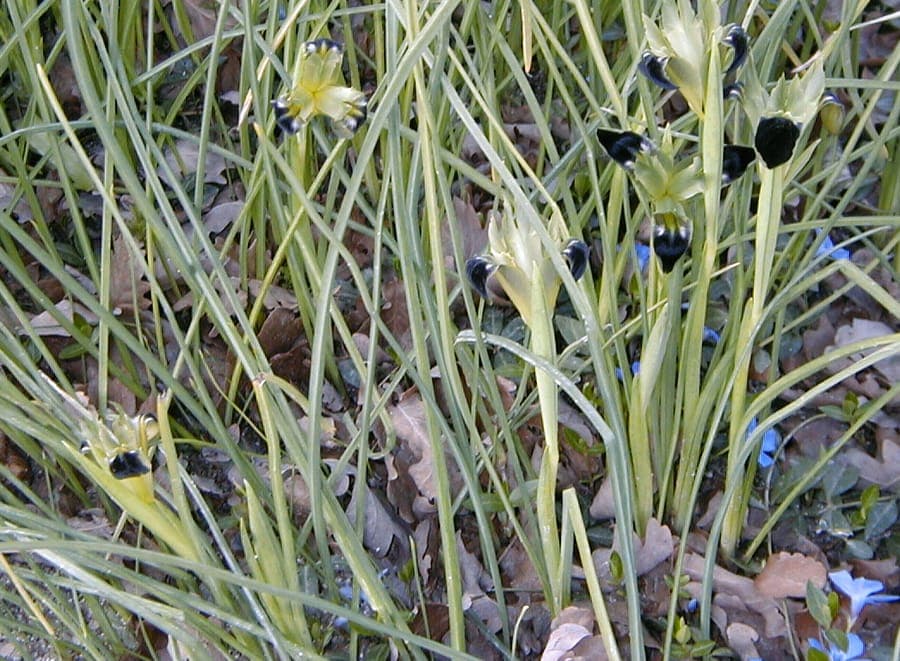
A. Barra / CC BY-SA 4.0, via Wikimedia Commons
Iris tuberosa: complete guide
Iris tuberosa
Want to see Iris tuberosa: complete guide in your garden?
1 minute, no credit card
Overview
Iris tuberosa (also known as Hermodactylus tuberosus) is a unique, rare iris from Southeast France to the Aegean Islands. This iris is renowned for its very dark brown to nearly black flowers with intriguing markings. The plant grows to approximately 40-50 centimeters tall and blooms very early in spring, from March to April. Iris tuberosa is an absolute classic for Mediterranean and South European gardens.
Appearance and bloom
Iris tuberosa is characterized by slender, fine leaves and very compact growth. The flowers are small to medium, approximately 4-6 centimeters in diameter, with striking brown coloration. The upper petals (standards) are greenish-brown, while the lower ones (falls) are much darker to nearly black. The flower appears very exotic and mysterious, which is the major difference from other iris species. Blooming occurs very early: February to April, often before many other plants are actively growing.
Ideal location
Iris tuberosa grows best in full sun, requiring at least 6-8 hours of direct sunlight daily. The plant is hardy to -10 degrees Celsius, making it suitable for mild climates and southern regions. In northern areas, winter protection is advisable. Plant in locations where plenty of warmth is available. A spot against a south-facing wall or on a terrace is ideal.
Soil
Iris tuberosa requires very well-draining soil with a pH between 6.5 and 7.5. The plant grows best in poor soils (not too much nutrition). For optimal growth, mix garden soil with sand and gravel in a 1:1:1 ratio. Rot is a major hazard here; ensure perfect drainage. Planting depth is important: plant the tubers approximately 10-15 centimeters deep.
Free design
Want to see Iris tuberosa: complete guide in your garden? Make a free design now.
Watering
Water Iris tuberosa moderately, especially during the growing season. The plant tolerates drought well after establishment. Water once weekly during the growing season, provided there is no rain. After blooming (May), severely reduce watering; the plant then enters dormancy. During the rest period (May-October), water minimally.
Pruning
Pruning is minimal: remove only spent flowers after blooming. After blooming (April-May), foliage can be carefully trimmed, but keep foliage on the plant as long as possible because it transports energy back to the tubers. Remove foliage only when it is completely yellow.
Maintenance calendar
January to February: plant begins to grow. February to April: blooming, water regularly. May to October: plant rests, minimize water. September to October: prepare plants for next season. November to December: check drainage. January: winter rest ends.
Winter hardiness
Iris tuberosa is sensitive to heavy frost and is best considered sensitive to temperatures below -10 degrees Celsius. In very cold winters, protection may be needed, for example with a layer of dead leaves or branches. In southern regions, the plant can remain outside; in central areas, it grows best in pots that can be brought indoors in winter.
Companion plants
Plant Iris tuberosa with other early spring bloomers:
- Crocus (crocus)
- Muscari (grape hyacinth)
- Thymus (thyme)
- Dianthus (carnation)
This plant combination provides early spring blooming.
Closing
Iris tuberosa is a very rare and spectacular iris that attracts much attention. The plant is not difficult, but requires patience and good drainage. With care, Iris tuberosa will provide beautiful flowers for many years. Specialized nurseries or online sources carry tubers for planting.
At gardenworld.app, you can have professional front yard designs created that optimally integrate Iris tuberosa into your garden with other spring bloomers.
Want to see Iris tuberosa: complete guide in your garden? Make a free design now.
Upload a photo, pick a style, and get a photorealistic design with plant list in under a minute.
No credit card required


Similar plants
Iris pallida: complete guide
Iris pallida
Discover the soft purple Iris pallida, a classic front yard iris with fragrant rhizomes and reliable annual blooms. Perfect for sunny locations.
Iris sibirica: complete guide
Iris sibirica
Discover elegant Iris sibirica with fine blue flowers. Perfect for moist soils, 60-80cm tall. Excellent in groups and as a cut flower.
Iris spuria: complete guide
Iris spuria
Discover Iris spuria with stunning blue flowers and slender growth. Suitable for full sun locations, 80-120cm tall. Strong growth and long blooming.