
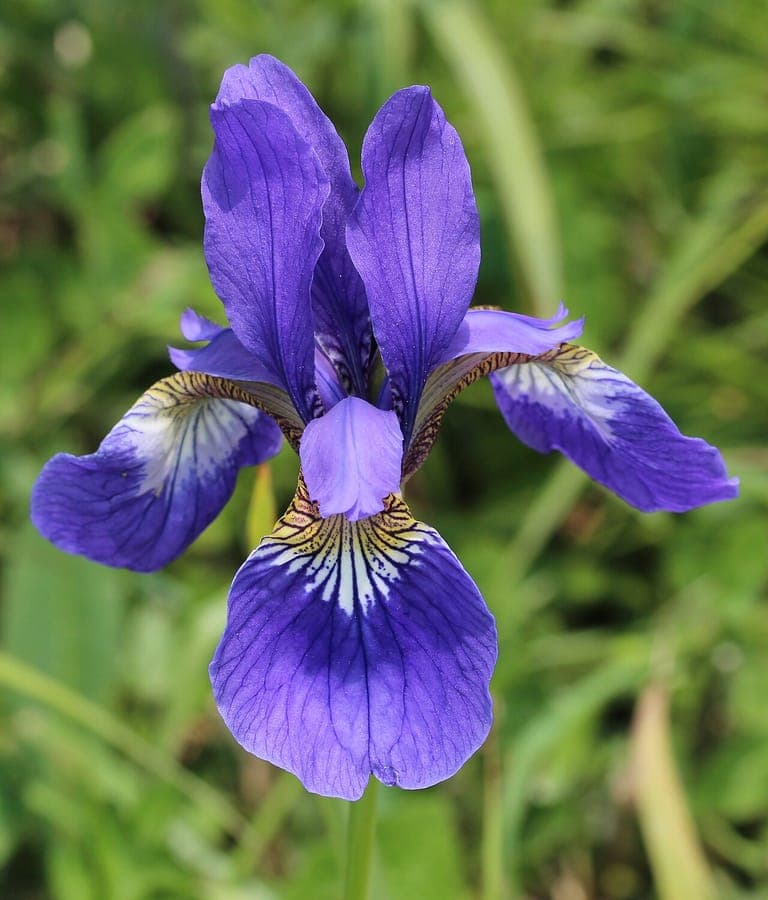
Alpsdake / CC BY-SA 3.0, via Wikimedia Commons
Iris sanguinea: complete guide to bloodred iris
Iris sanguinea
Want to see Iris sanguinea: complete guide to bloodred iris in your garden?
1 minute, no credit card
Overview
Iris sanguinea, commonly known as bloodred iris or blood iris, is an elegant heart-shaped iris from southern Siberia to Japan. This refined perennial is celebrated for its deep red to purple flowers, narrow graceful leaves, and compact growth habit.
Bloodred iris grows to approximately 50-60 cm in height and blooms from May to June. It is moisture-loving but tolerates normal garden soil. Perfect for borders, waterside plantings, and damp zones in the garden.
Appearance & Bloom
The leaves of Iris sanguinea are narrow and upright, growing in compact clumps. They are gracefully green. The stems are stiff and slender.
The flowers are the true attraction: deep red to purple, small to medium-sized (approximately 5-7 cm), without beards. The characteristic deep red hue gives the plant its name. Blooming occurs in May and June. The flowers are fragrant and attract pollinators.
Ideal Location
Iris sanguinea grows best in full sun to partial shade. A minimum of 4-6 hours of sunlight daily is needed. Plant in moisture-rich soils, pond banks, or normal garden soil.
Although the plant loves moisture, it tolerates normal, well-draining soil as long as it does not completely dry out. Protect from strong, dry winds.
Soil
Iris sanguinea prefers acidic to neutral, moisture-rich soil. Add organic material for better moisture retention. The plant also grows in normal garden soil as long as it does not dry out.
A pH of 6 to 7 is ideal. Avoid very heavy clay soils without drainage.
Free design
Want to see Iris sanguinea: complete guide to bloodred iris in your garden? Make a free design now.
Watering
Thorough watering during growth and blooming. Keep soil moist but not waterlogged. In dry weather, water regularly. Mulch helps maintain moisture levels.
Once established, the plant tolerates normal rainfall and supplemental water is only needed during dry periods.
Pruning
Remove faded flowers and stems after blooming. Cut back dead foliage in spring. Divide clumps every three to four years for vigor.
Minimal shape pruning is needed.
Maintenance Calendar
March to May: Growth starts. Water regularly. Divide if needed. Blooming begins in May.
June: Full bloom. Apply water as needed.
July to October: Blooming fades. Remove dead stems. Winter preparation.
November to February: Dormancy. Minimal water, only if very dry.
Winter Hardiness
Iris sanguinea is hardy to USDA zone 3 (-40 degrees C). In northern climates, it thrives outdoors without protection.
Companion Plants
Iris sanguinea pairs beautifully with:
- Hosta species for foliage contrast
- Astilbe for feathery blooms
- Filipendula for summer interest
- Heuchera for leaf variation
- Liriope for fall structure
Closing
Bloodred iris is an elegant, hardy Siberian iris that brings refinement to borders, waterside plantings, and damp zones. With its deep red flowers and graceful structure, it creates a poetic garden mood.
Design your dream garden with Iris sanguinea using gardenworld.app. Visualize how this elegant plant transforms your garden plan.
Available at major garden centers. Create your dream garden today on gardenworld.app.
Want to see Iris sanguinea: complete guide to bloodred iris in your garden? Make a free design now.
Upload a photo, pick a style, and get a photorealistic design with plant list in under a minute.
No credit card required


Similar plants
Iris tingitana: complete guide
Iris tingitana
Iris tingitana, the Morocco iris, is the bulb species behind the Dutch iris: early blue-violet blooms that need a sunny, well-drained position.
Iris hookeri: complete guide
Iris hookeri
Hooker's Iris is a compact North American native plant with blue flowers. Low-growing and moisture-loving water plant.
Siskiyou iris: complete guide
Iris bracteata
Complete guide to Iris bracteata, the Siskiyou iris: location, soil, bloom cycle, watering, pruning and companion plants for this rare Pacific Coast iris.