
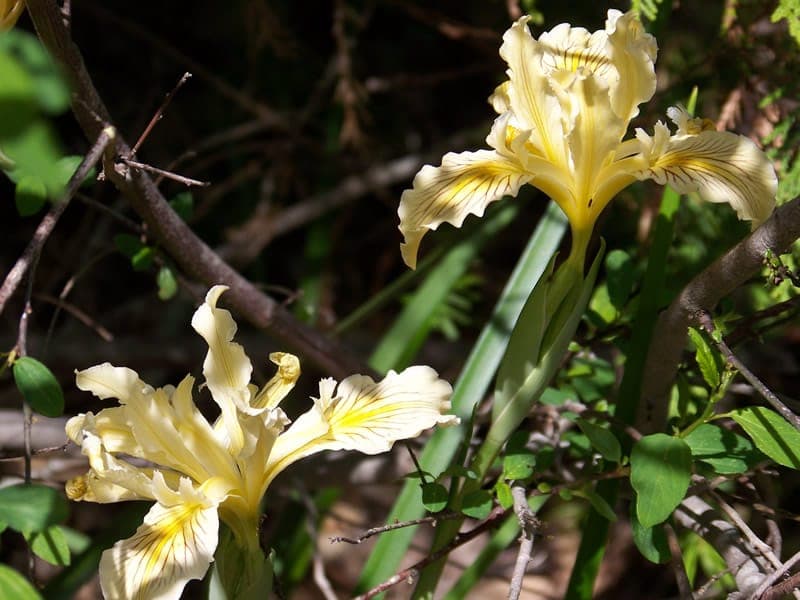
John McRae / Public domain, via Wikimedia Commons
Siskiyou iris: complete guide
Iris bracteata
Want to see Siskiyou iris: complete guide in your garden?
1 minute, no credit card
Overview
Iris bracteata, the Siskiyou iris, is a rare and botanically distinctive iris from the Pacific Coast iris group - an informal assemblage of iris species endemic to the western coast of North America. The species was formally described in 1885 by the American-British botanist Sereno Watson and is native to a restricted range spanning southern Oregon to northern California, centred on the Siskiyou Mountains, the rugged borderland between the two states.
The species belongs to the subfamily Iridoideae of the family Iridaceae and is also recorded under the synonym Iris tenax subsp. bracteata. Its most distinctive feature is the prominent bracts (bracteoles) that enclose the flower stems - hence the botanical name. The yellow flowers are a striking characteristic of this species: while many of its Pacific Coast iris relatives bloom in purple, blue, or white, Iris bracteata carries bright yellow flowers with darker veining on the falls.
In the horticultural world, the Siskiyou iris is a genuine collector's plant. Specialist perennial growers and iris enthusiasts value it for its unusual colour, elegant habit, and remarkable ecological backstory. At gardenworld.app you can have a garden design created that gives the right conditions to special iris species like this one in a dry, sunny border or rock garden setting.
Appearance & bloom cycle
Iris bracteata is a compact, grass-like perennial with the characteristic iris growth form. The leaves are narrow, sword- to strap-shaped, dark green, and glossy, reaching 20 to 40 cm in length. The foliage is semi-evergreen: in mild winters the leaves remain green; in colder conditions they may die back partly or fully. New leaf growth appears early in spring.
The flowers are bright yellow, sometimes with fine brown or purplish veins on the falls (the downward-curving petals). Each flower is 5 to 8 cm in diameter. Bloom time falls in late spring, typically May to June in western European gardens - slightly later than common bearded irises. Each stem carries one to two flowers above the distinctive bracts that give the species its name.
After flowering, the plant sets small, three-lobed seed capsules with brown seeds. These have some ornamental interest in autumn, and the plant can self-seed modestly if capsules are left in place. Growth is in compact clumps, spreading slowly via short rhizomes without aggressive expansion.
The foliage carries a yellow-green tint in botanical records, which accounts for a slightly warm golden cast that the leaves can show in autumn or in lower light conditions. Fruit colour at maturity is brown.
Ideal location
Iris bracteata grows in its native Siskiyou Mountains habitat in open, somewhat sheltered positions at the edge of pine forests, on soils derived from weathered serpentine or granite rock. This tells us two crucial things about its garden requirements: it wants light and a freely draining, lean soil.
The plant performs best in full sun to light shade. In the western European garden, choose a south- or southwest-facing position. Deep shade severely reduces flowering and increases vulnerability to disease. The plant tolerates a degree of dappled shade - the filtered light beneath a sparse, open-canopied tree - but never performs as well as in full sun.
Crucially, Iris bracteata does not tolerate summer waterlogging. In its native habitat, summers are warm and dry - the characteristic climate of the Siskiyou region - while autumn and winter bring more rainfall. Replicating this seasonal rhythm is the key to success in the garden: careful drainage in summer, and protection from excessive cold winter rain on exposed or poorly drained sites.
A raised bed, a rock garden, or a slope with excellent drainage are all ideal placements for Iris bracteata in the European garden. The specialists at gardenworld.app can design your front garden or border to give special plants like this one the conditions they need to thrive.
Soil requirements
Iris bracteata has specific soil requirements that differ somewhat from most common garden irises. The plant prefers a mineral, freely draining soil with a pH of 6.0 to 8.0. It is accustomed to relatively poor, stony soils and performs poorly on rich, moisture-retentive garden ground.
The ideal soil for Iris bracteata in the garden consists of a mix of existing garden soil with a generous proportion of coarse grit, perlite, or crushed stone. Blended soils of 50 percent garden soil and 50 percent volcanic grit or equivalent drainage material give the best results. Avoid adding large amounts of compost or well-rotted manure: high fertility promotes lush leaf growth at the expense of flowering and raises the risk of rhizome rot.
The plant is specifically adapted to the soils of the Siskiyou area, which often carry high concentrations of serpentine minerals. This gives the plant a certain tolerance for soils that are suboptimal for other plants. Restraint with fertilising in regular garden soil is therefore the right approach.
When planting in a pot, use a lean, sharply draining potting mix - ideally a specialist iris or alpine mix available from specialist garden centres.
Watering
Water management for Iris bracteata differs fundamentally from that of most other garden perennials and is the greatest challenge when growing it in northwest Europe. The plant is adapted to dry summers and wetter, cooler winters - a Mediterranean-type seasonal pattern that is not standard in our climate.
During the active growth and flowering period in spring (March to June), water moderately when the soil becomes dry. The plant must never stand in stagnant water. After flowering - from June to September - restraint with watering is the key: the plant has a summer rest period and is most vulnerable to root rot from excess moisture at this time.
Autumn and winter are the period of renewed growth and charging up for the following season: moderate rainfall is then welcome. In regions with heavy winter rain or on poorly drained soils, protection against excessive moisture is needed: a pane of glass, a cold frame, or a large overhanging ledge can protect the plant from rhizome rot.
In dry summers - which are actually ideal conditions for this plant in the western European garden - supplementary watering is only occasionally necessary. An established plant survives several weeks without rainfall without difficulty.
Free design
Want to see Siskiyou iris: complete guide in your garden? Make a free design now.
Pruning
Iris bracteata needs little maintenance pruning. After flowering in June, remove the spent flower stems at the base. This prevents the plant investing energy in seed production if you do not want it; that said, the seed capsules do have ornamental value and allowing the plant to self-seed can be worthwhile in suitable conditions.
In early spring, before new leaf growth begins, remove any damaged, yellowed, or desiccated outer leaves. The same applies in autumn, when older leaves die back. Cut the leaves back to about 10 cm above the ground or remove them entirely if dead.
On sheltered, mild sites the leaves may remain green through winter. In that case, simply leave them in place. Avoid unnecessarily deep cutting into the rhizomes: the iris growth points sit just at the soil surface and are vulnerable to infection if damaged.
Every three to four years you can divide the clump to rejuvenate it. Do this just after flowering in early summer. Use clean secateurs to cut the rhizomes, replant the sections immediately, and ensure good drainage at the new planting site.
Maintenance calendar
January-February: Plant partly green or dormant. On freely draining soil there is little risk. Protect on wet soils in severe frost. No maintenance needed.
March: New leaf growth begins. Remove any winter-damaged leaves. Check that drainage at the site is still adequate.
April-May: Flowering approaches. The plant looks its best with rising leaves and flower buds. No fertilising needed. Moderate watering if dry.
May-June: Flowering season. Enjoy the yellow blooms. After flowering, remove stems or leave for seed set.
July-August: Summer rest period. Water as little as possible. No fertilising. Monitor for rhizome rot in overly wet conditions.
September-October: Plant resumes growth. Moderate rainfall is now welcome. Optionally remove older leaves.
November-December: Plant dormant or partly green. Protect on wet, cold soils from excessive moisture. No maintenance.
Winter hardiness
Iris bracteata is moderately winter-hardy. The species is native to the Siskiyou Mountains on the Oregon-California border, a region with colder winters than the coastal lowlands but less extreme frosts than the continental interior. Based on its distribution and growth characteristics, the species is generally placed in USDA hardiness zone 7, corresponding to minimum temperatures of around -17 degrees Celsius.
However, the real cold sensitivity is more nuanced than the USDA zone alone suggests: it is not cold per se that harms the plant, but the combination of winter moisture and cold. In its native habitat, winters are cold but dry; in northwest Europe, wet winters even at moderate frost can be fatal for the rhizomes.
In freely draining, relatively dry garden soil, the plant is reliably hardy to zone 7. On clay or moisture-retentive soils, protection is necessary: a layer of coarse grit as mulch around the rhizomes, combined with a glass or fleece cover during prolonged wet and frosty periods, provides considerably more security.
In coastal regions of the Netherlands, Belgium, and northern France with mild winters, the plant typically survives if the soil is freely draining. Inland, at higher elevations, or on wetter ground, additional protection is advisable.
Companion plants
Iris bracteata pairs best with other plants that enjoy dry, freely draining, and sunny conditions, preferably in a rock garden or dry border setting:
- Iris innominata and Iris tenax: close relatives from the Pacific Coast iris group with similar site requirements and a beautiful colour contrast in purple or blue against the yellow of Iris bracteata.
- Sedum species: low-growing, drought-tolerant ground covers that fill the gaps between iris clumps and share the same seasonal rhythm.
- Erigeron compositus (cut-leaved daisy): a compact, drought-tolerant mountain plant equally suited to poor, stony soils, carrying small white to lilac flowers.
- Phlox subulata (creeping phlox): a low-growing phlox for dry rock gardens that creates a colourful spring carpet alongside the iris leaves.
- Armeria maritima (sea thrift): compact cushions that thrive on lean soil and add structure to a dry border.
- Zauschneria californica (California fuchsia): another western American plant for dry, sunny positions that blooms in orange-red tubular flowers in late summer and autumn, providing a fine complement to the early summer bloom of Iris bracteata.
For an integrated design of a botanically rich dry garden or rock garden featuring special plants like Iris bracteata, visit gardenworld.app for personalised planning support.
Closing
Iris bracteata is a botanical gem: rare in cultivation, demanding in its specific site requirements, but extraordinarily beautiful for the gardener willing to meet those conditions. The bright yellow flowers, the compact grass-like habit, and the fascinating ecological origins in the rugged Siskiyou Mountains make it a remarkable addition to the dry border, rock garden, or specialist collector's planting.
The key to success lies in the right soil and water management: freely draining, low in nutrients, dry in summer. With those conditions in place, this rare Pacific Coast iris will reward the attentive gardener with a display that is truly unlike anything else in the early summer garden.
Want to see Siskiyou iris: complete guide in your garden? Make a free design now.
Upload a photo, pick a style, and get a photorealistic design with plant list in under a minute.
10,000+ gardens designed already
No credit card required


Similar plants
Iris tingitana: complete guide
Iris tingitana
Iris tingitana, the Morocco iris, is the bulb species behind the Dutch iris: early blue-violet blooms that need a sunny, well-drained position.
Iris hookeri: complete guide
Iris hookeri
Hooker's Iris is a compact North American native plant with blue flowers. Low-growing and moisture-loving water plant.
Del Norte County iris: complete guide
Iris innominata
Everything about Iris innominata, the Del Norte County iris: location, soil, bloom, care and companion plants for your garden.