
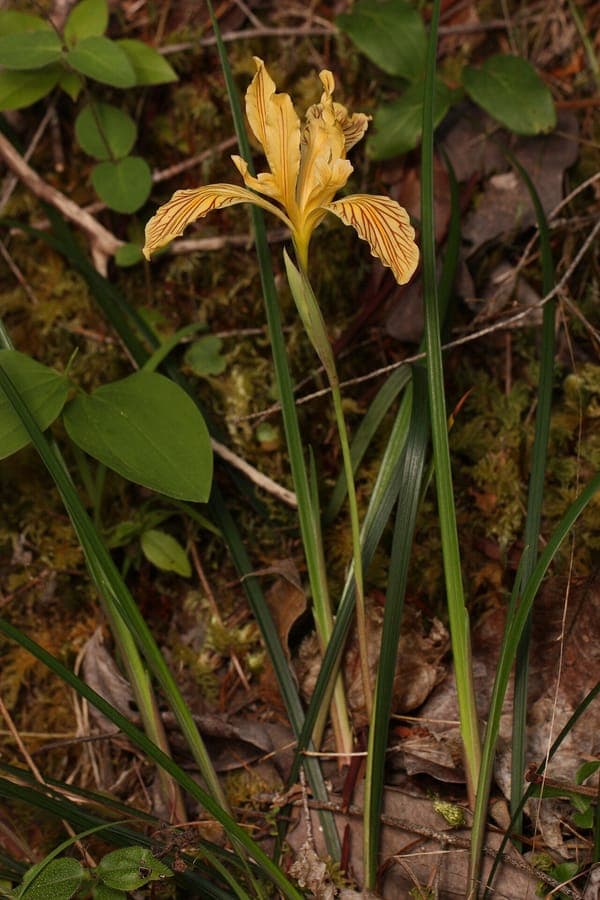
Walter Siegmund (talk) / CC BY-SA 3.0, via Wikimedia Commons
Del Norte County iris: complete guide
Iris innominata
Want to see Del Norte County iris: complete guide in your garden?
1 minute, no credit card
Overview
Iris innominata, commonly known as the Del Norte County iris, is one of the most exquisite and botanically fascinating members of the Pacific Coast Iris group. The species was first formally described by botanist L.F. Henderson in 1930, and its curious name - 'innominata' meaning 'without a name' in Latin - reflects Henderson's initial difficulty in distinguishing this distinctive plant from its close relatives. The species is native to a relatively small geographic area straddling the border between southwestern Oregon and northwestern California, particularly in Del Norte County, from which the common name derives.
This iris belongs to the Pacific Coast Iris group (PCI), also known as the Californian irises or Series Californicae - a group of slender-leaved, beardless, evergreen irises that thrive in the mild, moist climate of the Pacific coast, growing under conifer canopy and in open, wooded grasslands. Iris innominata stands out within this group for its compact size, its graceful flowers, and its extraordinary variability in flower colour. Individual plants can bear flowers in pure yellow, gold, cream, lavender, violet, blue-purple, and nearly white, often with intricate veining or patterning on the falls.
The plant grows from slowly spreading rhizomes that form neat, compact grass-like clumps. In the garden, it is particularly valuable as underplanting beneath large conifers or deciduous trees, in rock gardens, or in sheltered borders. Once established, it asks for little maintenance and rewards the gardener year after year with a reliable and beautiful spring bloom.
For gardeners seeking a distinctive, relatively little-known iris for shadier parts of the garden, Iris innominata is an outstanding choice. Browse garden design ideas featuring Pacific Coast irises in naturalistic woodland borders at gardenworld.app.
Appearance & bloom cycle
Iris innominata forms dense clumps of narrow, dark green leaves that reach 20 to 35 cm in length. The leaves are glossy and slightly more leathery in texture than those of many other iris species, and they remain green throughout the year, providing winter interest even when the plant is not in bloom. Growth is rhizomatous: underground rhizomes spread slowly and steadily, widening the clump over time and eventually producing divisions suitable for sharing or replanting.
Flower stems emerge in May and June, rising 15 to 25 cm above the foliage. Each stem carries one or two flowers. The blooms are remarkably variable in colour: from bright yellow, golden yellow, and cream through various shades of lilac, violet, and blue-purple to near white. Most plants display attractive dark veining or net-like patterning on the falls, which greatly enhances the elegance of the flowers.
The falls of mature flowers typically measure 4 to 6 cm in length. They are broad and spreading with a slightly undulate margin. The upright standards are slightly narrower and give the flower a light, airy quality. There is no beard, as Iris innominata belongs to the beardless (apatela) irises along with all other Pacific Coast irises.
After flowering, small, elongated seed capsules develop and ripen to light brown. Self-seeding does occur but is rarely invasive. Seedlings can vary considerably in flower colour compared with the parent plant, which makes the species particularly interesting for gardeners who enjoy selecting for particular colour forms.
Ideal location
In the wild, Iris innominata grows in partial to light shade, on open patches in coastal conifer forests and under shrubs along the Oregon and California coast. The ideal garden position reflects this origin: partial shade to dappled light is optimal, though the plant will also tolerate more sun provided the soil remains adequately moist.
Full sun combined with dry soil is the greatest threat to this iris. Excessive direct sunlight causes leaves to pale, edges to scorch, and bloom to decline markedly. A position beneath a deciduous or evergreen tree that provides filtered light without drip or root competition, or an east- or north-facing border, suits the plant perfectly.
Some wind protection is beneficial but not strictly essential. Strong, drying winds desiccate leaf tips and can topple flower stems. A sheltered garden position or a light windbreak of shrubs is an advantage.
Iris innominata fits beautifully into rock gardens, under trees, along paths in a woodland garden style, and as ground cover on shaded slopes. At gardenworld.app you will find many more guides to similar plants suited to shaded and semi-shaded borders.
Soil requirements
Iris innominata performs best in well-drained, humus-rich, slightly acidic soil. In its native habitat, it grows in the forest floor of coastal woodland, characterised by a deep layer of partially decomposed conifer needles - a loose, airy, relatively nutrient-poor substrate with a pH typically between 5.5 and 6.5.
In the garden, a pH of 5.5 to 7.0 is acceptable, but strongly alkaline or chalky soils should be avoided. On calcareous clay, Pacific Coast irises generally perform poorly and gradually decline. Where soil conditions are suboptimal, working generous amounts of composted material or pine needle mulch into the upper 20 cm before planting will improve both structure and acidity.
Good drainage is essential. Standing water, particularly in winter, quickly leads to rhizome rot, which is the main cause of Pacific Coast iris death in European gardens. Raise planting level if necessary, or amend with grit and compost to improve permeability.
Avoid heavy, wet clay unless substantially improved. Nutrient-rich garden soil high in nitrogen promotes lush leaf growth at the expense of flowers. A lean to moderately fertile substrate produces the best results.
Free design
Want to see Del Norte County iris: complete guide in your garden? Make a free design now.
Watering
Iris innominata comes from the moist, mountainous coastal regions of Oregon and California where rainfall is distributed throughout the year, though summers can be relatively dry. In the garden, the plant needs a moderate, consistent moisture supply, avoiding extremes in either direction.
In the first year after planting, consistent watering is essential to allow the plant to establish a good root system. Water twice a week during dry spells, ensuring the soil at 15 cm depth always feels lightly moist. Apply water gently rather than in large quantities all at once.
From the second year onward, watering frequency can be reduced. In the rainfall patterns typical of the UK, Belgium, and the Netherlands, supplemental irrigation is rarely needed during most summers. During heat waves above 28 degrees Celsius lasting more than two weeks without rain, watering once a week at moderate volume is advisable.
Be cautious about winter watering onto the rhizomes. Combined with cold, persistently wet soil around the rhizomes in winter can lead to rot. Ensure good drainage and avoid overwatering from October through March.
Pruning
Iris innominata requires minimal pruning. Removing spent flower stems is the main routine task: cut them as low as possible, preferably to leaf level, to maintain a tidy appearance and reduce the risk of fungal infection through dying tissue.
In autumn and early winter, dry brown leaf tips may appear on the clumps. Trim these tips carefully with sharp scissors back to the still-green portion. Remove fully dead leaves at the base to improve air circulation and discourage mould.
Avoid cutting back healthy leaves during the active growing season. The leaves of Pacific Coast irises produce the energy reserves for the following year's bloom; over-aggressive cutting damages the following season's flowers. A light tidy-up in early spring before new growth begins - removing dead material while leaving healthy green leaves intact - is the best approach.
Dividing overgrown clumps is best done in September or early autumn. Ensure each division has at least three to four healthy rhizomes and replant immediately. Mature, large clumps that have not been divided for several years sometimes bloom less freely - timely division maintains vigour.
Maintenance calendar
February–March: Remove dead and damaged leaves at the base of the clump. Apply a thin layer of well-composted material or shredded conifer needle mulch (2–3 cm). Avoid fertilisers with high nitrogen concentrations.
April–May: Flower stems begin to emerge. Protect young stems against expected night frosts with a light garden fleece. Enjoy the early blooms.
May–June: Full bloom period. Remove spent flower stems as low as possible. Watch for slug damage on young stems.
July–August: Post-bloom rest period. Avoid overwatering during this period. Weed carefully around the clumps without disturbing the rhizomes.
September: Best time for dividing and replanting large clumps. Planting new divisions at this time allows roots to establish before winter. Check for signs of rhizome rot.
October–December: Minimal maintenance. Good drainage is now the most critical concern. Trim brown leaf tips but leave healthy green foliage in place.
Winter hardiness
Iris innominata is moderately hardy. The plant is broadly suited to USDA zones 7 to 9, meaning it tolerates light frosts well but prolonged severe cold, especially combined with wet soil, can cause problems. In the coastal regions of its native habitat, winters are mild - rarely falling below -10 degrees Celsius.
In the coastal provinces of the Netherlands and Belgium, and in the mild urban climates of cities such as Amsterdam, Antwerp, and Brussels, most Pacific Coast irises overwinter without protection under normal conditions. In continental areas with regular hard winters, a light winter protection of conifer branches or dry leaves over the clump is recommended when temperatures consistently fall below -10 degrees Celsius.
The critical risk factor is the combination of cold and wet soil: this is the most threatening condition for Iris innominata in European gardens. Ensuring excellent drainage is the first and most important protective measure; insulating against ground temperature comes second.
During severe winters with prolonged frost, mulching the root zone with 5 to 8 cm of dry compost or straw is an effective protective measure, stabilising both temperature and moisture balance in the soil around the rhizomes.
Companion plants
Iris innominata combines beautifully with other inhabitants of shaded, humus-rich woodland gardens. The following plants make particularly successful companions:
- Trillium grandiflorum (great white trillium): simultaneous or slightly earlier bloom in white, the same preference for partial shade and rich woodland soil. A stunning combination.
- Dicentra formosa (western bleeding heart): pink to purple flowers from May to July, elegant ferny foliage that complements the fine leaves of the iris.
- Helleborus x hybridus (Lenten rose): early to mid-winter bloom in diverse colours, overlapping growing period and site requirements. Good contrast in leaf texture.
- Carex oshimensis 'Evergold' (Japanese sedge): gold-and-green striped foliage that brightens the year-round green carpet of iris leaves.
- Polystichum setiferum (soft shield fern): feathery fronds as backdrop for the graceful iris foliage. Both thrive in the same shade and slightly acidic soil.
- Epimedium x versicolor 'Sulphureum' (barrenwort): low, spreading, excellent under trees - fills space between iris plants and suppresses weeds.
Avoid combining with sun-loving, drought-tolerant plants such as lavender, rosemary, or Sedum, whose soil and moisture requirements are fundamentally at odds with those of Iris innominata.
Closing
Iris innominata is a botanical curiosity of the highest order: rarely seen in northwest European gardens, botanically fascinating through its remarkable colour variability, and deeply rewarding for the gardener willing to provide the right conditions. Its compact scale, evergreen leaves, and exquisite flowers make it a versatile choice for the shade border, woodland garden style, and rock garden alike.
Curious to see how Iris innominata could feature in your own front garden or shaded border? Visit gardenworld.app for a personalised garden design tailored to your space. You will also find dozens of further plant guides there covering unusual and underused garden plants for every situation.
Want to see Del Norte County iris: complete guide in your garden? Make a free design now.
Upload a photo, pick a style, and get a photorealistic design with plant list in under a minute.
10,000+ gardens designed already
No credit card required


Similar plants
Iris tingitana: complete guide
Iris tingitana
Iris tingitana, the Morocco iris, is the bulb species behind the Dutch iris: early blue-violet blooms that need a sunny, well-drained position.
Iris hookeri: complete guide
Iris hookeri
Hooker's Iris is a compact North American native plant with blue flowers. Low-growing and moisture-loving water plant.
Siskiyou iris: complete guide
Iris bracteata
Complete guide to Iris bracteata, the Siskiyou iris: location, soil, bloom cycle, watering, pruning and companion plants for this rare Pacific Coast iris.