
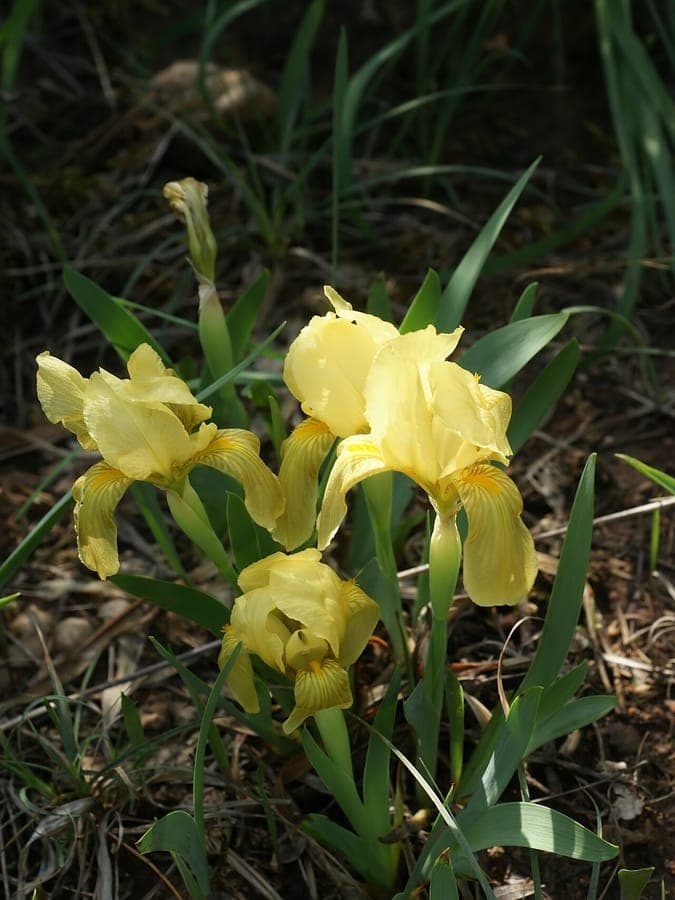
(Hans Hillewaert) / CC BY-SA 3.0, via Wikimedia Commons
Iris lutescens: complete guide
Iris lutescens
Want to see Iris lutescens: complete guide in your garden?
1 minute, no credit card
Overview
Iris lutescens is a compact, dwarf iris from Southwest Europe to Italy. This iris is renowned for its small, elegant growth and unique yellow-purple flowers. The plant reaches a height of only 25-40 centimeters and blooms very early in the season, from April to May. Iris lutescens is perfect for front yard borders, stone steps, and other compact spaces.
Appearance and bloom
Iris lutescens is characterized by very compact, grayish-green foliage and small, elegant flowers. The flowers are striking yellow to yellow-orange, with purple veining on the lower petals (falls). The plant's height is very low, making it perfect for front yard borders. Flowers grow approximately 4-5 centimeters in diameter. The plant grows as compact, cohesive clumps.
Ideal location
Iris lutescens grows best in full sun, requiring at least 6-8 hours of direct sunlight daily. The plant is hardy to -15 degrees Celsius and suitable for all temperate climates. Plant in locations with plenty of sun and good drainage. A south-facing wall or sunny border is ideal. Iris lutescens tolerates light shade, but flowering is less prolific.
Soil
Iris lutescens requires well-draining soil with a pH between 6.5 and 7.5. Heavy clay soils must be amended with sand and compost. The plant grows well in poor to moderately rich soils. For optimal growth, mix garden soil with sand in a 2:1 ratio. Rot is a hazard in wet winters; ensure perfect drainage.
Watering
Water Iris lutescens moderately, especially during the growing season. The plant tolerates drought well after establishment. Water once weekly during the growing season, provided there is no rain. After blooming, watering can be reduced. In winter, watering is not needed.
Free design
Want to see Iris lutescens: complete guide in your garden? Make a free design now.
Pruning
Pruning is straightforward: remove spent flowers after blooming. After blooming (May), foliage can be carefully trimmed. However, the plant grows so compactly that much pruning is not necessary. Remove dead foliage or dead parts each autumn.
Maintenance calendar
April to May: blooming, water regularly. May to June: remove spent flowers and foliage. June to September: divide plants. August to October: prepare plants. October to November: remove autumn debris. December to March: plant rests. April: start of active growth.
Winter hardiness
Iris lutescens is hardy to -15 degrees Celsius. Very cold winters can cause damage, but protection is usually not needed. Snow and frost do not harm the plant. Foliage may freeze back, but the plant will rejuvenate.
Companion plants
Plant Iris lutescens with other compact early spring bloomers:
- Pulsatilla (pasque flower)
- Aubrieta (rock cress)
- Sedum (stonecrop)
- Alyssum (sweet alyssum)
This plant combination creates a beautiful front yard border planting.
Closing
Iris lutescens is a very attractive, compact iris that fits perfectly in front yard designs. The plant is easy to maintain and very winter-hardy. With patience, Iris lutescens grows into a beautiful border planting. Local garden centers carry seedlings ready for immediate planting.
At gardenworld.app, you can have professional front yard designs created that optimally showcase Iris lutescens with other compact early spring bloomers.
Want to see Iris lutescens: complete guide in your garden? Make a free design now.
Upload a photo, pick a style, and get a photorealistic design with plant list in under a minute.
No credit card required


Similar plants
Iris pallida: complete guide
Iris pallida
Discover the soft purple Iris pallida, a classic front yard iris with fragrant rhizomes and reliable annual blooms. Perfect for sunny locations.
Iris sibirica: complete guide
Iris sibirica
Discover elegant Iris sibirica with fine blue flowers. Perfect for moist soils, 60-80cm tall. Excellent in groups and as a cut flower.
Iris spuria: complete guide
Iris spuria
Discover Iris spuria with stunning blue flowers and slender growth. Suitable for full sun locations, 80-120cm tall. Strong growth and long blooming.