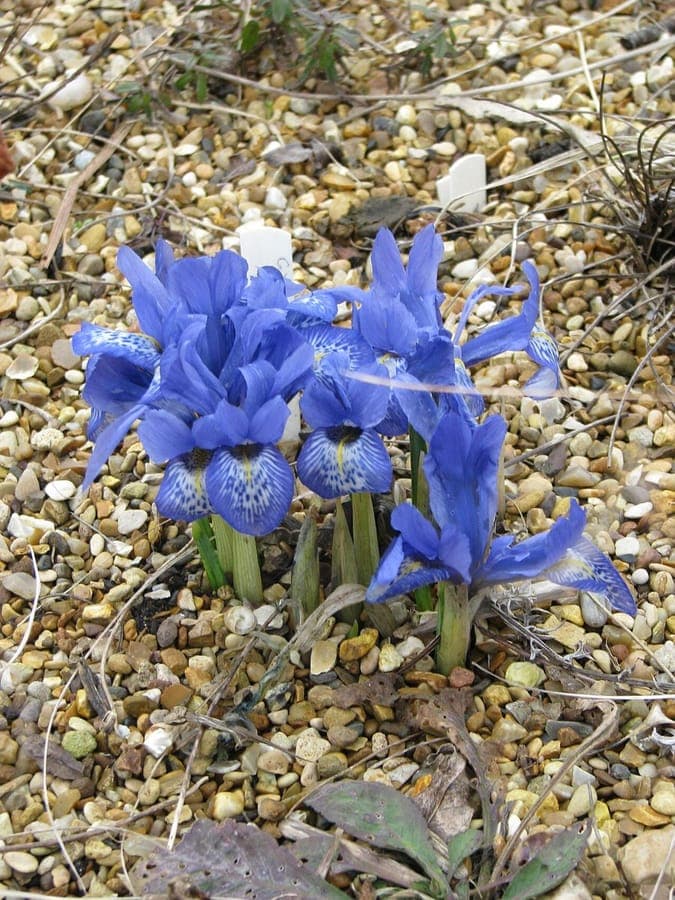
peganum from Small Dole, England / CC BY-SA 2.0, via Wikimedia Commons
Iris histrioides: complete guide
Iris histrioides
Want to see Iris histrioides: complete guide in your garden?
Full design in HD: €7.99
Look after your Iris histrioides with the GardenWorld app
Identify plants with your camera and get a care calendar with reminders for this plant.


Overview
Iris histrioides is a small bulbous iris that opens its flowers while the rest of the garden is still asleep. In February, and in a mild winter as early as late January, deep blue blooms push up through bare soil. For such a tiny plant the flowers are remarkably large and robust, and they shrug off a frosty night or a dusting of snow.
The species comes from northern Turkey, from the mountains behind the Black Sea coast, where it grows in alpine meadows that only clear of snow late in winter. It belongs to the reticulata group, small irises whose bulbs sit inside a net-like tunic of fibres. Nurseries often lump the whole group together as dwarf irises, but Iris histrioides is a species with its own character: its flowers are larger and appear earlier than those of the better-known Iris reticulata, and there is barely any foliage to be seen while it is in bloom.
A flowering plant is only 8 to 12 cm tall. That puts it at the very front of a border, in a rock garden, a gravel bed or a raised trough where you can study the markings on each flower up close. If you would like to know where such a winter flower would look best in your own garden, you can have a garden design made on gardenworld.app that takes account of sun, soil and the views from the house.
Toxicity
Irises are poisonous, and Iris histrioides is no exception. The bulb in particular contains irritant compounds. Eating it causes nausea, vomiting, stomach pain and diarrhoea. Cats and dogs show the same symptoms, often with drooling and lethargy. The sap can irritate sensitive skin. Wear gloves when planting, keep loose bulbs out of reach of children and pets. If you suspect anyone has eaten part of the plant, contact a doctor or vet.
Appearance and flowering season
Each bulb usually produces a single flower, 6 to 8 cm across, on a short tube-like stem. Like every iris, the flower consists of three drooping outer petals, the falls, and three upright inner ones, the standards. In Iris histrioides the falls are broad, with a white or pale blue central blaze densely dotted in dark blue and a yellow to orange ridge down the middle. The colour ranges from clear sky blue to violet blue. The scent is faint at most.
In a British or northern European garden the flowers usually appear between mid-January and mid-March. Each flower lasts about a week, longer in cold weather. The leaves are narrow and four-angled in cross-section, and only a few centimetres long when the flowers open. They lengthen afterwards to 20 or 30 cm before turning yellow and dying back around June. In summer there is nothing to see above ground.
The forms most often offered are 'Major', with large, deep blue flowers, and 'Lady Beatrix Stanley', a paler blue with heavily spotted falls. Well-known hybrids with Iris histrioides as a parent, such as 'Katharine Hodgkin' and 'George', are widely sold alongside the dwarf irises, but they are not the pure species.
Ideal position
Give Iris histrioides a spot in full sun. Light is in short supply in winter, and without enough of it the flowers stay closed and the bulb builds up too little reserve after flowering. A sunny edge along a path, a south-facing rock garden or a gravel garden is ideal. Beneath deciduous shrubs works too, provided the shrubs do not leaf up until the iris has finished.
More important than warmth is a dry summer for the bulb. In the wild the soil bakes dry in summer while the bulbs rest. A spot where neighbouring plants receive plenty of summer watering, or keep the soil moist with their roots, is therefore less suitable. The species also does very well in a pot or stone trough. After flowering, stand the container in a sunny place where it will not be soaked by every summer shower.
Soil requirements
Sharp drainage and a fairly lean soil matter most. On wet clay the small bulbs rot quickly. On heavy ground, work coarse sand, fine grit or lava chippings into the top 15 cm, or plant in a raised bed. A neutral to slightly alkaline soil is ideal, though mildly acid conditions are tolerated.
In containers, use a mix of roughly half compost and half fine grit or perlite, finished with a layer of grit on top. This keeps the neck of the bulb dry.
Free preview
Want to see Iris histrioides: complete guide in your garden? Make a free preview of your design.
Planting the bulbs
Plant the bulbs from late September to late October, while the soil still holds some warmth and the roots can establish before winter. Set them about 8 to 10 cm deep, measured from the base of the bulb, and 5 to 8 cm apart. That is deeper than you might expect for such a small bulb, but it helps with a well-known problem in this group: after flowering the bulb often splits into a cluster of tiny offsets that take years to bloom again. Deeper planting reduces that splitting.
Plant in groups of ten or more so they make a real impact in February. Check that the bulbs are firm when you plant them. Bulbs with black blotches or a soft, inky patch may have ink disease and are best thrown away.
Watering
Water once thoroughly after planting so the soil settles around the bulbs. After that, autumn and winter rainfall in Britain and the Low Countries usually provides more than enough moisture. If spring is exceptionally dry, water now and then while the leaves are green, because that is when the bulb rebuilds its reserves.
Once the foliage turns yellow, the plant needs no further water. A dry summer rest is actually beneficial. Move pots under cover or lay them on their side so they stay dry.
After flowering
No pruning is needed. Let the leaves grow on and die back naturally after flowering, even if they look a little untidy for a while. Only remove them once they are fully yellow and withered. Straight after flowering, feed with a high-potash fertiliser, such as liquid tomato feed at half strength, two or three times at two-week intervals. Potash helps the bulb stay in one piece and form a new flower bud.
To increase your stock, lift clumps in summer once the foliage has gone. Divide them and replant the largest bulbs straight away. The small offsets can be grown on in a pot; expect two to three years before they flower.
Maintenance calendar
January–March: Flowering. Watch for slugs, which nibble the blooms in mild spells.
March–April: After flowering, apply a high-potash feed two or three times. Water during prolonged dry spells.
May–June: The leaves turn yellow. Leave them until they come away on their own.
July–August: Summer dormancy. Keep pots dry. Divide congested clumps if needed.
September–October: Plant new bulbs 8 to 10 cm deep in well-drained soil.
November–December: Roots are already growing below ground. Spread a layer of grit over the spot so you do not damage them while weeding.
Winter hardiness
Iris histrioides is fully hardy. The Royal Horticultural Society rates it H6, which corresponds to temperatures down to about -20 °C. A flower caught by a hard night frost can occasionally be damaged, but the bulb itself needs no protection.
The real enemy is wet rather than cold. In waterlogged, poorly drained soil the bulbs rot during winter or during their summer rest. Make sure drainage is good and avoid spots where rainwater collects.
Companion plants
Other early bulbs and winter flowers are the natural partners. Snowdrops (Galanthus nivalis) and winter aconites (Eranthis hyemalis) flower at the same time and set off the blue beautifully with white and yellow. Crocus tommasinianus follows shortly after and fills the space with lilac. Cyclamen coum is another small winter bloomer that thrives in a similar well-drained spot, and its pink and carmine flowers intensify the blue.
In a rock or gravel garden, Iris histrioides sits well beside low succulents such as houseleeks (Sempervivum tectorum) and beside Euphorbia myrsinites, which shows grey-blue foliage all year. To extend the season, combine it with Iris reticulata, which flowers a few weeks later. If you plan combinations like these month by month, the plant calendar on gardenworld.app shows at a glance what flowers when.
Final thoughts
Iris histrioides is a small plant with a big effect. In the dullest weeks of the year it opens deep blue flowers that stand up to frost and snow. What it asks for is simple: full sun, well-drained soil, a dry summer rest and a little potash after flowering. Plant the bulbs deep enough, leave the foliage alone after flowering and keep children and pets away from the bulbs. Then this blue winter treasure will return year after year.
Frequently asked questions about Iris histrioides
Is Iris histrioides winter hardy?
Iris histrioides is fully hardy. The Royal Horticultural Society rates it H6, which corresponds to temperatures down to about -20 °C.
How much water does Iris histrioides need?
Water once thoroughly after planting so the soil settles around the bulbs. After that, autumn and winter rainfall in Britain and the Low Countries usually provides more than enough moisture.
What soil does Iris histrioides need?
Sharp drainage and a fairly lean soil matter most. On wet clay the small bulbs rot quickly.

See it in your garden
See Iris histrioides in your garden
One photo of your garden and a few questions. You see the result in about a minute.
Try it with a photoIdentify this plant in your own garden. Identify a plant
Similar plants
Iris reticulata: complete guide
Iris reticulata M.Bieb.
The netted iris is a precious early-blooming iris from the Middle East with beautiful violet flowers. Discover how to grow this enchanting miniature iris in your front yard.
Common snowdrop: complete guide
Galanthus nivalis
Common snowdrop growing guide. The world's most familiar snowdrop with delicate white pendant flowers.
Early crocus: complete guide
Crocus tommasinianus
Crocus tommasinianus blooms early in spring and naturalizes easily. Learn how to plant, care for and combine this hardy, low-maintenance bulb.
