
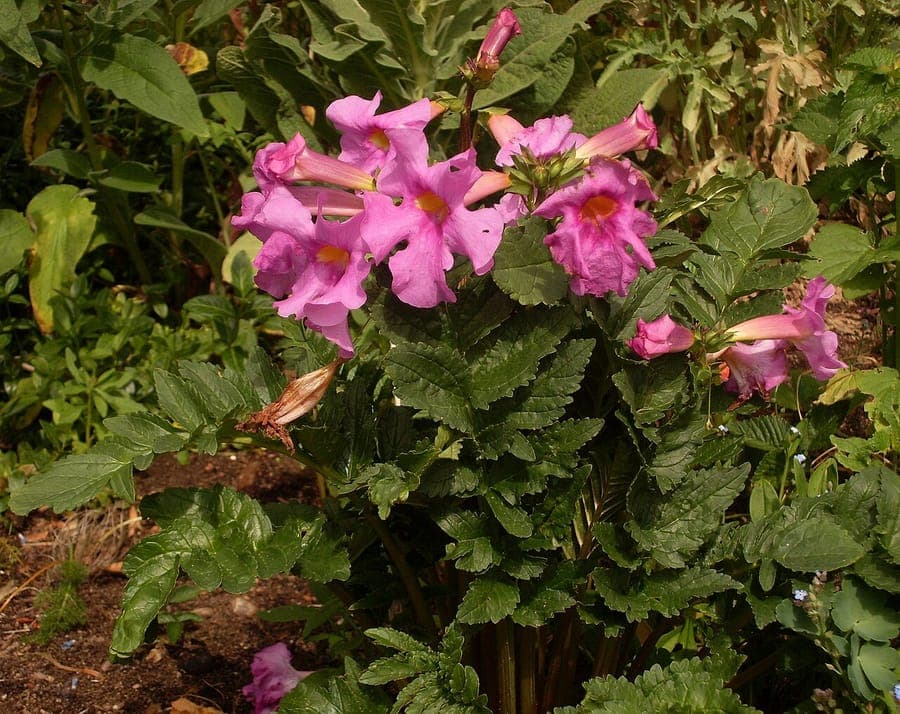
This Photo was taken by FredrikLähnn All my photos are public domain, but if you use them outside Wikimedia I will appreciate if you credit it Fredrik Lähnn and send me an email or contact me at my userpage. / Public domain, via Wikimedia Commons
Incarvillea delavayi: complete guide
Incarvillea delavayi
Want to see Incarvillea delavayi: complete guide in your garden?
1 minute, no credit card
Introduction
The Incarvillea delavayi, commonly known as Chinese trumpet-flower or hardy gloxinia, is a fascinating perennial from the mountain meadows of Sichuan and Yunnan in China. This plant is named after Delavas, a French plant hunter who discovered this beauty in the nineteenth century. The plant grows wild in high plateaus between 2000 and 3000 meters, where it experiences short summers and harsh winters. This makes the Incarvillea a tough and adaptable plant companion perfect for gardeners wanting something different in their perennial collection.
This remarkable plant is known for its colorful trumpet-shaped flowers that appear in summer. With minimal maintenance requirements and a long flowering period, this makes it an excellent choice for anyone wanting to enjoy exotic beauty without complicated care. For those seeking a perennial with character and genuine visual impact, the Chinese trumpet-flower is certainly worth considering.
Appearance and Bloom
The Incarvillea delavayi grows into a compact perennial with fine, feathery foliage that strongly resembles fern or acacia leaves. The plant reaches a height of approximately 50 to 70 centimeters depending on growing conditions. The leaves are grassy green and provide fine texture that is interesting even before flowers appear.
The true stars of this plant are, however, the trumpet-shaped flowers. These appear throughout the summer period, usually from May through August. The flowers are typically pink, red, or a mixture of both colors, sometimes with yellow centers. Each flower is approximately 5 to 6 centimeters long and grows in clusters atop stems, creating a spectacular visual effect.
After flowering, interesting seed pods form, giving the plant additional decorative value. The plant is relatively slow-growing and reaches its full size in the second or third season after planting.
Ideal Location
The Incarvillea delavayi thrives best in full sun to partial sun. The plant requires at least 6 hours of direct sunlight daily for optimal growth and flowering. In climates with very hot summers, some afternoon shade can be beneficial, especially in warm southern regions.
The plant is, however, quite adaptable and can also thrive in environments with less sun, although flowering may be less profuse. A spot on a sheltered mountain slope or rockery is ideal. The plant feels at home on composite terrain with good views and light.
Ensure that the planting location is well-draining, as this mountain plant cannot tolerate waterlogged soil.
Soil
The Incarvillea delavayi has very specific soil requirements. The plant requires well-drained, preferably stony and sandy soil. This mimics the highland plateau environment where the plant naturally grows. Heavy clay soils must be improved with sand, gravel, and organic material.
Construct a good drainage system with at least 10 to 15 centimeters of gravel or drainage beneath the plant. This prevents water stagnation, which can be fatal for this plant. The pH preference is neutral to slightly acidic (pH 6 to 7).
Better drainage can also be achieved by growing the plant on raised beds or in containers. This is a popular method for alpine gardeners and provides complete control over soil moisture.
Free design
Want to see Incarvillea delavayi: complete guide in your garden? Make a free design now.
Watering
Because this is a mountain plant accustomed to drought, water must be handled carefully. Once the plant is established, it is relatively drought-tolerant. During growth and flowering periods, however, the plant needs regular watering, especially during dry spells.
In containers, water more frequently than in-ground plantings. Check daily if the soil feels dry and water only when this is the case. Ensure water flows completely out of the pot and does not stagnate.
In winter, when the plant becomes dormant, water should be reduced drastically. Even in wet periods, do not water unless the soil is completely dried out.
Pruning
The Incarvillea delavayi requires very minimal pruning. The plant grows naturally compact and maintains its shape without much intervention. Only remove dead flowers during the season to encourage further blooming and keep the plant neat.
When the plant dies back at season's end, remove all dead material. Leave the underground rhizome undisturbed for next season. Pruning living stems is not necessary and can damage the plant.
Maintenance Calendar
Spring: Begin with careful watering as growth starts. Summer: Regular water, especially during flowering. Fall: Gradually reduce water as plant dies back. Winter: Minimal water, frost protection in very cold regions.
Winter Hardiness
The Incarvillea delavayi is moderately winter-hardy and can tolerate temperatures down to approximately minus 12 to minus 15 degrees Celsius. In most Dutch gardens, however, frost protection is needed during severe winters. The plant is better left frozen outside than experiencing moisture problems.
In very cold regions, it is recommended to grow the plant in containers so it can be brought indoors during winter. A layer of mulch around the plant also helps enormously. Very mild winters can mean the plant does not become fully dormant, which can lead to problems.
Companion Plants
The Incarvillea combines beautifully with other alpine plants. Mountain palms, sedums, sempervivums, and small herbaceous plants form good underplanting. Gray-foliage plants like Artemisia provide good contrast.
In borders, the plant combines beautifully with lupines, salvias, and lavender. The bright flowers harmonize well with white and purple partners.
Conclusion
The Incarvillea delavayi is a unique perennial that brings genuine exotic beauty to your garden. With its characteristic flowers, interesting foliage, and toughness, it is a perfect choice for gardeners wanting something different. Whether you maintain an alpine rock garden or simply seek something special for your border, this Chinese beauty will certainly impress.
The plant is available at specialized garden centers carrying alpine plants. Many retailers stock seeds year-round. Once planted, your Incarvillea delavayi will provide years of beauty and characteristic charm. For more planting help and design tips, visit gardenworld.app where you can request personalized garden designs.
Want to see Incarvillea delavayi: complete guide in your garden? Make a free design now.
Upload a photo, pick a style, and get a photorealistic design with plant list in under a minute.
No credit card required


Similar plants
Tabebuia pallida: complete guide
Tabebuia pallida
Full growing guide for Tabebuia pallida: location, soil, watering, pruning, hardiness and companion plants for this tropical trumpet tree.
Northern catalpa: complete guide
Catalpa speciosa
Everything about northern catalpa (Catalpa speciosa): bold white flowers, fast growth, and how to grow this striking tree in your garden.
Desert willow: complete guide to Chilopsis linearis
Chilopsis linearis
Complete growing guide for desert willow (Chilopsis linearis): sun, soil, flowering, pruning, and winter care for this spectacular flowering small tree.