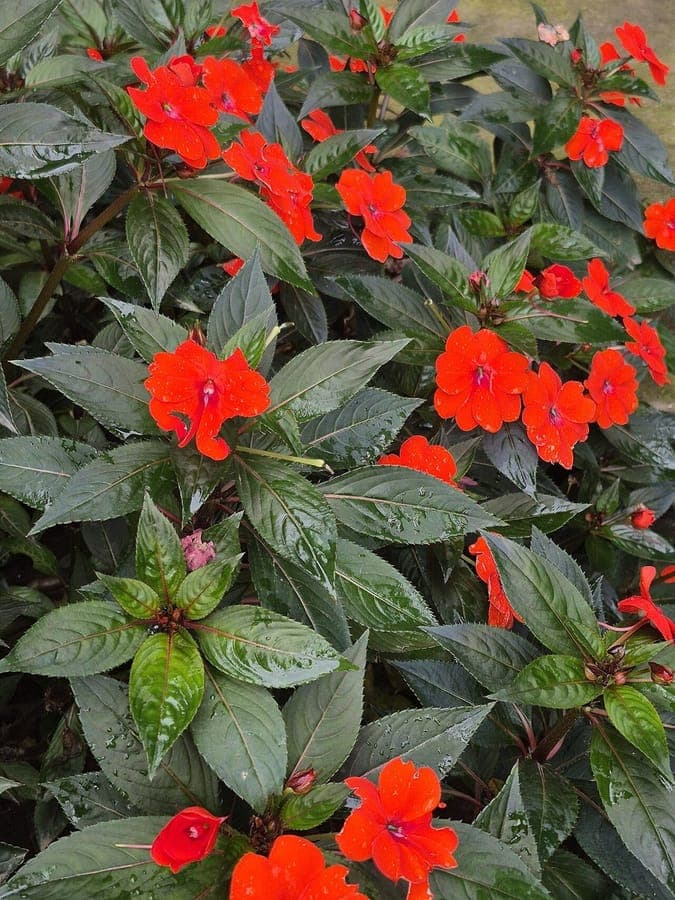
Bageense / CC BY 4.0, via Wikimedia Commons
New Guinea impatiens: complete guide
Impatiens hawkeri
Want to see New Guinea impatiens: complete guide in your garden?
Full design in HD: €7.99
Look after your New Guinea impatiens with the GardenWorld app
Identify plants with your camera and get a care calendar with reminders for this plant.


Overview
New Guinea impatiens (Impatiens hawkeri) is the sturdier, larger-flowered cousin of the familiar busy lizzie. Where the ordinary busy lizzie really wants shade, this plant copes with a few hours of sun as well, and over the past few decades it has become one of the most popular summer bedding plants for containers, window boxes and shady borders across north-western Europe.
The species grows wild in the humid mountain forests of New Guinea, the Solomon Islands and neighbouring islands. What you find at the garden centre is almost always a cultivar from the New Guinea Group: hybrids in which Impatiens hawkeri plays the leading role, sometimes with related species blended in. Labels may simply say "New Guinea impatiens" or carry series names such as 'Divine', 'Infinity' or 'SunPatiens', the last being an interspecific cross bred to take even more sun.
One major advantage over the common busy lizzie (Impatiens walleriana) is strong resistance to impatiens downy mildew, the disease that has wiped out whole beds of busy lizzies in many gardens since the late 2000s. Curious how this plant would look in a shady corner or on an east-facing patio? On gardenworld.app you can have a garden design made in which seasonal plants like this one are given a proper place alongside perennials and shrubs.
In our climate Impatiens hawkeri is grown as an annual. It cannot take frost, and even a run of cold nights below 10 °C slows growth considerably. Treat it as a plant for mid-May until the first chilly nights of October and you will be rewarded with five months of continuous flowering.
Appearance and bloom cycle
The plant forms a compact, upright to slightly spreading mound 25 to 50 cm tall and roughly as wide. The stems are succulent, flushed red or brown and rather brittle. The leaves are arranged in whorls of three to five around the stem, lance-shaped with finely toothed edges and 6 to 12 cm long. In many cultivars the foliage is deep green with a bronze or reddish sheen and a striking red midrib; variegated forms with yellow or cream markings exist too.
The flowers are flat, five-petalled and 5 to 8 cm across, noticeably larger than those of the common busy lizzie. A thin, curved spur holding nectar sits at the back. The colour range is wide: scarlet, orange, salmon, pink, magenta, lilac, purple and white, often with a paler or darker eye. The photo shows a plant smothered in bright orange-red blooms among dark, glossy green leaves.
Flowering starts under glass at the nursery in April and continues outdoors from late May until the first cold spell in October. Spent flowers drop by themselves, so there is very little tidying to do. Few seed capsules are produced, and those that are split open explosively when touched, as with every Impatiens.
Ideal location
New Guinea impatiens perform best with morning sun and afternoon shade, or in light, dappled shade beneath a tree. An east- or west-facing patio is ideal. They will tolerate full midday sun against a south wall only if the roots never dry out, and even then the leaves may scorch or fade. The 'SunPatiens' series is the exception: it was bred for sun and does well there.
In deep shade the plant still grows but flowers less and becomes leggy. Choose a spot out of the wind, because the brittle stems snap easily in heavy rain or gusts. Hanging baskets and window boxes in sheltered positions therefore work well. In open ground, space plants 30 to 40 cm apart; in a window box three plants per metre is plenty.
Compost and soil
In pots and containers use a good, open multipurpose or container compost that holds moisture without compacting. A mix with some loam or coir buffers better than a very light blend on its own. Make sure there are drainage holes, as waterlogged roots lead to stem and root rot.
In the ground the plant wants humus-rich soil that stays moist but drains well. Work some garden compost into the top 20 cm before planting. A slightly acidic to neutral pH between 5.5 and 6.5 is ideal. Open up heavy clay with compost and a little grit; enrich poor sandy soil with compost so it holds water for longer.
Free preview
Want to see New Guinea impatiens: complete guide in your garden? Make a free preview of your design.
Watering and feeding
Water is the key to success. With its generous foliage and fleshy stems the plant loses a lot of moisture in summer. Never let the compost dry out completely: drooping leaves are a clear sign that it is time. On hot days containers need watering daily, sometimes twice. Water in the morning where possible and aim at the compost rather than over the leaves.
At the same time the roots must not sit in water. Empty saucers after a downpour, because permanently soggy compost causes root rot.
Impatiens hawkeri is a hungry plant. From June to mid-September give a liquid feed for flowering plants every week, or mix a slow-release fertiliser into the compost at planting time. Too much nitrogen produces mostly leaves, so choose a feed with a little more potassium.
Pruning
There is no real pruning to do. The plant branches well of its own accord and faded flowers fall off naturally. If a plant becomes leggy or open by midsummer, cut the longest stems back by a third, just above a whorl of leaves. Within two to three weeks it will have filled out again and carry on flowering.
Don't throw away stems that snap off: cuttings of 8 to 10 cm root quickly in a glass of water or damp cutting compost. Remove yellowing or damaged leaves too, so fungal diseases get no foothold.
Maintenance calendar
March–April: Plants are on sale under glass. If you buy early, keep them indoors somewhere bright and cool, above 12 °C.
May: After mid-May, once nights stay above 10 °C, harden plants off for a week in a sheltered spot outdoors, then plant them out.
June: Start weekly feeding. Water daily in dry weather.
July–August: Peak flowering. Check containers every day for dryness and trim back over-long stems. Watch for aphids and red spider mite in hot spells.
September: Stop feeding halfway through the month. Take cuttings if you want to keep a plant going indoors.
October: Once nights drop below 5 °C the season is over. Clear the plants and add them to the compost heap.
November–February: Keep overwintering cuttings in good light and just moist at 15 to 18 °C.
Winter hardiness
Impatiens hawkeri is not hardy at all. Leaves and flowers are already damaged at around 5 °C, and a light frost kills the plant outright. That is why it is treated as an annual throughout the UK and the Low Countries.
If you want to keep a special colour, take cuttings in September or pot up a small plant and overwinter it on a bright windowsill at a minimum of 15 °C. It can be done, but plants tend to become thin and drawn in the dark months, and red spider mite thrives in dry, heated rooms. For most gardeners it is simpler to buy fresh plants each spring.
Toxicity to pets
Good news for dog and cat owners: the ASPCA lists the genus Impatiens as non-toxic to dogs and cats. The plant is not known to be poisonous to people either.
That doesn't mean your pet can eat large amounts without consequence. A lot of leaf can give dogs and cats a mild stomach upset, such as vomiting or diarrhoea, simply because the plant material is hard to digest. If your animal keeps nibbling at the plants, hang the containers a little higher. If your pet seems unwell, contact your vet.
Companion plants
In a shady window box or pot the plant looks lovely next to trailing lobelia (Lobelia erinus) spilling blue or white over the edge, and the silvery foliage of Helichrysum petiolare. For a calmer look, pair a single colour of New Guinea impatiens with foliage plants such as coral bells (Heuchera micrantha) in a dark or lime-green leaf colour.
In a shady border it sits well among hostas, such as Hosta sieboldiana, and ferns. The large blue-green hosta leaves make a quiet backdrop for the vivid flower colours. Tuberous begonias, fuchsias and the common busy lizzie share the same needs. To spread your seasonal planting sensibly through the year, the plant calendar on gardenworld.app shows you when to plant what.
Final thoughts
New Guinea impatiens (Impatiens hawkeri) is a rewarding summer plant for anyone with a partly shaded spot who is happy to water regularly. The foliage is attractive in its own right, the flowers are large and bright, and the plant stays healthy where the common busy lizzie often succumbs to downy mildew. Plant after mid-May, keep it watered and fed, and you will have colour on your patio until October.
Frequently asked questions about New Guinea impatiens
Is New Guinea impatiens winter hardy?
Impatiens hawkeri is not hardy at all. Leaves and flowers are already damaged at around 5 °C, and a light frost kills the plant outright.
When and how do you prune New Guinea impatiens?
There is no real pruning to do. The plant branches well of its own accord and faded flowers fall off naturally.
How much water does New Guinea impatiens need?
Water is the key to success. With its generous foliage and fleshy stems the plant loses a lot of moisture in summer.
Where does New Guinea impatiens grow best?
New Guinea impatiens perform best with morning sun and afternoon shade, or in light, dappled shade beneath a tree. An east- or west-facing patio is ideal.

See it in your garden
See New Guinea impatiens in your garden
One photo of your garden and a few questions. You see the result in about a minute.
Try it with a photoIdentify this plant in your own garden. Identify a plant
Similar plants
Lobelia erinus: complete guide
Lobelia erinus L.
Lobelia erinus is popular trailing plant with blue or red flowers, perfect for hanging baskets and containers. Flowers continuously all summer long.
Hosta sieboldiana: complete guide
Hosta sieboldiana
Hosta sieboldiana growing guide: large blue-green shade plant from Japan. Complete care tips, placement and maintenance for shady gardens and woodland areas.
Alumroot: complete guide
Heuchera micrantha
Discover how to grow and care for Heuchera micrantha: ideal light, soil, watering, and seasonal maintenance for thriving plants in your garden.
