
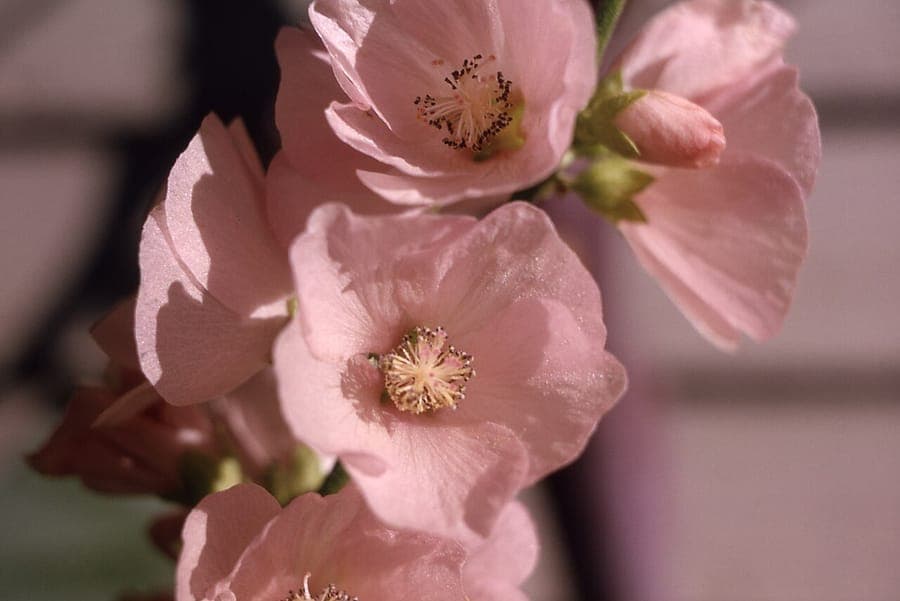
Unknown authorUnknown author / Public domain, via Wikimedia Commons
Wild hollyhock: complete guide
Iliamna rivularis
Want to see Wild hollyhock: complete guide in your garden?
1 minute, no credit card
Overview
Iliamna rivularis, commonly called wild hollyhock, streambank wild hollyhock, or mountain hollyhock, is a stately herbaceous perennial in the mallow family (Malvaceae). Native to the mountains and stream corridors of western North America, from British Columbia and Alberta in Canada south through Montana, Idaho, Oregon, Washington, Wyoming, Colorado, Nevada, and New Mexico, this impressive plant grows naturally along stream banks, in moist ravines, and at the base of mountain slopes. It is closely related to the common hollyhock (Alcea rosea) and shows the characteristic large, five-petalled flowers of the mallow family.
The species name 'rivularis' refers directly to its preferred streamside habitat. Plants are multi-stemmed and can reach 100 to 200 cm in height in a single growing season, making them among the tallest herbaceous perennials available for the garden. The leaves are broadly palmate, deeply lobed with five to seven lobes, mid-green and slightly rough in texture, closely resembling maple or geranium foliage. The flowers are pale pink to light lavender-pink, appearing from June through August in generous terminal and axillary clusters.
In the garden, Iliamna rivularis is still relatively uncommon outside its native range, but deserves far wider use in European horticulture. It provides excellent vertical structure in the back of borders, associates naturally with moisture-loving perennials near water features, and offers a superb late-season alternative to the more commonly grown hollyhock. Bees, bumblebees, and butterflies are strongly attracted to the flowers, adding wildlife value to any garden where it is planted.
Appearance & bloom cycle
Iliamna rivularis forms robust, erect clumps of multiple stems arising from a deep, woody rootstock. The stems are stout, light green to silvery-grey, covered with stellate (star-shaped) hairs that give them a soft, slightly rough feel. The leaves are alternately arranged, broadly palmate with five to seven pointed lobes, 10 to 20 cm across, and covered on the underside with a light grey-green felt of hairs that gives a two-toned appearance.
Flowers are the outstanding feature: pale pink to light lavender-pink, 4 to 6 cm across, with five broad rounded petals and a prominent central column of fused stamens typical of the mallow family. They appear in dense spikes at the tops of the stems and in the leaf axils, blooming successively from June through August, sometimes into September in cooler summers. The flowers are open and saucer-shaped, facing outward, and last one to two days each, with new buds opening continuously to maintain the display.
After flowering, the plants develop the ring-shaped seed capsules (schizocarps) characteristic of Malvaceae. Seeds ripen in August to September and can be collected for sowing. The plant does not flower until its second or third year from seed, but once established it blooms reliably each summer. Foliage dies back completely in autumn; new shoots emerge late in spring, sometimes as late as May, which makes the plant easy to dig up accidentally in early spring - mark the location clearly.
Ideal location
Wild hollyhock thrives in full sun to light partial shade. A minimum of five to six hours of direct sunlight promotes the richest flowering. In more shaded positions the plant remains structurally impressive but flowers less freely. In its native habitat it grows in open stream corridors and mountain meadows where light is plentiful, confirming its preference for sunny conditions.
The site should have access to consistent soil moisture. Unlike many ornamental perennials, Iliamna rivularis performs best where the soil does not dry out completely between rains. Near a pond, stream, or water feature is ideal, but any reasonably moist garden border with adequate summer watering suits the plant well. The tall stems can reach 150 to 200 cm in good conditions, so position it at the back or middle of a wide border, with 60 to 90 cm of space on all sides. In exposed, windy positions the stems may need staking.
For naturalistic plantings, this plant looks particularly effective in a prairie-style or cottage border alongside other tall perennials. Spacing plants 60 to 90 cm apart allows each plant to develop its full multi-stemmed form and creates an impressive display over the years.
Soil requirements
Iliamna rivularis grows best in moderately fertile, moisture-retentive soil. The preferred soil pH range is 6.0 to 8.5, which is broad enough to encompass most garden soils from slightly acidic to moderately alkaline. The plant tolerates loamy, clay, and sandy loam soils, provided there is adequate organic matter to retain moisture during dry spells. On light sandy soils, incorporating 10 to 15 cm of mature compost at planting time is essential.
On heavy clay soils, drainage improvement is advisable: incorporate coarse sand and compost to prevent waterlogging at the crown, which can cause rotting even in this moisture-tolerant species. The goal is a soil that retains moisture without becoming waterlogged - conditions that closely mimic the moist but freely draining mountain soils of the plant's native range.
An annual application of a generous layer of mature compost around the base of the plant in early spring provides sufficient nutrition. Mulching with 5 to 8 cm of wood chips or leaf mould in late spring helps retain soil moisture through the summer, which significantly benefits the plant during hot, dry spells. Top up the mulch layer each autumn to maintain its effectiveness.
Free design
Want to see Wild hollyhock: complete guide in your garden? Make a free design now.
Watering
Iliamna rivularis requires more consistent moisture than many drought-tolerant perennials. During the first growing season after planting, regular watering is essential until the deep roots are established. Water thoroughly once or twice per week, soaking the root zone to a depth of 30 to 40 cm rather than applying frequent shallow waterings.
In subsequent years, established plants show reasonable drought tolerance once their roots reach deeper, moister soil layers, but they perform best with consistent moisture. During prolonged dry spells in summer, weekly deep watering maintains plant vigour and extends the flowering period. Apply water at the base of the plant rather than overhead, keeping the large leaves dry to reduce the risk of fungal disease in warm, humid conditions.
In areas of natural rainfall exceeding 700 mm per year, established plants may require little supplemental watering. In drier climates or during drought summers, irrigation once a week is the recommended minimum. During cool, rainy periods, reduce watering frequency to avoid waterlogging around the crown.
Pruning
Iliamna rivularis requires straightforward management. After the main flowering flush in August or September, the spent stems can be cut back to 20 to 30 cm above ground level. Alternatively, leave the stems standing through winter: the ornamental seed capsules add winter interest and the stems provide some protection to the dormant crown. Remove them in early spring before new shoots emerge.
To produce more branched, slightly more compact plants, pinch back the young stems by one half in May. This delays flowering by two to three weeks but results in a bushier habit with more flower-bearing lateral branches. Support with bamboo stakes in windy positions to prevent the tall stems from collapsing.
Divide the clumps every three to four years in early spring or early autumn when the clumps become congested. Lift a section of the rootstock with a sharp spade, separate the divisions by hand, and replant immediately at the same depth. Newly divided plants may flower less freely in their first season but return to full vigour the following year.
Maintenance calendar
February-March: Remove previous year's stems if not already done. Apply a generous top-dressing of compost. Mark the location to avoid disturbing late-emerging shoots.
April-May: Shoots emerge late. Water if conditions are dry. Pinch back stems by half in May for a more compact habit.
June-July: Flowering begins. Water weekly during dry spells. Stake tall stems if needed in exposed positions.
August: Peak flowering or flowering begins to decline. Collect seeds if desired. Continue regular watering.
September: Cut stems back to 20 to 30 cm, or leave for winter structure. Refresh mulch layer around the base.
October-November: Foliage dies back completely. No watering required. The rootstock enters dormancy.
December-January: Remove old stems if left in autumn. No other maintenance needed.
Winter hardiness
Iliamna rivularis is reliably cold-hardy in USDA zones 4 through 8, tolerating temperatures as low as -30 °C with adequate snow or mulch cover. This makes it a fully dependable perennial across the United Kingdom, the Netherlands, Belgium, France, and most of Germany. Even in continental climates with severe winters, the deep woody rootstock survives underground.
Apply a 8 to 10 cm mulch of bark chips, straw, or fallen leaves around the crown before the first hard frosts as extra winter protection in the coldest zones. In temperate oceanic climates this precaution is rarely necessary. The plant is adapted to the harsh winters of its native Rocky Mountain habitat, which explains its remarkable cold hardiness.
The primary winter risk is not frost but prolonged waterlogging of the crown in wet, heavy soils. Ensuring good drainage at the planting site is more important than applying winter protection. On well-drained soils in temperate climates, the plant requires no special care through winter.
Companion plants
Iliamna rivularis works best in combinations with other tall or medium-height perennials in naturalistic, moist, or cottage-style borders. Recommended companions include:
- Echinacea purpurea (purple coneflower): similar flowering period, pink-purple tones that harmonise with the pale pink of Iliamna.
- Rudbeckia fulgida (black-eyed Susan): contrasting golden-yellow flowers create a vibrant colour combination.
- Lobelia cardinalis (cardinal flower): lower-growing moisture-loving plant with scarlet flowers, perfect near water features.
- Filipendula rubra (queen of the prairie): shared moisture preference, feathery pink plumes make a romantic pairing.
- Vernonia fasciculata (ironweed): late summer purple flowers extend the display into September.
Avoid very drought-tolerant or compact low plants as immediate neighbours, as the contrasting watering requirements can be problematic. Tall ornamental grasses such as Miscanthus sinensis cultivars or Panicum virgatum 'Shenandoah' provide complementary vertical structure.
Use gardenworld.app to design a tall perennial border incorporating Iliamna rivularis and see how it combines with companion plants in a virtual design before planting. More ideas for naturalistic and moisture-loving perennial combinations are at gardenworld.app.
Closing
Iliamna rivularis is one of the garden's most impressive and underused native perennials. Its tall, multi-stemmed habit, deeply lobed maple-like leaves, and generous summer flowering make it a standout choice for the back of a border or a naturalistic planting near water. Once established, it is long-lived, reliably hardy, and produces an increasing display of pale pink flowers each summer. Combined with its strong wildlife value as a pollinator plant, wild hollyhock is a perennial that richly rewards the gardener who gives it the moist, fertile conditions it deserves.
Want to see Wild hollyhock: complete guide in your garden? Make a free design now.
Upload a photo, pick a style, and get a photorealistic design with plant list in under a minute.
10,000+ gardens designed already
No credit card required


Similar plants
Crimean linden: complete guide
Tilia × euchlora
Crimean linden is an elegant, fast-growing shade tree ideal for large gardens. Discover cultivars, spacing, maintenance tips and winter hardiness.
California flannelbush: complete guide
Fremontodendron californicum
Everything about California flannelbush (Fremontodendron californicum): sunny placement, drainage, pruning and care for this spectacular yellow-flowering shrub.
Hairy rose mallow: complete guide
Hibiscus moscheutos subsp. lasiocarpos
Full growing guide for hairy rose mallow (Hibiscus moscheutos subsp. lasiocarpos): location, soil, watering, winter hardiness and garden design tips.