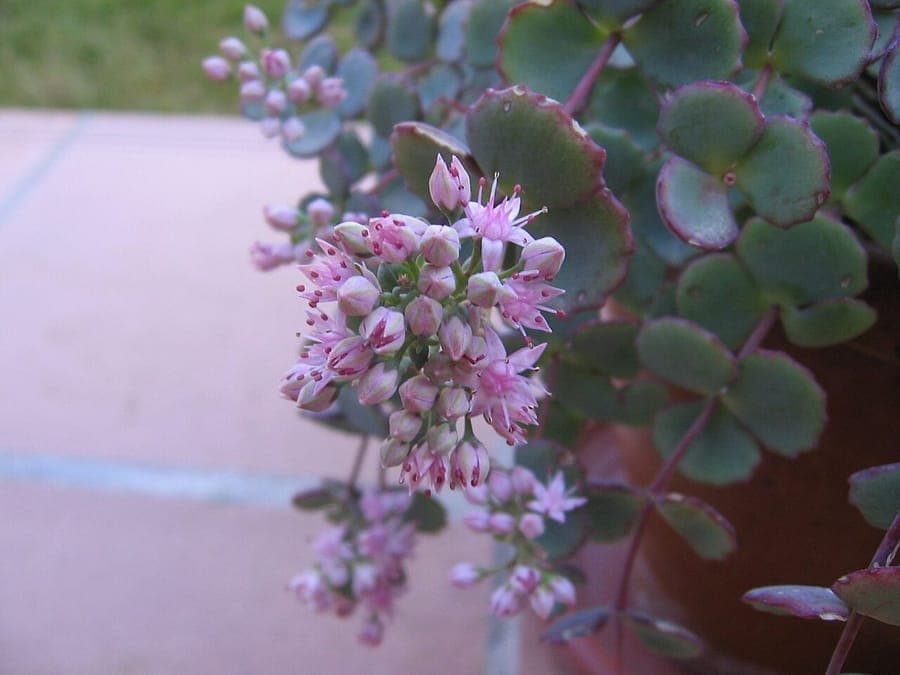
Digigalos / CC BY-SA 3.0, via Wikimedia Commons
October daphne (Hylotelephium sieboldii): complete guide
Hylotelephium sieboldii
Want to see October daphne (Hylotelephium sieboldii): complete guide in your garden?
Full design in HD: €7.99
Look after your October daphne with the GardenWorld app
Identify plants with your camera and get a care calendar with reminders for this plant.


Overview
Just as most perennials are running out of steam in October, October daphne (Hylotelephium sieboldii) is only getting started. A rounded posy of pink star-shaped flowers appears at the tip of every arching stem, and the blue-grey, coin-shaped leaves develop a red rim that deepens as autumn advances. This is a succulent best enjoyed up close: in a pot at table height, in a hanging basket or on top of a low wall, where its stems can tumble gracefully over the edge.
The species comes from Japan, where it grows wild mainly on the island of Shodoshima and on Shikoku, clinging to rocks and steep slopes. It is named after Philipp Franz von Siebold, the German physician who worked for the Dutch in Japan and sent a remarkable number of plants back to Europe in the nineteenth century. For a long time it was called Sedum sieboldii, and you will still find it under that name in garden centres and older books. Botanists now place it in the genus Hylotelephium, alongside the familiar ice plant Hylotelephium spectabile. Besides October daphne, it is also known as October stonecrop or Siebold's stonecrop.
This is not a groundcover for large areas but a plant for detail and intimacy. If you would like to see where a small autumn highlight like this fits best among your other plants, gardenworld.app can create a garden design that takes pots, low walls and terrace edges into account as well.
Appearance and bloom cycle
The plant forms a central crown from which dozens of slender, purplish-red stems emerge in spring. These stems grow 15 to 25 cm long, rising at an angle before curving gracefully outwards and downwards. The result is a loose, fan-shaped mound 20 to 40 cm wide or, in a hanging basket, a curtain of stems.
The foliage is the first thing you notice. The leaves are held in whorls of three around the stem, almost perfectly round, 1 to 2 cm across and fleshy. Their colour is blue-grey to grey-green, with a finely scalloped margin tinted pinkish-red. In sun and cooler weather that edge deepens to red, and in late autumn the whole leaf may blush pink or purple.
Flowering takes place in September and October, sometimes lingering into early November. At the tip of each stem a dense, domed head 4 to 6 cm across appears, made up of dozens of small pink starry flowers. The stamens carry dark anthers, which give the flowers a speckled look when seen up close. For bees and bumblebees still foraging late in the year, it is a valuable source of food.
A well-known form is 'Mediovariegatum', which has a creamy yellow blotch in the centre of each leaf and holds the RHS Award of Garden Merit. This variegated form grows a little more slowly and is somewhat more sensitive to frost. If a completely green shoot appears, remove it, as green shoots are more vigorous and can take over.
Ideal location
October daphne likes sun but will also accept light shade around midday. In full sun it stays compact and the leaf margins colour most strongly. In too much shade the stems become long and floppy.
The best positions are those where you can see the plant up close and the stems are free to trail: a terracotta pot on a table or wall, a hanging basket by the front door, the top of a dry-stone wall, the edge of a raised bed or a rock garden. It also performs well in a window box on a sunny balcony. Choose a spot you pass often in autumn so that you do not miss the late flowers.
Soil requirements
Like all succulents, it needs a free-draining root run. In containers, use a mix of two parts multipurpose or loam-based compost to one part coarse grit, perlite or fine gravel. In open ground, light sandy or gritty soil is ideal. Improve heavy clay thoroughly with grit and coarse sand, or plant on a raised spot.
It grows in slightly acidic to slightly alkaline soil. There is no need for rich ground: a little compost at planting time is plenty. A pot that receives a fresh top-dressing of compost each spring needs no further feeding.
Free preview
Want to see October daphne (Hylotelephium sieboldii): complete guide in your garden? Make a free preview of your design.
Watering
In open ground the plant copes on its own after its first summer. Pots and hanging baskets are a different matter, as they dry out quickly in summer. Water as soon as the top few centimetres feel dry, and always let excess water drain away. A plant that is too dry lets its leaves droop and drops the lowest ones. A plant that is too wet develops glassy, soft stems that rot at the base.
Reduce watering after flowering. In winter, once the plant has died back above ground, water hardly at all. Move pots under the eaves if you can, so rain does not rot the crown.
Pruning
In late autumn the stems change colour and die back. You can leave them until the end of winter or cut them off once they turn brown. In any case, remove them before mid-March, when the new shoots appear as tight little rosettes at the base. That way old stems will not get tangled up with the fresh growth.
Propagate by dividing the clump in April or by taking stem cuttings 5 to 8 cm long in June and July. Let the cut end dry for a day, then insert the cuttings in a mix of sand and compost. They root within a few weeks. In containers, watch out for vine weevil grubs, which love succulent roots, and for aphids that sometimes gather on the flower buds.
October daphne is not known to be toxic to people or pets. A cat that nibbles the leaves may at most suffer a mild stomach upset.
Maintenance calendar
February and March: Cut away the old, dead stems. Repot, or top-dress containers with fresh compost.
April: New shoots are growing. An ideal time to plant or divide. Keep an eye out for slugs.
May to August: The stems lengthen and begin to arch. Water pots during dry spells. Take cuttings in June or July.
September and October: Flowering time. Move pots to a spot where you can enjoy them. Check the buds for aphids.
November: The leaves colour and fall. Cut back on watering and move pots under cover.
December and January: Dormancy. Keep pots dry and protect them in severe frost.
Winter hardiness
Sources do not fully agree on hardiness. The RHS rates the species H4, which corresponds to roughly -10 to -15 °C, whereas American sources consider it considerably hardier. In practice, the plain green species survives most British and Belgian winters in open ground without trouble, provided it sits in a dry, free-draining spot. It retreats to its crown in winter, which shields it from frost and wind.
Take more care with pots and with the variegated 'Mediovariegatum'. Roots freeze more easily in a container. In winter, stand pots against a house wall or in an unheated shed, or wrap them in hessian or bubble wrap. Here, too, wet is a bigger enemy than cold.
Companion plants
In containers, Hylotelephium sieboldii looks lovely with blue fescue (Festuca glauca), whose fine blue blades echo its blue-grey leaves. Mexican fleabane (Erigeron karvinskianus) flowers from May until the frosts and fills the summer before the stonecrop gets going. A dark-leaved heuchera such as Heuchera micrantha makes a striking contrast in a neighbouring pot in lighter shade.
On a wall or in a rock garden it sits well beside the common houseleek (Sempervivum tectorum). Orpine (Hylotelephium telephium), its taller relative, also flowers in late summer, so together the two give you a small autumn border in pink and purple.
Final thoughts
Hylotelephium sieboldii, formerly Sedum sieboldii, is a small, refined succulent for anyone who loves detail. Its round leaves in whorls of three, the red edges and the late pink flowers turn an ordinary pot into a showpiece in October. Give it sun, free-draining soil and a dry winter, and it will return year after year.
Want to know when to take cuttings, repot or clear the old stems? The planting calendar on gardenworld.app lists the jobs for you, month by month.
Frequently asked questions about October daphne
Is October daphne winter hardy?
Sources do not fully agree on hardiness. The RHS rates the species H4, which corresponds to roughly -10 to -15 °C, whereas American sources consider it considerably hardier.
When and how do you prune October daphne?
In late autumn the stems change colour and die back. You can leave them until the end of winter or cut them off once they turn brown.
How much water does October daphne need?
In open ground the plant copes on its own after its first summer. Pots and hanging baskets are a different matter, as they dry out quickly in summer.
Where does October daphne grow best?
October daphne likes sun but will also accept light shade around midday. In full sun it stays compact and the leaf margins colour most strongly.
What soil does October daphne need?
Like all succulents, it needs a free-draining root run. In containers, use a mix of two parts multipurpose or loam-based compost to one part coarse grit, perlite or fine gravel.

See it in your garden
See October daphne in your garden
One photo of your garden and a few questions. You see the result in about a minute.
Try it with a photoIdentify this plant in your own garden. Identify a plant
Similar plants
Blue fescue: complete guide
Festuca glauca
Festuca glauca, or blue fescue, is a low-maintenance ornamental grass with silvery-blue foliage. Perfect for sunny, dry borders and rock gardens.
Erigeron karvinskianus: complete guide
Erigeron karvinskianus
Discover Erigeron karvinskianus, Karwinsky's fleabane or Mexican daisy, a delightful rock garden plant. Learn cultivation, care requirements, and design for challenging garden spaces.
Alumroot: complete guide
Heuchera micrantha
Discover how to grow and care for Heuchera micrantha: ideal light, soil, watering, and seasonal maintenance for thriving plants in your garden.
