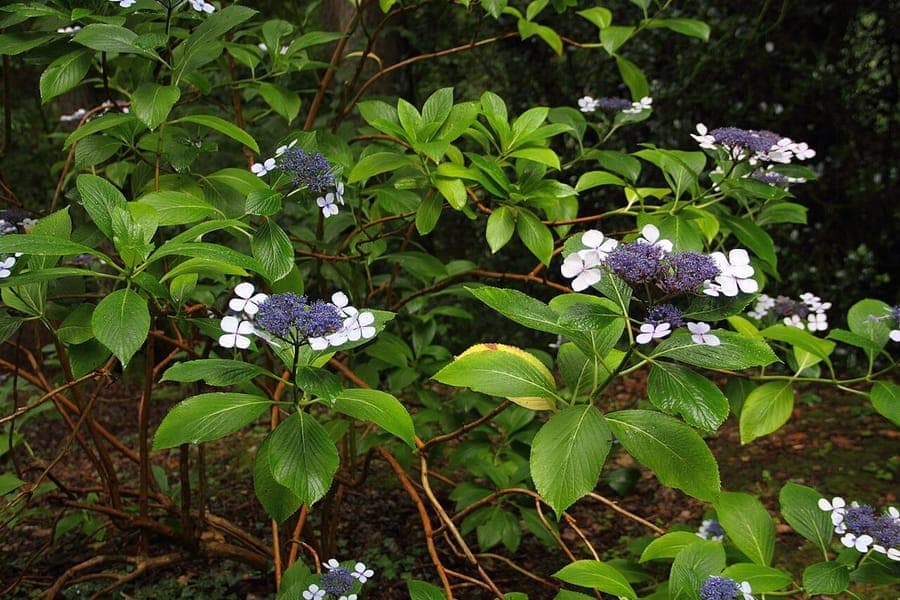
Schorle / CC BY-SA 4.0, via Wikimedia Commons
Mountain Hydrangea: complete guide
Hydrangea serrata
Want to see Mountain Hydrangea: complete guide in your garden?
Full design in HD: €7.99
Look after your Mountain Hydrangea with the GardenWorld app
Identify plants with your camera and get a care calendar with reminders for this plant.


Overview
The mountain hydrangea (Hydrangea serrata) is the refined, compact cousin of the familiar mophead hydrangea. In the wild it grows in mountain woodland in Japan and Korea, sheltered by taller trees. That background explains why it does so well in British and European gardens: it copes with cold winters better than many big-leaf hydrangeas, stays smaller and has a lighter, more natural look. More and more gardeners choose it for a small town garden, a shady border or a pot on a north-facing patio.
A mountain hydrangea usually reaches 60 to 120 cm in height and spread. Some botanists treat it as a subspecies of Hydrangea macrophylla, but in the garden the difference is clear: narrower, matt leaves, finer stems and, above all, flat lacecap flowers. Popular cultivars include 'Bluebird' (clear blue on acid soil), 'Preziosa' (rounded heads that age from pink to deep wine red), 'Grayswood' (white outer florets that turn crimson) and 'Kiyosumi' (white with a red picotee edge). If you would like to see how it fits into your plot, you can have a garden design for your shady corner made on gardenworld.app.
Appearance and bloom cycle
The leaves are lance-shaped to oval, 5 to 15 cm long, matt green and finely toothed along the margin, which is where the name serrata, meaning saw-toothed, comes from. Several cultivars colour red to purple-brown in autumn, and young shoots are often flushed red.
Mountain hydrangeas flower from June into September. Most cultivars carry flat heads 6 to 10 cm across, with a centre of many small fertile flowers ringed by larger, showy sterile florets. The effect is delicate and lacy, and the fertile flowers attract bees and hoverflies, something mopheads rarely do. In blue and pink cultivars the colour depends on the soil: blue on acid soil, pink on alkaline ground. White cultivars stay white at first and often blush pink or red as summer goes on. The faded heads remain decorative for months.
Ideal location
Give a mountain hydrangea dappled or partial shade. The ideal spot has morning sun and shade during the hottest part of the day, for example on the east or north-west side of the house or beneath the canopy of tall trees. In full midday sun the leaves scorch and the plant wilts on hot afternoons, while in deep shade it flowers less freely.
Shelter helps too, as cold spring winds can damage young shoots. Space plants 80 to 100 cm apart for a loose group, or grow a single specimen in a pot at least 40 cm across. Avoid planting close to large trees with greedy surface roots, such as birch, which take most of the moisture.
Soil requirements
Mountain hydrangeas like humus-rich soil that holds moisture yet drains well. Slightly acid ground with a pH between 5 and 6.5 is ideal. Work plenty of compost, leaf mould or composted bark into the planting hole. On heavy clay, improve the structure with organic matter and some grit; on dry sandy soil, add extra organic matter so it retains moisture.
For blue flowers the soil must be acid (below pH 5.5) with aluminium available to the roots. On limy soil you can help this along with a hydrangea colourant and by watering with rainwater. For pink flowers, a slightly higher pH works better. Feed in spring with an organic fertiliser for ericaceous plants and stop feeding after July so the stems can ripen.
Watering
The genus name Hydrangea roughly means water vessel, and this species lives up to it. Its roots are fairly shallow, so the soil should never dry out completely. In dry spells give a thorough soak of about 10 litres per plant twice a week, ideally in the morning and at the base. A 5 cm mulch of leaf mould or bark keeps the roots cool and moist.
Use rainwater wherever possible. Tap water is often hard and gradually turns blue cultivars pink. Plants in pots may need watering almost daily in summer. Leaves drooping on a hot afternoon are not necessarily a cause for alarm: check again the next morning, and if they are still limp, the soil is too dry.
Free preview
Want to see Mountain Hydrangea: complete guide in your garden? Make a free preview of your design.
Pruning
Mountain hydrangeas flower on the previous year's wood. The flower buds for next summer form in late summer and sit at the tips of the stems through winter, so never prune in autumn and never prune hard.
Leave the faded flower heads on over winter. They look lovely in a frost and help protect the buds below. In March, cut the old heads back to just above the first pair of plump, healthy buds, and remove any dead or weak stems. Every two or three years, take out one or two of the oldest stems at ground level so the shrub keeps renewing itself from the base.
Be aware that all parts of the plant contain cyanogenic glycosides. If eaten they can cause stomach upsets in people, dogs, cats and horses. Serious poisoning is rare, but keep an eye on small children and pets that like to nibble plants.
Maintenance calendar
March: Cut old flower heads back to the first pair of plump buds. Remove dead wood. Feed with an ericaceous fertiliser.
April: Apply a layer of mulch. Cover young shoots with fleece if night frost is forecast.
May-June: Keep the soil moist. Flower heads begin to colour.
July-August: Full bloom. Water regularly with rainwater, especially plants in pots. No more feeding after July.
September-October: Flowers fade to red, green or purple tones and several cultivars colour up in autumn. A good time for planting.
November-February: Leave the old flower heads in place. Move pots against a sheltered wall and wrap them in hard frost.
Winter hardiness
Hydrangea serrata is reliably hardy and generally tolerates around -20 °C. More importantly, its flower buds tend to survive severe winters and late frosts better than those of the mophead hydrangea. As a result, a mountain hydrangea usually still flowers after a cold winter, when a mophead may produce nothing but leaves.
Late frosts in April can still damage the new shoots, so throw a sheet of fleece over the plant on cold nights. Plants in pots are more vulnerable because the rootball can freeze solid. Over winter, stand them against the house wall on pot feet and wrap the container in hessian or bubble wrap. The plant itself does not need covering.
Companion plants
The mountain hydrangea is at home in a Japanese-inspired shade garden or a natural woodland edge. A Japanese maple (Acer palmatum) provides light shade and autumn colour, and the two leaf shapes contrast nicely. Hostas such as Hosta sieboldiana carpet the ground with large blue-green leaves, while the autumn fern (Dryopteris erythrosora), with its coppery young fronds, is a perfect match.
For interest at other times of year, add Astilbe japonica for summer plumes and Lenten roses (Helleborus orientalis) for late winter. Japanese forest grass (Hakonechloa macra) also makes a lovely partner at the front of the border. The plant calendar on gardenworld.app shows when each of these is at its best, so your border has something to offer from February to October.
Final thoughts
The mountain hydrangea combines the charm of a hydrangea with compact growth, dependable hardiness and flowers that pollinators actually visit. Given partial shade, humus-rich soil and plenty of rainwater, it will flower faithfully from June to September.
Prune only in March and only lightly, leave the old flowers on over winter and keep the soil moist. That is all Hydrangea serrata asks in return for being one of the finest shrubs in a shade garden, year after year.
Pruning
Frequently asked questions about Mountain Hydrangea
Is Mountain Hydrangea winter hardy?
Hydrangea serrata is reliably hardy and generally tolerates around -20 °C. More importantly, its flower buds tend to survive severe winters and late frosts better than those of the mophead hydrangea.
When and how do you prune Mountain Hydrangea?
Mountain hydrangeas flower on the previous year's wood. The flower buds for next summer form in late summer and sit at the tips of the stems through winter, so never prune in autumn and never prune hard.
How much water does Mountain Hydrangea need?
The genus name Hydrangea roughly means water vessel, and this species lives up to it. Its roots are fairly shallow, so the soil should never dry out completely.
Where does Mountain Hydrangea grow best?
Give a mountain hydrangea dappled or partial shade. The ideal spot has morning sun and shade during the hottest part of the day, for example on the east or north-west side of the house or beneath the canopy of tall trees.
What soil does Mountain Hydrangea need?
Mountain hydrangeas like humus-rich soil that holds moisture yet drains well. Slightly acid ground with a pH between 5 and 6.5 is ideal.

See it in your garden
See Mountain Hydrangea in your garden
One photo of your garden and a few questions. You see the result in about a minute.
Try it with a photoIdentify this plant in your own garden. Identify a plant
Similar plants
Japanese Maple: complete guide
Acer palmatum
Everything about Japanese Maple (Acer palmatum): planting, pruning, cultivars and autumn colour. Expert tips for a spectacular ornamental tree in your garden.
Hosta sieboldiana: complete guide
Hosta sieboldiana
Hosta sieboldiana growing guide: large blue-green shade plant from Japan. Complete care tips, placement and maintenance for shady gardens and woodland areas.
Autumn fern: complete guide
Dryopteris erythrosora
A semi-evergreen fern with copper-red young fronds perfect for shady gardens. Ideal for ground cover applications. Very low maintenance and sustainable.
