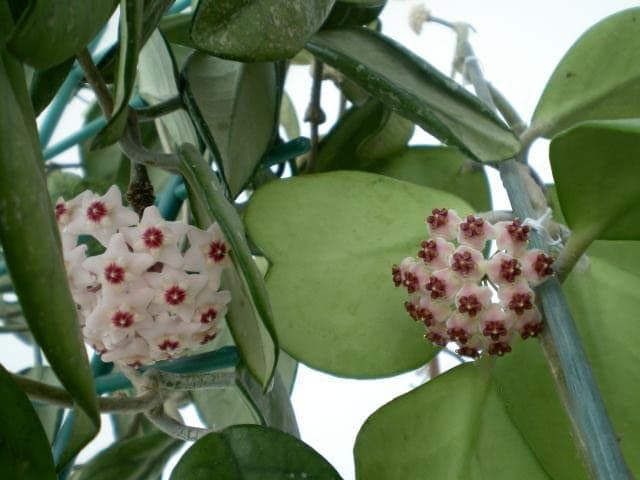
Hobbykafe / CC BY-SA 3.0, via Wikimedia Commons
Sweetheart hoya: care guide
Hoya kerrii
Want to see Sweetheart hoya: care guide in your garden?
Full design in HD: €7.99
Look after your Sweetheart hoya with the GardenWorld app
Identify plants with your camera and get a care calendar with reminders for this plant.


Overview
The sweetheart hoya (Hoya kerrii) is a climbing plant from the dogbane family (Apocynaceae) with thick, fleshy leaves shaped like hearts. Around Valentine's Day they are everywhere: a single leaf in a little pot, sold as a green love letter. It is also known as wax hearts or Valentine hoya. If you want to get to know the plant properly, though, choose one with stems. That grows into a trailing or climbing plant that lasts for years and, after a while, produces clusters of waxy, scented flowers.
The species grows wild in South-East Asia, from southern China through Vietnam, Laos, Cambodia and Thailand to Java. There it lives as an epiphyte or climber on trees and rocks, its roots tucked into a thin layer of humus and moss. That origin explains a lot: it copes with drought better than with wet roots, loves light but not scorching sun, and wants an airy, fast-draining mix. The species name honours the Irish physician and botanist Arthur Kerr, who collected plants in Thailand.
The sweetheart hoya is slow-growing but tough and forgiving. If you want the green mood to carry on from indoors to out, you can have a garden design made at gardenworld.app for your patio, conservatory or veranda.
Appearance and flowering
The leaves are the star. They are firm, glossy and succulent, usually 5 to 10 cm long and up to about 6 cm wide, with an unmistakable heart shape. Variegated forms exist: 'Albomarginata' has a white edge and 'Variegata' a yellow one. The stems start green and later turn woody. In the wild they climb several metres; indoors the plant usually stays at 1 to 2 m, not least because it grows so slowly.
A mature plant flowers in summer with rounded umbels of fifteen to twenty-five star-shaped flowers. Each flower is roughly 1 cm across and looks as if it were made of wax or porcelain: creamy white to soft pink, with a small dark red to reddish-brown crown in the centre. That is exactly what the photo shows: two domed clusters of white star flowers with dark red hearts among sturdy, slightly heart-shaped leaves and grey-green stems. The flowers smell sweet, mainly in the evening, and sometimes drip sticky nectar, so do not put your best tablecloth under a plant in bloom.
One important rule: never cut off the flower stalks after flowering. Hoyas flower again year after year from the same short spurs, which grow a little longer each season.
Where to put it indoors
Give the sweetheart hoya a warm spot with plenty of light, such as an east- or west-facing windowsill or a place a metre from a south window. It can trail from a hanging pot, but most growers train it around a hoop, a small trellis or a moss pole. Avoid moving the plant too often while it carries buds, as a big change in light or temperature can make it drop them.
Light
Light is the key to flowering. In a dark corner the plant survives but barely grows and will not bloom. Bright, indirect light with a few hours of gentle morning or evening sun is ideal. Harsh midday sun through glass can turn the leaves yellow or reddish and even scorch them. Variegated forms need a little more light than plain green ones.
Humidity
Thanks to its fleshy leaves, Hoya kerrii is less fussy about dry air than many tropical houseplants. Ordinary humidity of 40 to 60 % is enough. In a very dry, heated living room it helps to group it with other plants, but misting is not necessary.
Potting mix and repotting
The roots want air. Use an open mix of roughly one third houseplant compost, one third orchid bark and one third perlite or pumice. Ordinary compost on its own stays wet for too long. A pot with a drainage hole is essential, and a terracotta pot helps the mix dry out faster.
Hoyas like a snug pot and prefer to be repotted as rarely as possible. Only repot when roots are genuinely growing out of the pot, and then in spring into a pot just one size larger. A plant that is slightly pot-bound generally flowers more willingly.
Free preview
Want to see Sweetheart hoya: care guide in your garden? Make a free preview of your design.
Watering and feeding
Let the mix dry out most of the way between waterings. Push a finger into the pot: if it is dry 3 to 4 cm down, water thoroughly and let the excess drain away. In summer that is often once a week or less, in winter sometimes only every two to three weeks. Thin, wrinkled leaves mean the plant is thirsty; yellow, soft leaves and blackened stems point to overwatering and root rot.
From April to September, feed every three to four weeks with a liquid houseplant or orchid fertiliser at half strength. Do not feed in winter.
Propagation
The single heart leaf sold in shops often does root, but without a node at the base of the leaf stalk it rarely produces a new stem. Such a leaf can sit unchanged in its pot for years. If you want a genuine new plant, take a stem cutting with at least one, preferably two nodes and one or two leaves. Let the cut end dry for a few hours; a little white latex will seep out. Root the cutting in water, moist perlite or sphagnum moss at 20 to 25 °C in a bright spot. Roots appear after three to six weeks, and a new shoot may take weeks longer still. Patience comes with this plant.
Maintenance calendar
March-April: Growth begins. Repot only if really necessary and start feeding.
May-June: Take stem cuttings. Train new shoots onto the support and check for mealybugs and aphids around the buds.
July-August: Flowering time for mature plants. Do not move the plant and leave the flower spurs in place.
September-October: Stop feeding and gradually water less.
November-February: Rest period in a bright, slightly cooler spot. Keep the mix on the dry side. To keep track of everything, add watering, feeding and repotting to the planting calendar on gardenworld.app.
Temperature and winter care
Hoya kerrii grows best between 18 and 27 °C. In winter it can be a little cooler, around 15 to 18 °C; a cooler, drier rest may even encourage flowering the following summer. Below about 12 °C it suffers damage, and it will not survive frost. In summer the plant can stand on a sheltered patio in light shade as long as nights stay above 15 °C. Bring it back in well before autumn and check it for pests when you do.
Toxicity to pets
According to the ASPCA, the American animal welfare organisation that keeps a database of toxic and non-toxic plants, Hoya kerrii is non-toxic to dogs, cats and horses. An animal that chews a lot of the tough leaves may still get a mild stomach upset or vomit. The white latex that oozes from a cut can mildly irritate sensitive skin, so wash your hands after taking cuttings.
Companion plants
The sweetheart hoya goes well with other plants that like light and are happy to dry out between waterings. A Phalaenopsis amabilis wants almost the same airy mix and the same soft light. A Christmas cactus (Schlumbergera truncata) is an epiphyte just like the hoya and adds winter colour. For a group on a sunny shelf, Sedum morganianum, a Crassula ovata or a Zamioculcas zamiifolia all fit well and need little water. If you have pets, note that Crassula and Zamioculcas can make dogs and cats ill, so keep those out of reach.
Final thoughts
Hoya kerrii is more than a Valentine's gift. Choose a plant with stems, give it plenty of indirect light, an airy pot that dries out between drinks and, above all, time. Leave the flower spurs alone and repot as little as possible, and after a few years it will reward you with clusters of fragrant porcelain stars above its green hearts.

See it in your garden
See Sweetheart hoya in your garden
One photo of your garden and a few questions. You see the result in about a minute.
Try it with a photoIdentify this plant in your own garden. Identify a plant
Similar plants
Phalaenopsis amabilis: complete guide
Phalaenopsis amabilis (L.) Blume
Phalaenopsis amabilis (Moon Orchid) is an elegant houseplant with gorgeous white flowers. Learn care, watering, and blooming techniques.
Thanksgiving cactus: complete guide
Schlumbergera truncata
Schlumbergera truncata produces vibrant autumn flowers perfect for indoor cultivation. Learn watering, blooming triggers, and care for this popular houseplant.
Sedum morganianum: complete guide
Sedum morganianum
Burro's-tail succulent from Mexico: elegant trailing plant with watery-green, bead-like foliage. Perfect for hanging baskets and living walls.
