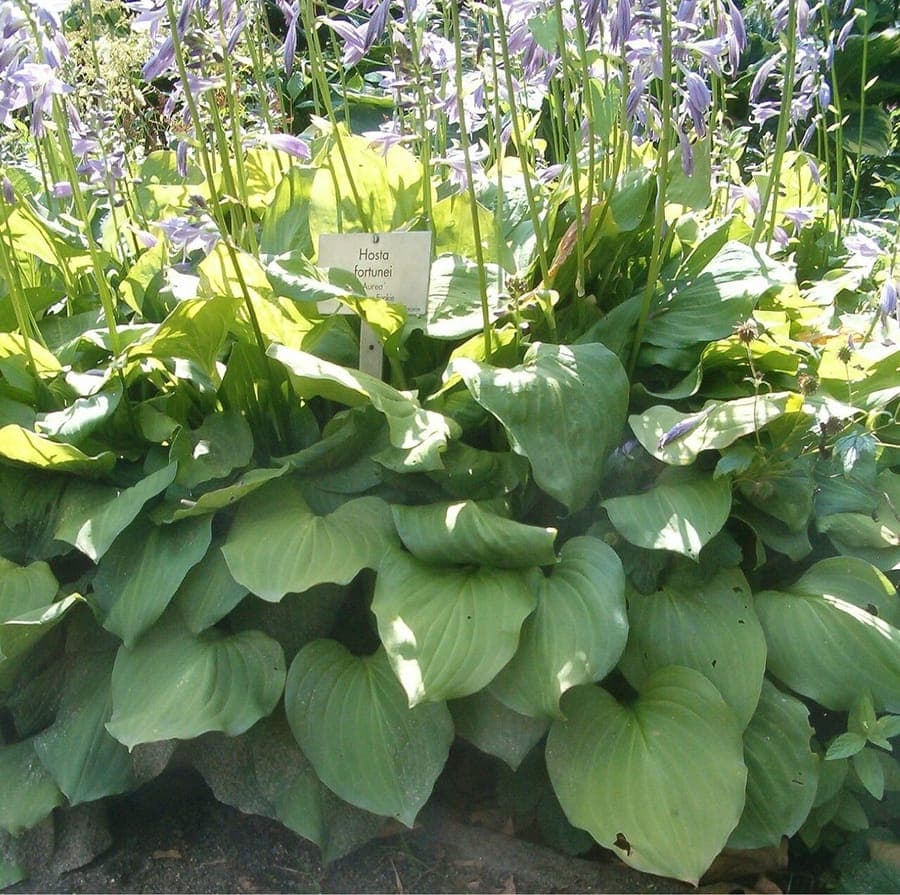
User:BotBln / CC BY-SA 3.0, via Wikimedia Commons
Hosta fortunei: complete guide
Hosta fortunei
Want to see Hosta fortunei: complete guide in your garden?
Full design in HD: €7.99
Look after your Hosta fortunei with the GardenWorld app
Identify plants with your camera and get a care calendar with reminders for this plant.


Overview
Hosta fortunei is one of the classic hostas for a shady garden, and the parent of many of the hostas found in every garden centre today. It comes from Japan, where it has been grown in gardens for centuries. It has never been found in the wild, so botanists regard it more as an old garden form than a true wild species, and some references place it within the Hosta sieboldiana group. Its name honours Robert Fortune, the Scottish plant hunter who brought many East Asian plants to Europe in the nineteenth century.
For gardeners, these botanical debates matter little. What counts is that Hosta fortunei is a tough, dependable perennial that forms dense clumps of large, heart-shaped leaves. The leaf mound reaches 40 to 60 cm high and 60 to 90 cm across. Well-known forms include 'Aureomarginata' (green leaves with a yellow margin), 'Albopicta' (yellow leaves edged green that turn green in summer), 'Aurea' (bright gold in spring, later pale green) and 'Hyacinthina' (grey-green leaves with a fine white edge). The popular 'Francee', with its narrow white margin, also belongs to this group.
Looking for the spot where a hosta will look its best? You can have a garden design drawn up on gardenworld.app in which shady corners and damp patches get the right planting from the outset.
Appearance and bloom cycle
The leaves are ovate to heart-shaped, 20 to 30 cm long and 12 to 20 cm wide, with deep parallel veins. In the species they are mid-green with a light grey bloom, especially on the underside. In spring they emerge as tightly rolled points and unfurl in April and May. From then until October the plant forms a closed, lush carpet.
In July and August sturdy flower stems rise 70 to 90 cm above the foliage. They carry dozens of funnel-shaped, pale lilac flowers, each 4 to 5 cm long, opening from the bottom upwards. Bumblebees love them. Green seed pods follow and later turn brown.
In autumn the leaves turn buttery yellow before collapsing after the first frost. Through winter there is nothing to see above ground; the plant survives as a sturdy rhizome in the soil.
Take care with pets: hostas contain saponins and are toxic to dogs and cats. Eating large amounts of leaf can cause vomiting or diarrhoea. For people the plant is of little concern, but never eat garden plants unless you are certain.
Ideal location
Hosta fortunei grows best in partial or light shade. A spot with morning sun and afternoon shade is ideal. It feels at home beneath high-canopied trees, on the north side of a house or beside a pond. It still grows well in deep shade, although it flowers less there.
Variegated forms such as 'Aureomarginata' tolerate a little more sun, provided the soil stays moist. Gold-leaved forms such as 'Aurea' colour better with some light but scorch in strong midday sun. Grey-green forms keep their waxy bloom best in shade. Space plants 60 to 80 cm apart; they take a few years to grow into full clumps. They also do very well in a large pot on a shady patio, where they are easier to protect from slugs and snails.
Soil requirements
A humus-rich, moisture-retentive but not waterlogged soil is ideal. Hostas enjoy the cool, loose soil of a woodland edge. A pH between 6 and 7.5 suits them; they are not fussy about acidity. On sandy soil, dig in plenty of compost or leaf mould so that moisture is held for longer. Heavy clay is less of a problem than dry sand, as long as water does not stand in winter.
Spread a few centimetres of compost or leaf mould around the clumps every spring. It feeds the plant, keeps the soil moist and improves its structure. Additional fertiliser is rarely needed.
Free preview
Want to see Hosta fortunei: complete guide in your garden? Make a free preview of your design.
Watering
Hostas need evenly moist soil to keep their large leaves in top condition. In the first year after planting, water twice a week during dry weather. Established plants in a shady, humus-rich border need little extra water in a normal summer, but during heatwaves and long droughts you will need to step in, or the leaves develop brown edges.
Water in the morning and at the base of the plant, not over the leaves. Wet foliage in the evening attracts slugs. Container plants dry out faster and often need water daily in summer.
Pruning
Pruning in the true sense is not needed for a perennial like this. After flowering, cut the spent stems down low unless you want to keep the seed pods. During summer, remove damaged or slug-eaten leaves to keep the clump tidy.
In autumn, once the foliage collapses after the first frost, clear it away. This prevents slugs from laying eggs in the rotting leaves. Large clumps can be divided every four to five years in March or April, just before the leaves unfurl. Cut the clump into pieces with a sharp spade, each with a few buds, and replant straight away.
Slugs and snails are the main enemy. Start protection as soon as the shoots appear: copper tape around pots, a wildlife-friendly slug control, beer traps and evening patrols all help.
Maintenance calendar
March–April: Divide clumps or plant new ones. Mulch with compost. Start slug control as the shoots appear.
May–June: Leaves unfurl fully. Keep an eye out for slugs, especially after rain. Water in dry spells.
July–August: Flowering. Water during heat and drought, especially in pots. Cut off spent flower stems.
September–October: Leaves turn yellow. Divide in September if you did not do so in spring.
November–February: Dormancy. Clear away collapsed foliage. Move pots to a sheltered spot.
Winter hardiness
Hosta fortunei is exceptionally hardy and survives temperatures down to -35 °C, corresponding to USDA zone 3. In Britain, Ireland and the Low Countries it needs no winter protection at all in open ground. A cold winter actually helps: hostas need a chilly dormant period to come back strongly in spring.
The only risk comes in spring. A late night frost in April or May can damage young, unfurling leaves. This causes unsightly marks or holes but does not kill the plant, and new leaves will follow. In a pot, the root ball can freeze solid in a hard winter, so move the pot against a wall or sink it into the ground. Never leave pots standing in water over winter.
Companion plants
Together with ferns and other shade lovers, hostas form the backbone of a green woodland garden. Male fern (Dryopteris filix-mas) adds fine, airy fronds beside the broad hosta leaves. Astilbe japonica flowers at the same time and brings pink, red or white plumes into the shade.
For spring, before the hosta is up, Brunnera macrophylla and bleeding heart (Lamprocapnos spectabilis) make good partners. Heuchera micrantha and its coloured-leaf cultivars provide contrast at the front of the border.
Final thoughts
Hosta fortunei is the plant for turning a shady corner into a lush, green scene. It is tough, long-lived and completely hardy, and in summer it adds lilac flowers for the bumblebees. Give it humus-rich, moist soil, protect the young shoots from slugs and keep dogs and cats away from the leaves, and it will reward you for decades.
Want to know when to divide, feed or tidy up? The plant calendar on gardenworld.app gives you the right monthly tasks for your hostas and the rest of your garden.
Frequently asked questions about Hosta fortunei
Is Hosta fortunei winter hardy?
Hosta fortunei is exceptionally hardy and survives temperatures down to -35 °C, corresponding to USDA zone 3. In Britain, Ireland and the Low Countries it needs no winter protection at all in open ground.
When and how do you prune Hosta fortunei?
Pruning in the true sense is not needed for a perennial like this. After flowering, cut the spent stems down low unless you want to keep the seed pods.
How much water does Hosta fortunei need?
Hostas need evenly moist soil to keep their large leaves in top condition. In the first year after planting, water twice a week during dry weather.
Where does Hosta fortunei grow best?
Hosta fortunei grows best in partial or light shade. A spot with morning sun and afternoon shade is ideal.
What soil does Hosta fortunei need?
A humus-rich, moisture-retentive but not waterlogged soil is ideal. Hostas enjoy the cool, loose soil of a woodland edge.

See it in your garden
See Hosta fortunei in your garden
One photo of your garden and a few questions. You see the result in about a minute.
Try it with a photoIdentify this plant in your own garden. Identify a plant
Similar plants
Male fern: complete guide
Dryopteris filix-mas
Learn how to grow Male fern (Dryopteris filix-mas) successfully: care, soil, watering, and ideal companion plants for lush green woodland gardens.
Japanese astilbe: complete guide
Astilbe japonica
Japanese astilbe brings elegant feathery flowers and fine foliage to shaded gardens. Perfect border perennial for moist soils and cool settings.
Great forget-me-not: complete guide
Brunnera macrophylla
Brunnera macrophylla, also known as Great forget-me-not, is a shade-loving perennial with heart-shaped leaves and spring blue flowers. Learn care, soil and planting tips.
