
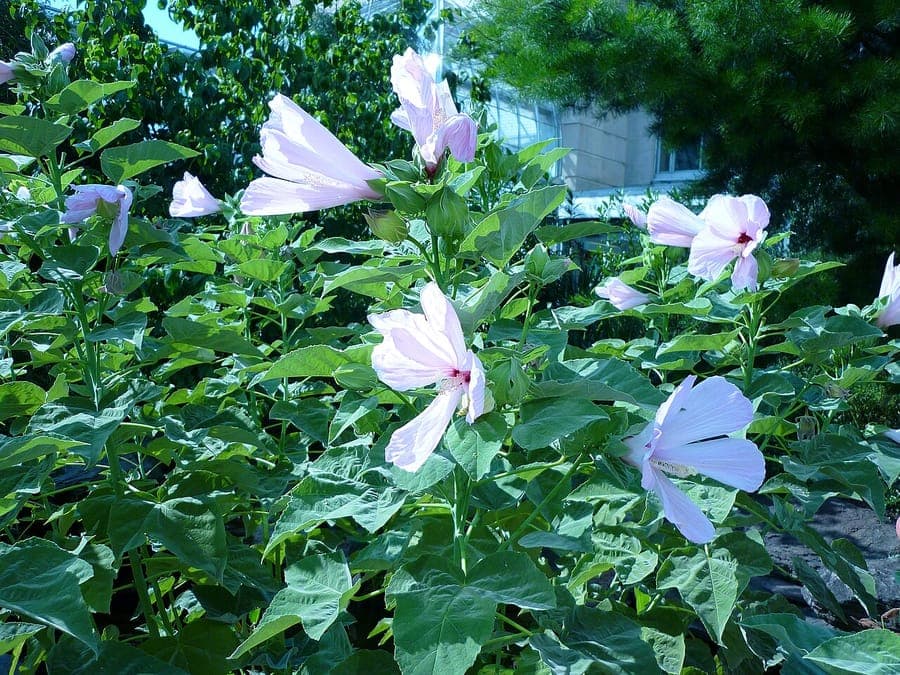
Mackenzie from Washington, DC / CC BY-SA 2.0, via Wikimedia Commons
Hibiscus grandiflorus: complete guide
Hibiscus grandiflorus
Want to see Hibiscus grandiflorus: complete guide in your garden?
1 minute, no credit card
Overview
Hibiscus grandiflorus, commonly known as swamp rosemallow or swamp rose-mallow, is a native American shrub occurring in wetland and marshy areas of the southeastern United States. This native hibiscus differs from tropical species through its large, silky flowers and preference for moist to wet growing conditions. The plant naturally occurs in swamps, water-saturated savannas, and lowlands from Alabama to Texas, with distribution extending to Cuba.
Unlike Mediterranean hibiscus species, Hibiscus grandiflorus tolerates permanently wet feet and thrives in soils that remain waterlogged for portions of the year. The shrub reaches heights of 1.5 to 2.5 metres and spreads 1 to 1.5 metres wide, making it suitable for large borders, back gardens with water features, and landscapes where standing water persists seasonally.
Appearance and Bloom
Swamp rosemallow grows as an upright shrub with dense, slender branching patterns. Leaves are lance-shaped to oval, 5 to 10 centimetres long, softly hairy, and deep green. From late July through October, flowers emerge, typically two to four centimetres across, though well-maintained plants produce blooms to five centimetres.
Flowers are pink to magenta-red with prominent dark red or magenta veins radiating from the centre. Some cultivars feature cream, white, or pale pink flowers. The flower centre is dark red with yellow stamens. Each bloom lasts one day only, but numerous buds opening gives continuous flowering over two to three months.
Ideal Location
Swamp rosemallow thrives in sunny locations, requiring minimum 6 hours direct sunlight daily. The plant tolerates partial shade (4-6 hours sun), though full sun produces maximum flowers. In very hot southern climates, some afternoon shade proves beneficial.
This is not a plant for dry, hot rock gardens. Rather, it thrives along pond edges, in rain gardens, wet borders, and locations where groundwater sits close to the surface. The plant suits USDA zones 6 to 9, but grows best in zones 7 to 9. In zone 6, frost damage to stems may occur; however, these regenerate from root crowns the following season.
Soil
Soil must retain moisture persistently to wet. This fundamentally distinguishes Hibiscus grandiflorus from most ornamental shrubs. In standard garden soils, incorporate abundant organic matter, at least 30 percent decomposed compost or peat, to increase moisture retention. Soil may be acidic; pH 5.5 to 7.0 proves acceptable.
In naturally wet areas (riverbanks, natural wetland zones), the plant grows without modification. When uncertain, add heavy clay or peat to improve water retention. Avoid light, sandy, or highly draining soils unless making substantial amendments.
Watering
Regular watering proves essential. During growing season (April through October), soil must remain consistently moist, never truly dry. For the first two seasons post-planting, check at least twice weekly, providing supplemental water if the top two centimetres feel dry.
After establishment (year 2 onwards), the plant tolerates slightly drier periods but continue providing water regularly. In hot summers or dry spells, water deeply two to three times weekly. In autumn and winter, water much less but ensure soil never completely dries. Drip irrigation or soaker hoses work well, delivering water slowly and deeply.
Free design
Want to see Hibiscus grandiflorus: complete guide in your garden? Make a free design now.
Pruning
Pruning significantly improves form and flowering performance. In late winter (February-March) or very early spring, cut back the entire shrub to approximately 60 centimetres height. This appears aggressive, but strong, floriferous stems emerge from this base.
During growing season, remove isolated lower branches to improve air circulation at the base and prevent sweet-rot disease. After flowering peak (September-October), deadheading encourages additional bloom formation, though this proves optional.
Avoid severe formal pruning; a mostly natural form appears better and produces more flowers than tightly clipped shapes. Seasonal or annual maintenance pruning suffices.
Maintenance Calendar
February-March: Heavy pruning to 60 centimetres. Add organic matter in spring. April-May: New leaf growth begins. Water regularly. Begin feeding every two weeks. June-July: Continued leaf growth. Continue watering. First buds appear. August-October: Peak bloom. Continue watering and feeding. Deadheading encourages extended flowering. November-January: Growth slows and blooming declines. Minimal watering. Prepare for next pruning cycle.
Winter Hardiness
Hibiscus grandiflorus is winter-hardy to USDA zone 6 (minimum temperature approximately -23 degrees Celsius). In zone 6, however, aboveground portions may die in severe winters. This proves non-fatal; the plant regenerates from root crowns the following growing season, though often with less vigor and fewer flowers.
In zones 7 to 9, plants typically survive complete winters. In zone 6, protect plants in November with a mulch layer around the base approximately 15 centimetres deep. This safeguards the root zone. Remove mulch in March when ground becomes frost-free.
Companion Plants
Swamp rosemallow pairs excellently with other moisture-loving plants: Iris laevigata (Japanese water iris), Astilbe species, and Filipendula ulmaria (meadowsweet). For larger compositions, add Vernonia species (ironweed) and Liatris species (blazing star). When edging water features, it combines beautifully with lower forms such as Carex species (sedges) and dwarf Hosta cultivars.
In gardens with less permanent moisture, it combines with other native American shrubs tolerating moderate moisture like Sambucus nigra (elderberry) and Calycanthus floridus (Carolina allspice).
Closing Thoughts
Swamp rosemallow provides abundant summer and autumn garden character for those accepting its moisture-loving nature. The large, silky flowers from July through October offer substantial pollinator attraction. In suitable marshy or wet conditions, it grows without issues and with minimal maintenance. Try groupings of three or more plants for dramatic effect, or plant individually as a focal point in a wet border. With consistent watering and annual pruning, this becomes a long-lived, floriferous garden addition.
Want to see Hibiscus grandiflorus: complete guide in your garden? Make a free design now.
Upload a photo, pick a style, and get a photorealistic design with plant list in under a minute.
10,000+ gardens designed already
No credit card required


Similar plants
Crimean linden: complete guide
Tilia × euchlora
Crimean linden is an elegant, fast-growing shade tree ideal for large gardens. Discover cultivars, spacing, maintenance tips and winter hardiness.
California flannelbush: complete guide
Fremontodendron californicum
Everything about California flannelbush (Fremontodendron californicum): sunny placement, drainage, pruning and care for this spectacular yellow-flowering shrub.
Hairy rose mallow: complete guide
Hibiscus moscheutos subsp. lasiocarpos
Full growing guide for hairy rose mallow (Hibiscus moscheutos subsp. lasiocarpos): location, soil, watering, winter hardiness and garden design tips.