
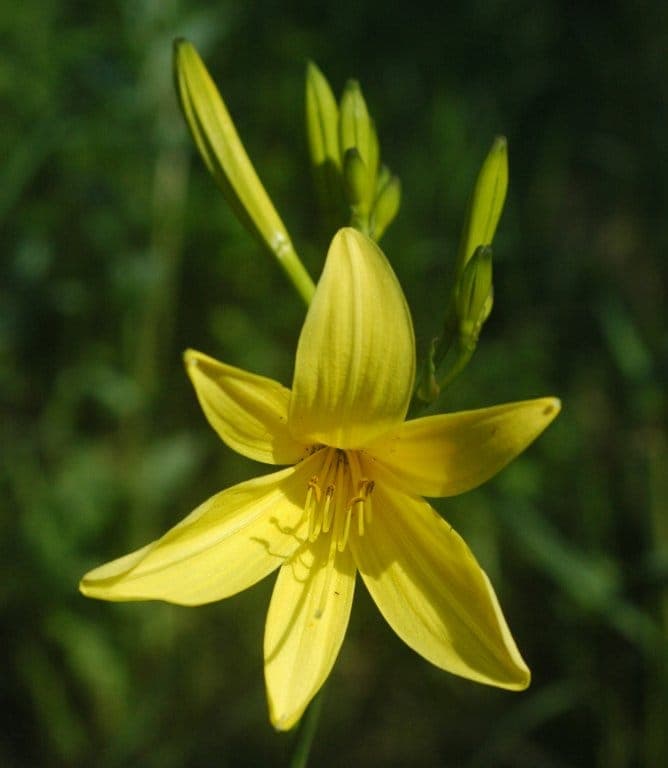
Doronenko / CC BY 2.5, via Wikimedia Commons
Daylily: complete guide
Hemerocallis
Want to see Daylily: complete guide in your garden?
1 minute, no credit card
Overview
The Daylily (Hemerocallis) is one of the most rewarding and versatile perennials you can plant in a garden. The name says it all: each individual flower opens in the morning and closes for good the following evening. But do not let that deter you - a mature plant produces thirty to fifty buds per flower stalk, which means the display can last six to eight weeks. From June to August, daylilies brighten the garden with lily-shaped blooms in virtually every conceivable colour: yellow, orange, red, pink, purple, cream, and even near-black.
Daylilies are herbaceous perennials reaching 40 to 100 cm in height, depending on the cultivar. On gardenworld.app you can create a garden design where daylilies deliver colour and structure - in a border, as ground cover on a slope, or as a bold accent beside a pond. The plant belongs to the family Asphodelaceae and originates from East Asia. There are now more than 80,000 registered cultivars, from dwarf forms to giants. Reliable popular choices include 'Stella de Oro' (golden yellow, reblooming, compact), 'Pardon Me' (deep red, fragrant, compact), and 'Happy Returns' (lemon yellow, reblooming).
Appearance and bloom cycle
Daylily flowers are trumpet-shaped to star-shaped, 5 to 15 cm across, and consist of six tepals. They appear on sturdy, leafless scapes that rise above the grassy foliage. Each scape carries multiple buds that open in succession, keeping the display going for weeks. Some modern cultivars, the so-called reblooming types, produce a second flush of flowers in late summer.
The foliage is long, narrow, and arching, similar to ornamental grasses. It forms dense clumps that provide a decorative green mass even when the plant is not in flower. Some daylilies are deciduous (dormant), others are evergreen, and there is an intermediate group (semi-evergreen). In temperate climates with cold winters, dormant types generally perform best because they enter full winter dormancy and cope well with frost.
Ideal location
Daylilies are true sun-lovers. Plant them where they receive at least 6 hours of direct sunlight per day for the most flowers and the richest colours. In partial shade they still bloom, but less abundantly, and the scapes may grow taller and weaker. Light-coloured cultivars (yellow, cream, pastel pink) tolerate partial shade better than dark shades (red, purple), which achieve their deepest tones in full sun.
The daylily is remarkably wind-resistant thanks to its flexible scapes and low foliage mass. It is also suitable for planting beside ponds and watercourses, on slopes and banks (an excellent erosion controller), and in coastal gardens with salt-laden air. Space clumps 40 to 60 cm apart, depending on the cultivar's size.
Soil requirements
Daylilies are remarkably tolerant regarding soil and grow in virtually any ground type: clay, loam, sand, and even poor soil. The ideal soil is moisture-retentive yet well-drained, slightly acidic to neutral with a pH of 6.0 to 7.0. On heavy clay it is advisable to work some compost and coarse grit into the soil at planting time to improve drainage.
Although daylilies survive in poor ground, they reward an annual application of compost or a slow-release organic fertiliser in spring with more flowers and larger clumps. Avoid high-nitrogen feeds - they encourage foliage at the expense of blooms. A 5 cm mulch layer (bark, cocoa shells, or leaf mould) around the clumps keeps the soil moist and suppresses weeds.
Watering
Daylilies are remarkably drought-tolerant once established. Their thick, fleshy roots store moisture like a sponge, allowing them to survive longer dry spells than most other perennials. In the first year after planting, water weekly during dry weather - roughly 5 to 8 litres per plant.
From the second year onward, supplementary watering is only needed during extreme drought exceeding three weeks. Flowering does benefit from regular moisture, however: daylilies that receive adequate water during the bloom period produce larger flowers and more buds. Always water at the base and avoid wetting the foliage, especially in the evening, to prevent fungal problems. In containers the soil dries out faster - check every two to three days.
Free design
Want to see Daylily: complete guide in your garden? Make a free design now.
Dividing
After three to five years, daylilies form dense clumps that flower less freely in the centre - a sign that it is time to divide. Division is also the simplest way to expand your collection. The best time is early spring (March–April) or early autumn (September).
Dig up the entire clump with a spade and shake off the soil. Divide it into pieces of three to five growth points (fans), using your hands or two forks placed back to back. Cut the foliage back to approximately 15 cm to reduce transpiration and replant the divisions at the same depth as the original, with the crown just below the soil surface. Water in well and keep newly planted divisions moist for the first few weeks.
Maintenance calendar
March–April: Remove old, dead foliage from dormant types. Apply a layer of compost or slow-release fertiliser around the clumps. Divide overcrowded clumps.
May: Foliage grows rapidly. Check for aphids and thrips - these can damage flower buds.
June–August: Flowering season. Remove spent flowers daily (deadhead) to keep the plant tidy and redirect energy to new buds. Cut completely finished scapes at the base.
September: Possible second flush on reblooming types. Divide clumps that have outgrown their space.
October–November: Foliage dies back on dormant types. Cut it to 5–10 cm above ground and remove it from the garden to limit overwintering pests.
December–February: Dormancy. Daylilies overwinter underground without any difficulty.
Winter hardiness
Hemerocallis is extremely winter-hardy. Most cultivars tolerate temperatures down to -30 °C and below (USDA zones 3 to 9). Across the entire British Isles, the Netherlands, Belgium, and most of Europe, daylilies overwinter without any protection. Dormant types are the hardiest and perform best in cool climates with a distinct winter period.
Evergreen types are slightly more susceptible to severe frost and may die back above ground in cold winters, but they usually recover in spring. Semi-evergreen cultivars form a reliable compromise. New plantings in late autumn benefit from a protective 10 cm mulch layer during their first winter.
Edible daylilies
Few gardeners realise it, but daylilies are edible - and not merely as a curiosity. In Chinese cuisine, daylily buds have been used as a vegetable for more than two thousand years. The closed buds are stir-fried, steamed, or added to stir-fry dishes and taste mild, slightly sweet, comparable to young green beans. The young shoots in early spring and the thickened roots are also edible.
Use only unsprayed plants and start with small quantities - some people experience mild sensitivity on first consumption. Important: never confuse daylilies (Hemerocallis) with true lilies (Lilium), which are toxic to cats. Daylilies are safe for pets and people.
Companion plants
Daylilies are fantastic companion plants thanks to their long flowering season and broad colour range. They pair excellently with ornamental grasses such as Stipa tenuissima and Miscanthus, which provide an airy contrast to the broad daylily foliage. The classic combination is daylilies with coneflower (Echinacea purpurea) and black-eyed Susan (Rudbeckia fulgida) for a late-summer display in warm tones.
For shadier spots, combine daylilies with hostas (Hosta), astilbe, and heuchera. In a formal border, daylilies work alongside lavender, sage (Salvia nemorosa), and catmint (Nepeta). For a wild, prairie-style look, plant daylilies among yarrow, Verbena bonariensis, and agastache. The green foliage clumps of daylilies also serve as ground cover in the foreground of a shrub border.
Final thoughts
The daylily is the ultimate plant for beginners and experienced gardeners alike: it flowers profusely, tolerates drought, grows in any soil, overwinters without trouble, and multiplies naturally into beautiful groups. With more than 80,000 cultivars, there is a daylily for every garden and every taste.
Choose 'Stella de Oro' for a reliable golden sea, 'Pardon Me' for dramatic deep red, or 'Happy Returns' for sunny lemon yellow. On gardenworld.app you can create a garden design that combines daylilies with the right partners for your specific garden. Plant a group of daylilies this spring and enjoy their daily flower salvo all summer long.
Want to see Daylily: complete guide in your garden? Make a free design now.
Upload a photo, pick a style, and get a photorealistic design with plant list in under a minute.
No credit card required


Similar plants
Hosta: complete guide
Hosta
Everything about hostas (plantain lilies): varieties, planting, care and slug control. Expert tips for stunning foliage in shade gardens.
Purple coneflower: complete guide
Echinacea purpurea
Everything about Purple Coneflower (Echinacea purpurea): planting, care, pruning and combinations. Expert tips for a thriving prairie-style garden.
Orange Coneflower: complete guide
Rudbeckia fulgida
Everything about Rudbeckia fulgida (orange coneflower): planting, care, combinations and bloom time. Practical tips for months of golden-yellow flowers.