
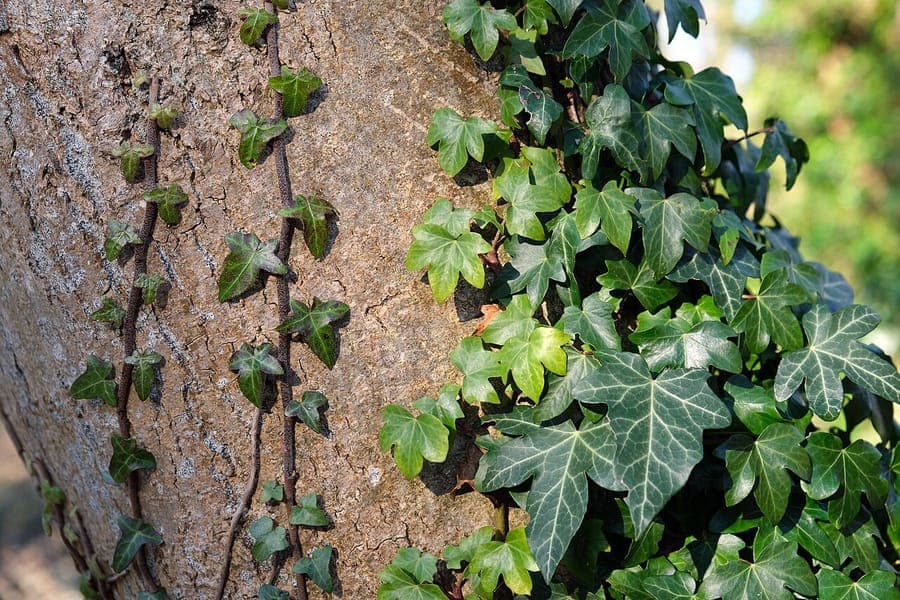
kallerna / CC BY-SA 4.0, via Wikimedia Commons
Ivy: complete guide
Hedera helix
Want to see Ivy: complete guide in your garden?
1 minute, no credit card
Overview
Common Ivy (Hedera helix) is the most versatile evergreen plant you can put in a temperate garden. Whether you need to clothe a bare wall, suppress weeds under mature trees, or create a dense screen on a fence, ivy handles every task with quiet efficiency, twelve months of the year. Native across Europe from the Mediterranean to southern Scandinavia, this self-clinging climber thrives in conditions that would finish most other plants.
Ivy ascends using adventitious aerial rootlets that grip onto brickwork, bark, and fencing, reaching heights of 30 metres on tall structures. As ground cover, it spreads indefinitely, forming a dense evergreen carpet that smothers weeds once established. On gardenworld.app you can create a garden design that gives ivy exactly the right role - as a living green wall, as weed-free ground cover beneath old trees, or as a fence screen. Dozens of cultivars exist: 'Goldchild' with yellow-green variegated leaves, 'Glacier' with silvery foliage, 'Hibernica' (Irish Ivy) with oversized leaves and rapid growth, and 'Green Ripple' with deeply cut, elegant foliage.
Appearance and bloom
Ivy has two distinct life phases that many gardeners never learn about. The juvenile phase produces the familiar palmate, three- to five-lobed leaves that press flat against walls or trail across the ground. During this phase, the plant climbs actively and produces no flowers. The adult phase occurs only when the plant reaches sufficient light, typically at the top of a wall or tree canopy. The leaves then change dramatically: they become oval to diamond-shaped, unlobed, thicker, and darker green. The stems become woody and grow away from the supporting surface.
In the adult phase, ivy flowers in September and October with spherical umbels of small, yellow-green blooms. This late flowering is ecologically significant: ivy is one of the last nectar sources of the season for bees, hoverflies, and butterflies across the Northern Hemisphere. After flowering, blue-black berries develop through winter and ripen in February to March, providing a vital food source for blackbirds, thrushes, and wood pigeons when little else is available. Few plants offer both late nectar and early berries.
Growth rate varies considerably by cultivar and situation. In the first two years after planting, ivy grows slowly while establishing its root system. Thereafter, the plant puts on 30 to 60 cm annually, and well-established specimens in a favourable spot easily manage a metre per year. 'Hibernica' is the fastest grower; compact variegated cultivars like 'Goldchild' grow noticeably more slowly.
Ideal location
The defining strength of ivy is its shade tolerance. No other evergreen climber performs as reliably in deep shade as Hedera helix. The plant excels on north- and east-facing walls that receive little direct sunlight, beneath dense tree canopies, and in narrow city gardens hemmed in by tall buildings. Full sun is also tolerated, though on a south-facing wall in full exposure, leaves may scorch in harsh winters from the combination of frost and bright sun.
For wall coverage, ivy is suited to brick, concrete, render, and natural stone. The persistent belief that ivy damages walls is largely a myth - on sound masonry, ivy actually protects mortar from rain, frost, and UV degradation. Problems arise only when pointing is already loose and the aerial rootlets exploit existing cracks. Inspect your wall before planting: if the mortar is sound, plant with confidence. On compromised walls, a trellis with guided growth is a better option.
In the United States and Australia, Hedera helix is classified as invasive in some regions. Check local regulations before planting and avoid allowing the plant to escape into native bushland. In the UK and continental Europe, ivy is native and supports a broad ecosystem of wildlife.
Soil requirements
Ivy is genuinely undemanding about soil. It grows in clay, sand, loam, chalk, and everything in between. Heavy clay that would defeat most Mediterranean plants? No problem. Dry sandy soil? Equally fine. The only soil condition ivy cannot tolerate is prolonged waterlogging, which leads to root rot.
The ideal soil pH sits between 5.5 and 7.5, but ivy also handles chalky soil up to pH 8.0 without complaint. When planting ivy as ground cover, lightly improving the soil with some compost speeds establishment, though the plant does not strictly require it. Dig a planting hole twice the width of the rootball and plant at the same depth as the pot. For wall coverage, position the plant 20 to 30 cm out from the wall, since soil directly against a wall is often too dry due to rain shadow.
Watering
Established ivy in open ground almost never needs supplementary watering. The plant is extremely drought-tolerant once its root system has developed, which typically happens within the first growing season. During the first year after planting, water weekly in dry spells - roughly 5 to 10 litres per plant - particularly when the ivy is planted at the base of a wall where rain cannot reach.
Ivy in containers requires more attention. Check soil moisture every three to four days in summer and water when the top 3 cm feels dry. In winter, keep container ivy slightly moister than most other evergreens, because the foliage continues to transpire and the roots remain active. Always ensure containers have drainage holes - despite its tolerance for damp conditions, ivy does not withstand standing water.
Free design
Want to see Ivy: complete guide in your garden? Make a free design now.
Pruning
You prune ivy primarily to keep it in check, not to encourage growth. Left unchecked, ivy will invade window frames, gutters, roof tiles, and downpipes. Prune two to three times per year: in April after the last frosts, in June once the first growth flush subsides, and optionally in September.
Use hedge shears for large surfaces and secateurs for individual runners. Cut wall ivy back to 15 to 20 cm from window and door frames, and keep growth clear of the top of the wall and the roofline. For ground cover that has grown too tall, you can mow established ivy with a rotary mower on the highest setting in spring - it sounds brutal, but ivy recovers effortlessly. Always remove runners that root in unwanted places, because once established, ivy is difficult to eradicate.
Be mindful of nesting season (approximately March to July in the Northern Hemisphere). Ivy is a key nesting site for blackbirds, wrens, and spotted flycatchers. Check for active nests before pruning during this period. In winter, ivy provides critical shelter for overwintering insects and roosting birds.
Maintenance calendar
March–April: First prune once risk of hard frost has passed. Clear dead and brown leaves from ground cover plantings. Inspect wall-grown plants for loose mortar.
May–June: Second prune in mid-June. Keep runners away from window frames, gutters, and downpipes. Plant new ivy and water in well.
July–August: Monitor for spider mite in hot, dry weather - the only pest that regularly troubles ivy. Blast infested foliage with a strong jet of water.
September–October: Flowering season for mature ivy. Leave the blooms for pollinators. Optional third prune.
November–December: Berries begin to colour. Ivy provides essential winter shelter for birds - disturb the planting as little as possible.
January–February: Berries ripen and are eaten by birds. Order new plants for spring planting.
Winter hardiness
Hedera helix is fully hardy across Europe, the UK, and much of North America, tolerating temperatures down to -20°C to -25°C (USDA zones 4 to 9). The plant retains its leaves year-round, though foliage may temporarily droop or take on a brownish tint during severe frost. It recovers completely once temperatures rise.
Variegated cultivars such as 'Goldchild' and 'Glacier' are slightly less hardy than green-leaved forms and may suffer leaf damage below -15°C. Plant these in a sheltered position - a west- or south-facing wall works well. 'Hibernica' is especially tough and is widely used in municipal plantings and along motorway embankments.
Winter scorch can occur when severe frost combines with bright sunshine, typically on south-east-facing walls in February. This is purely cosmetic - the plant pushes fresh growth in spring. A layer of mulch around the base of newly planted ivy helps insulate roots through the first winter.
Companion plants
Ivy as ground cover pairs beautifully with spring bulbs that push through the leaf canopy: snowdrops (Galanthus), crocuses, bluebells (Hyacinthoides), and daffodils naturalise effortlessly through an ivy carpet. The evergreen backdrop makes the spring flowers stand out vividly.
As wall cover, ivy complements clematis perfectly - the ivy shades the clematis root zone, which is precisely what clematis needs. Hydrangeas (Hydrangea macrophylla) planted in a border in front of an ivy-clad wall create a classic combination in urban garden design. Yew (Taxus baccata) and box (Buxus sempervirens) as clipped forms alongside ivy walls provide structure and depth.
For a naturalistic planting, combine ground-cover ivy with ferns (Dryopteris), hellebores, hostas, and bergenia - all shade-loving plants that appreciate identical conditions. Avoid combining ivy with sun-lovers such as lavender or salvia, whose requirements are fundamentally different.
Closing
Ivy deserves far more respect than it typically receives. Where other plants fail - in deep shade, on poor soil, under neglect - ivy performs quietly and continuously, every month of the year. It feeds and shelters dozens of wildlife species, protects masonry from the elements, and forms the lowest-maintenance ground cover available to gardeners.
Plant ivy with a plan: choose the right cultivar for the situation, ensure adequate drainage, and prune two to three times a year to manage growth. Most garden centres stock a broad selection, from compact variegated types for a balcony pot to vigorous forms for covering a large wall. On gardenworld.app you can create a garden design that assigns ivy the perfect role - as a green wall, ground cover, or component of a shade border. Start this season and give your garden a green dimension that is visible twelve months of the year.
Want to see Ivy: complete guide in your garden? Make a free design now.
Upload a photo, pick a style, and get a photorealistic design with plant list in under a minute.
No credit card required


Similar plants
Common Boxwood: complete guide
Buxus sempervirens
Everything about Common Boxwood (Buxus sempervirens): planting, pruning, topiary and box moth control. Practical tips for healthy, green hedges and shapes.
Bigleaf Hydrangea: complete guide
Hydrangea macrophylla
Everything about the Bigleaf Hydrangea (Hydrangea macrophylla): planting, pruning, flower colour control and winter protection. Practical tips for lush blooms.
English Yew: complete guide
Taxus baccata
Everything about English Yew (Taxus baccata): planting, clipping, topiary and care. Expert tips for a dense hedge or elegant sculptural form.