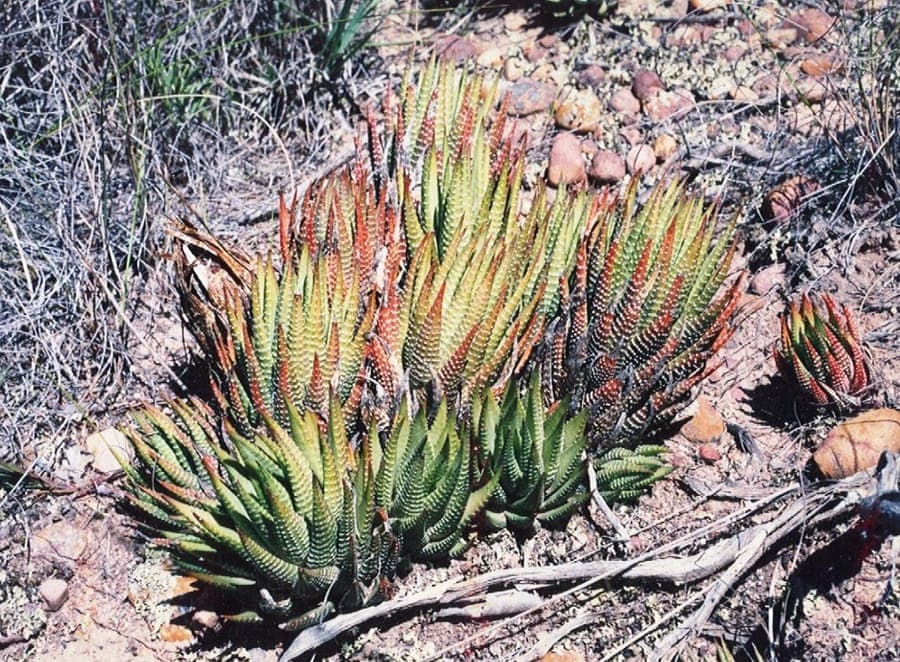
Abu Shawka / CC BY-SA 4.0, via Wikimedia Commons
Zebra plant (Haworthiopsis fasciata): care, light and rest
Haworthiopsis fasciata
Want to see Zebra plant (Haworthiopsis fasciata): care, light and rest in your garden?
Full design in HD: €7.99
Look after your Zebra plant with the GardenWorld app
Identify plants with your camera and get a care calendar with reminders for this plant.


Overview
The zebra plant (Haworthiopsis fasciata) is a small succulent with firm, dark green leaves covered in white horizontal stripes. It is closely related to aloes rather than cacti, and belongs to the Asphodelaceae along with Aloe and Gasteria. Garden centres often still label it Haworthia fasciata, because it was only in 2013 that a group of species with hard, rough leaves was split off into the new genus Haworthiopsis. The ASPCA uses the name zebra haworthia.
It comes from a small area of the Eastern Cape in South Africa, around Gqeberha (formerly Port Elizabeth). There it grows among grasses, low shrubs and stones, often partly sheltered from the fiercest sun. That background explains why it does so well indoors: it tolerates drought, wants plenty of light but not scorching sun, and is content in a small pot.
One point to know before you start: many plants sold as zebra plant are in fact Haworthiopsis attenuata or a hybrid. The difference is on the inner face of the leaves. In true fasciata it is smooth and glossy, with the white stripes only on the outer face. In attenuata the white bumps cover both sides. It makes little difference to care, but collectors look closely.
Appearance and flowering
The plant forms rosettes 5 to 10 cm tall. The leaves are triangular to lance-shaped, 4 to 8 cm long, stiff and pointed, and curve upwards and inwards. On the outer face, white tubercles merge into horizontal bands, creating the zebra pattern. Over time the mother plant produces offsets around its base, building a dense clump of rosettes, just like the wild plant in the photo.
In strong sun the leaves turn reddish brown to orange. That is a stress response, not a disease; with slightly less light they go green again. If they stay red and become soft or wrinkled, it is too hot or too dry.
Mature plants flower in late spring and summer. From the centre rises a slender stalk 20 to 40 cm long, carrying small, tubular white flowers with greenish or pinkish stripes. They are modest but graceful. If you prefer to keep the energy in the rosette, cut the stalk off after flowering.
Position and light
Give the plant a bright spot: an east or west-facing windowsill is ideal, with a few hours of morning or evening sun. A south window will also do, but in summer full midday sun behind glass is too fierce, so move it half a metre back or draw a net curtain.
Too little light soon shows: the rosette turns pale, the leaves lengthen and open out, and the plant leans towards the window. Give the pot a quarter turn every few weeks for an even shape. In summer it can go outside in a bright, sheltered spot, but let it adjust gradually to outdoor light or it will scorch. Keep it out of the rain too: a wet pot on a cool night is the quickest route to rot.
Compost and repotting
A haworthia wants a mineral, fast-draining mix. Use cactus compost and blend in an equal amount of pumice, lava grit or coarse sand. Ordinary potting compost holds water for too long.
The roots are thick and fleshy and partly renew themselves each year. A shallow, wide pot with a drainage hole suits it best, ideally terracotta, which lets moisture evaporate. Repot every two to three years in spring, or when offsets fill the pot. Leave the plant dry for a week after repotting so that damaged roots can callus before you water again.
Watering
Water on the soak-and-dry principle. Give a thorough drink until water runs out of the bottom, tip away the excess and then wait until the compost is completely dry. In the growing season that works out at roughly once a week to once a fortnight, depending on warmth and pot size.
Water the compost, not the heart of the rosette: water that sits there can cause rot. Overwatering is by far the most common cause of death. Soft, glassy or translucent leaves at the base almost always mean the roots are too wet.
Free preview
Want to see Zebra plant (Haworthiopsis fasciata): care, light and rest in your garden? Make a free preview of your design.
Growth and rest
Haworthiopsis fasciata grows mainly in spring and autumn. In the height of a hot summer growth slows, so give a little less water if the plant is making nothing new. From November to February it has a rest period. Ideally keep it cool, between 10 and 15 °C, in a bright place, and give only a small amount of water every three to four weeks, just enough to stop the leaves shrivelling. In a warm living room the plant will carry on growing, so water a little more often, but still sparingly.
This cool, dry rest is not essential, but plants that get one stay more compact and flower more readily.
Feeding
This succulent needs very little feed. From April to September, give a half-strength cactus fertiliser once a month. Give nothing during the rest period. Too much nitrogen leads to soft, stretched rosettes.
Propagation and care
The easiest way to propagate is from offsets. Wait until an offset has a few roots of its own, carefully separate it when repotting, let the cut dry for a day and pot it into a small container of dry, mineral mix. Water for the first time after a week. Leaf cuttings are possible too, but slow.
Beyond that, the plant asks for little. Remove dried-up lower leaves. Check between the leaves now and then for mealybug, which shows as white fluff. A cotton bud dipped in a little alcohol deals with a minor infestation.
Care calendar
January to February: Rest. Cool and bright, very little water.
March to April: Growth resumes. Gradually increase watering, repot if needed, remove offsets.
May to June: Full growth and flowering. Water when the compost is dry, feed monthly.
July to August: Protect from harsh midday sun. Water slightly less in a heatwave.
September to October: Second growth spurt. Last feed in September. Bring plants that summered outdoors inside before the first cold nights.
November to December: Rest begins. Almost stop watering, keep cool and bright.
Want a monthly overview of tasks for all your plants? Have a look at the plant calendar on gardenworld.app.
Temperature
The plant is not frost hardy. It tolerates a short spell around 5 °C if the compost is dry, but frost is fatal. It can spend the summer outdoors but must come in on time in autumn. A warm room of 18 to 24 °C is ideal during the growing season.
Toxicity to pets
The ASPCA, the American animal welfare charity that runs its own poison control centre, specifically lists zebra haworthia (Haworthia fasciata) as non-toxic to dogs, cats and horses. It is not poisonous to people either, which makes it an excellent succulent for a household with pets. A cat that gnaws on the tough leaves may still get a mild stomach upset, as with any plant material.
Companion plants
Group the zebra plant with other succulents that like the same dry, bright conditions. Aloe vera and the low-growing Aloe humilis are relatives and make a perfect match. Echeveria elegans adds a blue-grey rosette, and Kalanchoe tomentosa brings soft, felted leaves as a contrast to the hard zebra stripes. A small jade plant (Crassula ovata) gives height. In a wide bowl topped with grit, together they make a miniature desert garden for the windowsill.
Final thoughts
Haworthiopsis fasciata is a rewarding plant for anyone short of time: plenty of light without scorching midday sun, compost that dries quickly, sparing water and a cool winter rest are all it asks. Give it those and you will watch the clump grow year after year. Planning something for your garden as well? On gardenworld.app you can have a garden design made to suit your plot.

See it in your garden
See Zebra plant in your garden
One photo of your garden and a few questions. You see the result in about a minute.
Try it with a photoIdentify this plant in your own garden. Identify a plant
Similar plants
Aloe vera: complete guide
Aloe vera
Master aloe vera cultivation. Growing guide for placement, watering, and harvesting the precious medicinal gel.
Dwarf hedgehog aloe: complete guide
Aloe humilis
Discover dwarf hedgehog aloe (Aloe humilis), a compact South African succulent with red-tinted foliage and yellow flowers. Care and growing guide.
Jade plant: complete guide
Crassula ovata
Discover how to care for Crassula ovata: ideal lighting, watering, and seasonal care. A low-maintenance succulent perfect for homes and gardens on gardenworld.app.
