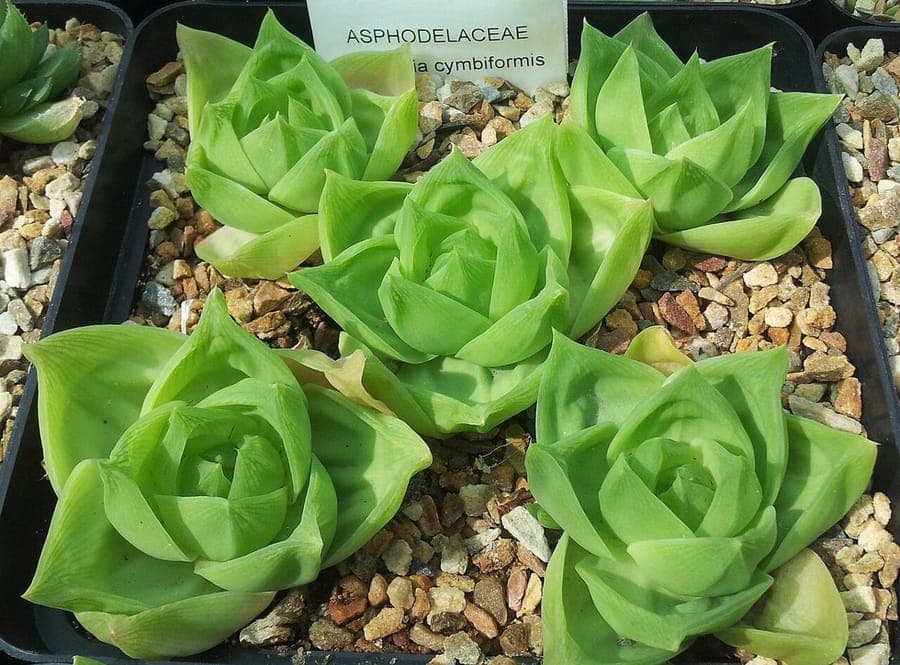
Abu Shawka / CC0, via Wikimedia Commons
Cathedral window haworthia (Haworthia cymbiformis): care
Haworthia cymbiformis
Want to see Cathedral window haworthia (Haworthia cymbiformis): care in your garden?
Full design in HD: €7.99
Look after your Cathedral window haworthia with the GardenWorld app
Identify plants with your camera and get a care calendar with reminders for this plant.


Overview
Haworthia cymbiformis is one of the most forgiving succulents you can grow indoors. The name tells you a lot: cymbiformis means boat-shaped, and each leaf really does look like a small, plump boat. The leaves are soft pale green, and at their tips sit translucent windows marked with fine lengthwise lines. Those glowing tips earned it the English name cathedral window haworthia, a nod to stained glass with the light behind it.
The species comes from the Eastern Cape of South Africa, where it grows on steep slopes and rocky ledges, often in the shade of boulders or shrubs. It belongs to the family Asphodelaceae, along with aloes and gasterias. What makes it so useful in the home is that it copes with more shade than almost any other succulent and multiplies eagerly. After a few years you no longer have a single plant but a cushion of dozens of rosettes. If you put it outdoors in summer, gardenworld.app can draw up a garden design for your patio or balcony, with a part-shaded spot where potted succulents look their best.
Appearance and flowering
Each rosette grows 5 to 10 cm across and stays low. The leaves are short, thick and hollowed on the upper side, with a rounded tip ending in a tiny point. Unlike Haworthia cooperi, it has almost none of the conspicuous white bristles along the margins: the leaf feels smooth and slightly rubbery. The photo shows exactly that, with five pale green rosettes of broad, boat-shaped leaves packed together in a black nursery tray of coarse gravel, and a label for the family Asphodelaceae behind them.
In strong light the leaves turn yellowish green to pinkish orange. In shade they stay fresh green and the windows show up better. Variegated forms with creamy stripes exist; they grow more slowly and tolerate even less sun.
Flowering follows the usual haworthia pattern. In spring and early summer a thin stem 20 to 30 cm long rises from the centre, carrying small white flowers with greenish or pink veins. They are a pleasant extra rather than a reason to buy the plant. Cut the stem off at its base once flowering is over.
Position and light
Haworthia cymbiformis is the haworthia for places where other succulents give up. An east or north-east window is enough. On a west or south-facing sill it needs protection from midday sun, because its soft leaves scorch more readily than those of the striped species. A spot a metre back from a large window, on a sideboard or bookcase, also works as long as the rosettes stay compact.
If the leaves stretch, the rosettes open out and the colour fades, the plant is too dark. Move it closer to the light, and turn the pot now and again so the cushion grows evenly.
Normal room temperature suits it well. In summer it can go outside in a bright, sheltered spot without direct midday sun, for example under a patio roof. Only move it out once nights stay reliably above 10 °C.
Watering and rest
Because the leaves are so juicy, the plant can go for weeks without water, and overwatering is a far greater danger than drought. From March to October, water thoroughly until it drains from the pot, then wait until the compost is completely dry. In a warm room that works out at roughly every ten days, less often in a cool one.
The dense clump traps moisture between its leaves, so always water the soil rather than the plant. Another good method is to stand a pot with a drainage hole in a tray of water for ten minutes and then let it drain well.
In winter the plant rests. In a cool spot at 10 to 15 °C, give a little water once a month at most. If it spends the whole year in a warm living room it keeps growing slowly, and a small drink every three to four weeks is enough. Soft, translucent leaves at the base point to rot; firm but wrinkled leaves point to thirst.
Feeding is almost unnecessary. A half-strength dose of cactus fertiliser twice a year, in April and August, is plenty.
Free preview
Want to see Cathedral window haworthia (Haworthia cymbiformis): care in your garden? Make a free preview of your design.
Compost and repotting
An open mix of cactus compost with about half pumice, lava grit or coarse sand works best. Because the plant spreads sideways, choose a wide, shallow pot or pan. A deep pot stays wet at the bottom for a long time, and that is where root rot starts.
Repot every two to three years, when the rosettes start pushing over the rim. Spring is the best time. Gently shake off the old compost, cut away dead roots and set the plant in fresh, dry mix. Wait a week before watering again.
Propagation by offsets and cuttings
Few succulents are as easy to propagate as Haworthia cymbiformis. The side rosettes are often loose enough to lift off with your fingers, usually with roots of their own. Pot them into a small container of dry cactus compost and give the first sip of water after a week.
Leaf cuttings also take well with this species. Ease a healthy leaf away with a gentle twist so its base stays intact. Let it dry for a few days, then lay it on dry compost in a bright place out of direct sun. After a few weeks small roots appear, followed by a tiny rosette at the base of the leaf. Only then start watering regularly. The old leaf shrivels away by itself.
In this way one plant can become a whole row of pots within a couple of years, perfect for passing on to friends.
Maintenance calendar
March and April: Start watering regularly again. Repot and divide where needed. Give a half dose of cactus feed in April.
May and June: Full growth and flowering. Take leaf cuttings from sturdy rosettes. Move the plant outside once nights are warm enough.
July and August: Shield from midday sun and heatwaves. Give one more half dose of feed in August.
September and October: Bring the plant in before night temperatures fall below 10 °C. Check for slugs and aphids as you do.
November to February: Rest in a bright place. Little water, no feed. Look between the tightly packed rosettes for mealybugs.
Temperature and hardiness
Haworthia cymbiformis cannot take frost. It stays healthy down to about 5 °C but grows best between 10 and 25 °C. A cold greenhouse kept above freezing makes a fine winter home, as does a cool bedroom. It will also overwinter in a warm room, though its rest is less pronounced there.
It handles summer warmth well, but move it into shade when temperatures climb above 30 °C, otherwise the leaves discolour and the windows collapse.
Toxicity to pets
The ASPCA, the American animal welfare organisation, lists the genus Haworthia as non-toxic to cats and dogs, which makes Haworthia cymbiformis a sensible choice for pet owners. A cat or dog that eats a leaf may at most vomit or have a loose stool from the unfamiliar plant material.
Because the plant resembles a small aloe, mix-ups do happen, and aloes are harmful to animals. If you are unsure which plant you have, keep it out of reach until you have checked the label. The plant is not considered poisonous to children either.
Companion plants
Since Haworthia cymbiformis makes do with less light, it pairs well with other succulents that tolerate part shade. Crassula multicava, with rounded leaves and starry flowers, is a good partner. Sedum morganianum can trail from a hanging pot in a bright spot nearby. Gasterias, close relatives with thick, tongue-shaped leaves, are happy in the same light too.
Do not plant it in one bowl with sun-lovers such as echeverias or houseleeks. They need far more light, so either they go short or the haworthia gets too much.
Final thoughts
Haworthia cymbiformis is a rewarding, tough succulent for rooms where light is not abundant. A spot without harsh sun, a gritty compost and water only when everything is dry: that is all it asks. In return you get a dense cushion of pale green boats with glowing windows, and enough offsets to give a plant to everyone you know. To see when to repot, divide or move it outdoors, the plant calendar on gardenworld.app lists the right jobs for each month.
Frequently asked questions about Cathedral window haworthia
Is Cathedral window haworthia winter hardy?
Haworthia cymbiformis cannot take frost. It stays healthy down to about 5 °C but grows best between 10 and 25 °C.
How much water does Cathedral window haworthia need?
Because the leaves are so juicy, the plant can go for weeks without water, and overwatering is a far greater danger than drought. From March to October, water thoroughly until it drains from the pot, then wait until the compost is completely dry.

See it in your garden
See Cathedral window haworthia in your garden
One photo of your garden and a few questions. You see the result in about a minute.
Try it with a photoIdentify this plant in your own garden. Identify a plant
Similar plants
Crassula multicava: complete guide
Crassula multicava
Discover the Cape Province pygmyweed, a frost-sensitive succulent with pink flowers. Grows 30cm tall with fine foliage. Perfect for pots and borders.
Sedum morganianum: complete guide
Sedum morganianum
Burro's-tail succulent from Mexico: elegant trailing plant with watery-green, bead-like foliage. Perfect for hanging baskets and living walls.
Jade plant: complete guide
Crassula ovata
Discover how to care for Crassula ovata: ideal lighting, watering, and seasonal care. A low-maintenance succulent perfect for homes and gardens on gardenworld.app.
