Wikimedia Commons / CC BY-SA 3.0, via Wikimedia Commons
Guzmania lingulata: caring for the scarlet star bromeliad
Guzmania lingulata
Want to see Guzmania lingulata: caring for the scarlet star bromeliad in your garden?
Full design in HD: €7.99
Look after your Guzmania lingulata with the GardenWorld app
Identify plants with your camera and get a care calendar with reminders for this plant.


Overview
Guzmania lingulata, often sold as scarlet star, is the bromeliad you are most likely to find in flower at a garden centre, florist or supermarket. A rosette of glossy green leaves with a blazing star of red bracts at its heart: that is all it takes to brighten a windowsill. The species grows wild in humid forests from Central America and the Caribbean to northern South America, Bolivia and Brazil, mostly as an epiphyte on trunks and branches and occasionally on the forest floor.
It belongs to the bromeliad family (Bromeliaceae). The leaves overlap to form a cup, or tank, that collects rainwater, and the plant draws much of its moisture from that reservoir. Many people treat a guzmania like a pot of cut flowers: buy it in bloom, enjoy it for months and then throw it away. There is no need. Once you understand how it lives, you can keep the pups that appear after flowering and enjoy a fresh display two or three years later. Most guzmanias in shops are cultivars or hybrids with Guzmania lingulata as a key parent, and they all need the same care.
Appearance and flowering
The rosette grows 30 to 45 cm tall and roughly as wide. The leaves are strap-shaped, soft, bright green and glossy, with smooth edges and no spines, which makes Guzmania lingulata much kinder to handle than many bromeliads. Fine dark lines often run along the length of the leaf.
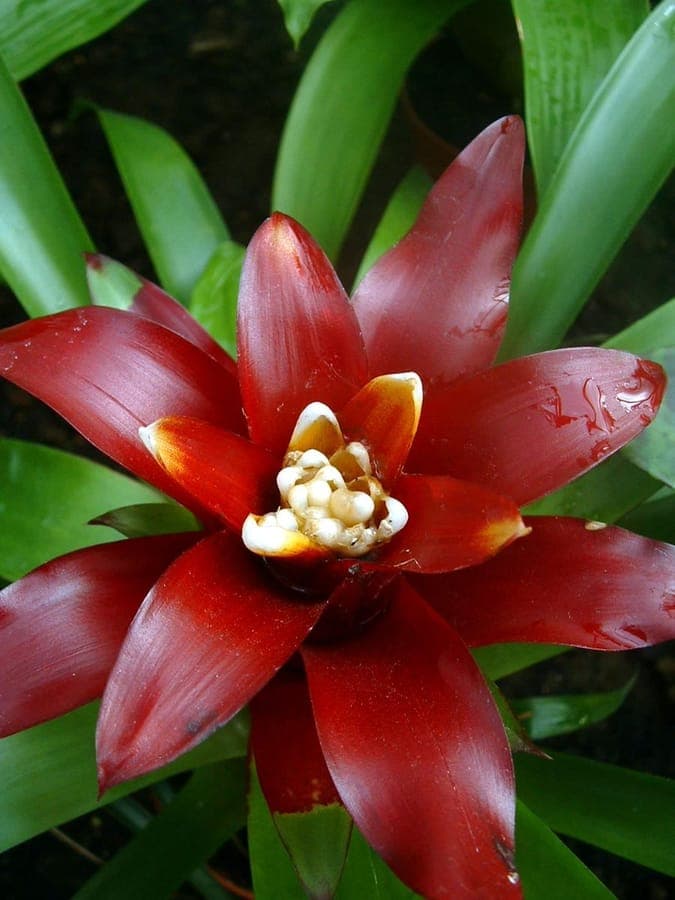
What everyone calls the flower is really a set of bracts. They form a star or funnel, usually scarlet, and in cultivars also orange, pink, yellow or purplish red. The true flowers are small, tubular and white to pale yellow. They peep just above the centre and fade within days. The bracts, on the other hand, hold their colour for three to four months and sometimes longer. The smaller Guzmania lingulata var. minor has a more compact rosette and is often orange-red. Each rosette flowers only once in its life.
Position and light
Guzmania lingulata likes bright light without harsh sun. In the rainforest it lives in the filtered light beneath the canopy. Indoors, a spot a metre or two from an east- or west-facing window is ideal, or close to a north-facing one. Full midday sun through glass leaves brown patches on the leaves and makes the bracts fade faster.
Too dark is no good either: in a dim corner the plant stays green, but its pups never produce a flower spike. Keep it out of draughts, away from radiators and away from the fruit bowl. Ripe fruit gives off ethylene, a gas that can make the bracts wither early. A bathroom with daylight or a bright kitchen is often the best spot, because the air there is more humid.
Water in the cup
With a tank bromeliad you water in two places: the centre of the rosette and the compost. Keep 1 to 2 cm of water in the cup and refresh it every week or two, either by tipping the plant gently to empty it or by flushing it through with fresh water. Otherwise the water starts to smell and the heart can rot.
Keep the compost just moist, never wet, and let the top few centimetres dry between waterings. In winter, when it is cooler and growth slows, water less and keep the cup almost empty. Use rainwater, filtered water or tap water at room temperature that has stood overnight. Hard, limy water leaves white marks on the leaves and builds up in the cup. A guzmania copes with being forgotten for a week far better than with a week standing in a saucer of water.
Humidity and temperature
As a plant of humid forests, Guzmania lingulata prefers humidity of 60 % or more. In a dry, centrally heated sitting room the leaf tips turn brown. Stand the pot on a tray of wet pebbles, making sure it does not sit in the water itself, or mist it lightly in the morning with soft water. Grouping plants together also raises the humidity around them.
The ideal temperature is 18 to 25 °C. Below 15 °C growth stops and the plant becomes prone to rot, especially with a full cup. A guzmania cannot simply spend the summer outdoors in Britain: the nights are too cool and the sun too strong. A warm, bright conservatory, however, suits it well.
Free preview
Want to see Guzmania lingulata: caring for the scarlet star bromeliad in your garden? Make a free preview of your design.
Compost and repotting
In the wild its roots sit in moss and bark, not heavy soil. Use an open mix: a bromeliad compost, orchid bark blended with some peat-free multipurpose compost, or your own mix of compost, bark and perlite. The roots are mainly anchors, so a 12 to 14 cm pot is enough for a mature plant. A heavy ceramic pot stops the rosette toppling over.
Repotting is rarely needed. Do it only when you separate pups or when the pot is truly full, preferably in spring. Never plant it deeper than before, because a buried heart soon rots.
Feeding
Guzmania lingulata needs little feeding. From April to September give a liquid bromeliad or orchid fertiliser once a month at half strength. Pour it onto the compost or mist it over the leaves rather than adding it neat to the cup. Do not feed in autumn and winter. A plant in full flower needs almost nothing, because from that point its energy goes into the pups.
After flowering and pups
After three to four months the bracts fade. The mother rosette then slowly yellows and dies over the following months. This is not a care mistake but the normal life cycle of a bromeliad. Meanwhile one to three pups appear at the base.
Cut off the spent flower head once it looks tatty, but leave the mother in place while she is still green, as she feeds the pups. When the pups are 10 to 15 cm tall and have roots of their own, cut them away with a sharp knife and pot them up in bromeliad compost. Alternatively, cut away the old mother and let the pup grow on in the same pot. After two to three years a pup is large enough to flower. If it refuses, put the plant in a clear plastic bag with a ripe apple for a week. The ethylene from the apple often triggers flowering, and a new star appears a few months later.
Care calendar
January-February: Little water, cup nearly empty. Brightest spot, away from radiators.
March-April: Growth starts. Refill the cup, separate and pot up pups. Start feeding in April.
May-August: Growing season. Refresh the cup weekly, feed monthly, shade from strong sun. Mist in dry spells.
September-October: Water less and stop feeding. Check leaf bases for mealybug and scale.
November-December: Quiet period. Add cup refreshing and feeding to the plant calendar on gardenworld.app so nothing slips during the busy festive weeks.
Toxicity to pets
The ASPCA, the American animal welfare organisation with a large plant database, lists Guzmania lingulata (as orange star, for the small var. minor) as non-toxic to dogs, cats and horses. No toxic compounds have been found in it, and it is also considered harmless to people. That makes it a safe choice in a home with animals. A cat that eats a lot of leaf may still get a mild upset stomach, as with any plant material. Also watch for pets drinking from the cup, since that water is not always fresh.
Companion plants
Guzmania lingulata pairs well with plants that want the same warm, humid and bright but not sunny spot. A group with a peace lily (Spathiphyllum wallisii), a flamingo flower (Anthurium andraeanum) and a bird's nest fern (Asplenium nidus) raises the humidity and creates a tropical island in the room. With a moth orchid (Phalaenopsis) and another bromeliad such as Aechmea fasciata you can build a flowering table display that lasts for months. If you want to carry the mood outdoors, you can have a garden design made on gardenworld.app for a patio or conservatory using plants that are genuinely hardy outside.
Final thoughts
Guzmania lingulata gives a great deal for very little: months of red star indoors, spineless leaves and a plant that is safe with cats and dogs. Give it bright light without fierce sun, a little fresh water in the cup, humid air and an open compost. Do not throw it away after flowering; grow on the pups instead. With some patience, a new star will be back on your windowsill in a few years.

See it in your garden
See Guzmania lingulata in your garden
One photo of your garden and a few questions. You see the result in about a minute.
Try it with a photoIdentify this plant in your own garden. Identify a plant
Similar plants
Urnplant: complete guide
Aechmea fasciata
Discover the stunning Urnplant (Aechmea fasciata), an exotic bromeliad with striking silver-banded foliage and brilliant red inflorescences. An easy tropical houseplant.
Flamingo-lily: complete guide
Anthurium andraeanum
Discover Anthurium andraeanum - a stunning tropical houseplant with iconic red heart-shaped flowers. Our complete care guide covers watering, humidity, propagation, and interior styling.
Phalaenopsis amabilis: complete guide
Phalaenopsis amabilis (L.) Blume
Phalaenopsis amabilis (Moon Orchid) is an elegant houseplant with gorgeous white flowers. Learn care, watering, and blooming techniques.
