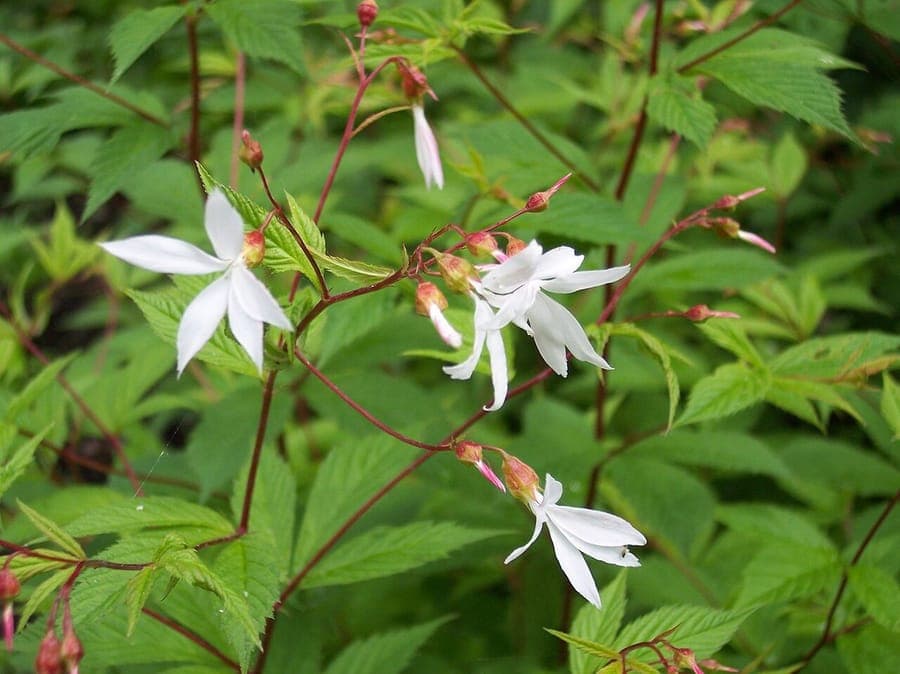
A. Barra / CC BY 3.0, via Wikimedia Commons
Bowman's root: a complete guide
Gillenia trifoliata
Want to see Bowman's root: a complete guide in your garden?
Full design in HD: €7.99
Look after your Bowman's root with the GardenWorld app
Identify plants with your camera and get a care calendar with reminders for this plant.


Overview
Bowman's root (Gillenia trifoliata) is one of those perennials you only truly appreciate once you see it moving in a breeze. Above a loose, shrubby clump of three-part leaves, hundreds of small white stars hover on thin, wine-red stems in June and July. The flowers look like a cloud of butterflies that has just landed. After flowering the red calyces stay decorative for weeks, and in autumn the foliage turns bronze, orange and red. Its other common name, Indian physic, and Bowman's root itself both refer to the old use of the root as an emetic.
The plant belongs to the rose family (Rosaceae) and is native to eastern North America, from southern Canada down to Georgia. There it grows in light deciduous woodland, along woodland edges and on slopes with humus-rich, moist soil. Older books sometimes list it as Porteranthus trifoliatus. It holds the RHS Award of Garden Merit, a fair reflection of how reliable it is in British gardens.
A mature plant reaches 60 to 100 cm tall and about 60 cm across. It is slow to establish, but it lives for many years in the same spot and asks for almost no attention. A few selections exist, such as 'Pink Profusion' with pink-tinged flowers and the compact 'Pixie'. On gardenworld.app you can have a garden design made in which Bowman's root brings a light, airy touch to a border in part shade.
Appearance and bloom cycle
Each leaf consists of three narrow, sharply toothed leaflets 5 to 8 cm long, fresh green through summer. The stems are thin but wiry and usually reddish, giving the whole plant a warm undertone. New shoots appear late in spring, often not until April, so mark the spot well to avoid digging into it by mistake.
Flowering runs from late May or June into July. Each bloom has five narrow, slightly uneven petals and is 2 to 3 cm across, carried in loose sprays at the tips of the stems. The buds are often pink and the calyx red, so the plant keeps its colour even after the petals drop. Bees and other small pollinators visit the flowers. In September and October the foliage turns a lovely red and orange, especially where it gets some sun.
Gillenia trifoliata is not considered seriously poisonous, but the root was formerly used to induce vomiting and can cause vomiting and stomach upset if eaten. Do not eat any part of the plant, and keep dogs that like to dig away from the roots.
Ideal location
Bowman's root is happiest in dappled or light shade: a spot with morning sun and afternoon shade, or filtered light beneath tall trees. It will grow in full sun provided the soil never dries out, but on a hot, dry site the leaves scorch and the plant flops more easily. In deep shade it becomes lax and barely flowers.
Plant it towards the front or middle of a border, where you can enjoy its airy flowers. It also suits a woodland edge, a shady front garden or a spot between shrubs with an open canopy. Allow 50 to 60 cm between plants. Because it grows slowly, you can fill the gaps with low, temporary plants for the first few years.
Soil requirements
The ideal soil is humus-rich, moisture-retentive yet well drained, much like good woodland soil. Slightly acidic to neutral ground with a pH of 5.5 to 7 is perfect, though it will tolerate a little lime. Improve heavy clay with compost or leaf mould at planting time, and on poor sandy soil work plenty of organic matter into the top 30 cm.
A mulch of leaf mould or fine bark keeps the roots cool and the soil moist. Feeding is hardly necessary: a spadeful of compost in spring is plenty. Too much nitrogen produces long, soft stems that lean over.
Free preview
Want to see Bowman's root: a complete guide in your garden? Make a free preview of your design.
Watering
After planting, water regularly during the first growing season, roughly 5 to 10 litres per plant each week when it is dry. That helps the root system establish well. Once settled in ordinary garden soil the plant is fairly self-reliant, but it does not enjoy prolonged drought.
In dry summers give a thorough soaking every other week, especially in a sunny spot. Water at the base of the plant, ideally in the morning. No watering is needed in winter or early spring. The plant dislikes waterlogged soil in winter, so avoid places where water collects.
Pruning
Bowman's root needs very little pruning. Feel free to leave the faded stems: the red calyces and autumn foliage are attractive. If you want a tidier look, cut a few spent sprays back to a healthy leaf in July.
Cut the whole plant down to a few centimetres above ground in late autumn or at the end of February. Many gardeners leave the stems standing over winter for insects and for their silhouette. Staking is rarely needed, though in too much shade a few twiggy supports pushed in during spring help. Dividing is not recommended, as the plant has a deep, woody rootstock and recovers slowly. If you do want to propagate it, do so in early spring with a sharp spade.
Maintenance calendar
March-April: Cut away old stems if you left them standing. Add a spadeful of compost and top up the mulch. Watch out for the late new shoots.
May: Rapid growth. Add low supports in a shady spot if needed. Keep an eye out for slugs on young shoots.
June-July: Full bloom. Water during dry spells. Cut back a few faded sprays if you like.
August: The red calyces remain decorative. Keep watering in drought, especially young plants.
September-October: Autumn colour in red and orange. A good time to plant new specimens.
November-February: Dormancy. Leave the stems standing or cut them down. Use the plant calendar on gardenworld.app to keep track of when to cut back and mulch.
Winter hardiness
Gillenia trifoliata is fully hardy and survives temperatures down to around -30 °C. Anywhere in Britain and most of Europe it needs no winter protection at all. The plant dies back completely in winter and sprouts again from its rootstock in spring.
The only real risk is cold, waterlogged soil in winter. On a well-drained site that will not trouble you. Young plants in pots are best placed against a wall or plunged into the ground so that the root ball does not repeatedly freeze and thaw.
Companion plants
Bowman's root is an ideal linking plant in a part-shaded border. Masterwort (Astrantia major) shares its needs and flowers at the same time, with beautifully contrasting flower shapes. Foamflower (Tiarella cordifolia) makes a low carpet beneath it, and dusky cranesbill (Geranium phaeum) adds deep purple tones.
For structure, Solomon's seal (Polygonatum multiflorum) and large-leaved hostas are good choices. Behind it, Chinese meadow rue (Thalictrum delavayi) looks lovely, its tall, wispy sprays echoing the same airy character. Ferns, bugbane and woodland grasses also fit the picture. Avoid vigorous spreaders that would crowd out the slow-growing clump.
Final thoughts
Bowman's root (Gillenia trifoliata) is a quiet star in the garden: it asks for little, lives long and gives three seasons of interest with flowers, red calyces and autumn colour. Give it a moist, humus-rich spot in light shade and leave it to grow undisturbed.
If you love natural, airy planting, this is a dependable partner that improves every year. Plant three or five together, so the white stars drift above the border like a swarm.
Frequently asked questions about Bowman's root
Is Bowman's root winter hardy?
Gillenia trifoliata is fully hardy and survives temperatures down to around -30 °C. Anywhere in Britain and most of Europe it needs no winter protection at all.
When and how do you prune Bowman's root?
Bowman's root needs very little pruning. Feel free to leave the faded stems: the red calyces and autumn foliage are attractive.
How much water does Bowman's root need?
After planting, water regularly during the first growing season, roughly 5 to 10 litres per plant each week when it is dry. That helps the root system establish well.
Where does Bowman's root grow best?
Bowman's root is happiest in dappled or light shade: a spot with morning sun and afternoon shade, or filtered light beneath tall trees. It will grow in full sun provided the soil never dries out, but on a hot, dry site the leaves scorch and the plant flops more easily.
What soil does Bowman's root need?
The ideal soil is humus-rich, moisture-retentive yet well drained, much like good woodland soil. Slightly acidic to neutral ground with a pH of 5.5 to 7 is perfect, though it will tolerate a little lime.

See it in your garden
See Bowman's root in your garden
One photo of your garden and a few questions. You see the result in about a minute.
Try it with a photoIdentify this plant in your own garden. Identify a plant
Similar plants
Astrantia: complete guide
Astrantia major
Complete care guide for Astrantia major: bloom time, ideal location, soil, watering and companion plants. Perfect for shady borders.
Tiarella cordifolia: complete guide
Tiarella cordifolia
Discover heart-leaf foamflower (Tiarella cordifolia), the elegant groundcover with distinctive heart-shaped leaves and frothy spring blooms. Care, placement, and growing tips.
Dusky cranesbill: complete guide
Geranium phaeum
Dusky cranesbill offers unique dark purple flowers in shady corners. This hardy plant thrives in woodland conditions.
