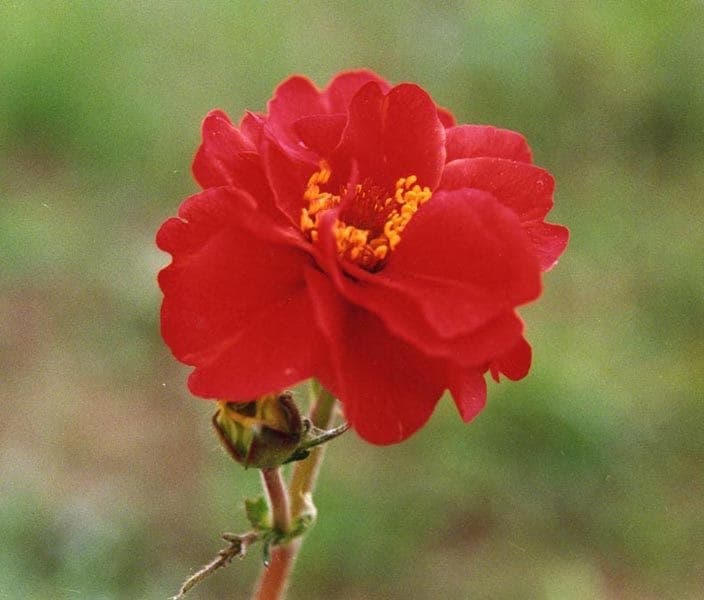
Ghislain118 (AD) http://www.fleurs-des-montagnes.net / CC BY-SA 3.0, via Wikimedia Commons
Chilean Avens: complete guide
Geum quellyon
Want to see Chilean Avens: complete guide in your garden?
Full design in HD: €7.99
Look after your Chilean Avens with the GardenWorld app
Identify plants with your camera and get a care calendar with reminders for this plant.


Overview
Geum quellyon, the Chilean avens, has flowers in colours you simply cannot miss in a border: vivid scarlet, orange or golden yellow, often semi-double and with a ring of yellow stamens at the centre. You will still find it in nurseries under its older name, Geum chiloense. It is native to central and southern Chile, where it grows in woodland clearings, grassland and along roadsides. In Chile it is known as 'hierba del clavo', clove herb, because its roots smell of cloves, just like those of our native wood avens.
The plant belongs to the rose family (Rosaceae). It forms a low, more or less evergreen rosette of hairy, pinnate leaves with a large, rounded terminal leaflet. From May onwards, slender branching flower stems rise to 40 to 60 cm. A mature clump is about 30 to 45 cm across. It is a true border plant: not large, but packed with colour at the height of low and mid-sized perennials.
Most garden plants are cultivars. 'Mrs J. Bradshaw' is the classic, with semi-double scarlet flowers like the one in the photo. 'Lady Stratheden' has semi-double golden-yellow blooms, and both have earned the Royal Horticultural Society's Award of Garden Merit. 'Feuerball' (sometimes sold as 'Fire Ball') is orange-red, while 'Blazing Sunset' carries fully double red flowers. Wondering where these splashes of colour would work best? On gardenworld.app you can create a garden design that matches colours, heights and flowering times for your own plot.
Appearance and bloom cycle
The main flush runs from late May into July. If you remove spent stems, new flowers keep coming into August and sometimes September. Each bloom is 3 to 4 cm across, cup-shaped to flat, with five or more rounded petals. In the semi-double cultivars two or three rings of petals sit one above the other, giving the flowers a slightly rose-like look. The centre is filled with numerous golden stamens and green styles.
The buds are round and hairy with a green calyx, and the flower stems are often tinged red. After flowering, a small ball of dry fruits forms, each with a tiny hook that lets the seed hitch a ride on passing animals in the wild. In mild winters the leaves stay largely green, so the plant keeps a tidy rosette through the cold months.
The open flowers are easy for insects to reach, and bees, bumblebees and hoverflies visit them happily. As cut flowers they last a few days in a vase, provided you pick stems that still carry a few buds.
Ideal location
Geum quellyon wants sun. A position with at least six hours of sun a day gives the most flowers and the sturdiest stems. Light afternoon shade is well tolerated and even welcome on hot, south-facing sites, where the blooms otherwise fade quickly. In proper shade it hardly flowers at all.
Place it at the front or in the middle of a sunny border, in a cottage garden, beside a patio or in a large container. Plant in groups of three to five, 30 to 35 cm apart, to create a glowing patch that catches the eye from a distance. The plant is low enough not to need staking, although the stems may splay a little after heavy rain.
Soil requirements
The ideal soil is fertile, humus-rich and moisture-retentive yet free-draining. Ordinary, well-cultivated garden soil with some compost is perfect. Geum quellyon likes ground that does not dry out completely in summer, but it will not tolerate standing water around its roots, particularly in winter.
On heavy clay, work compost and some coarse sand or fine grit into the top 20 to 25 cm when planting. On light, sandy soil, add plenty of compost or leaf mould to help hold moisture. Slightly acidic to slightly alkaline conditions suit it, roughly pH 6 to 7.5. Give a layer of compost every spring; extra fertiliser is unnecessary and mostly produces leaves.
Free preview
Want to see Chilean Avens: complete guide in your garden? Make a free preview of your design.
Watering
Water regularly for the first few weeks after planting, about 3 to 5 litres per plant a few times a week, until you see new growth. After that, watering is mainly needed during longer dry spells. A plant kept too dry stops flowering and develops brown leaf edges.
Water in the morning at the base of the plant if you can, so the foliage dries off quickly. A few centimetres of compost mulch helps keep the soil moist. In winter, on the other hand, the soil should not be too wet, as that is the main cause of losses. Container plants need watering more often in summer, but the pot must have good drainage holes.
Pruning
Cut spent flower stems back to the leaf rosette regularly. This prevents seed formation and encourages new flowers. The cultivars rarely come true from seed anyway, so seedlings are seldom worth keeping. After the main flush in July you can remove all the flower stems in one go. If the foliage looks tired at that point, take off the oldest leaves as well.
Geum quellyon is naturally a fairly short-lived perennial. After three or four years the centre of the clump often goes bare and flowering declines. Divide it every two to three years, in early spring or after flowering in August or September. Replant only the young, vigorous outer sections, each with a few rosettes and good roots. In spring, remove any leaves damaged or discoloured over winter.
Maintenance calendar
March-April: Remove winter-damaged leaves. Spread compost. Divide older clumps and plant new ones.
May: The first flower stems appear. Keep young plants moist and watch out for slugs.
June-July: Peak flowering. Deadhead spent stems and water during dry weather.
August: Repeat flowering. Once the last flowers are over, cut back all flower stems. A good time to divide.
September-October: Plant new specimens so they can root before winter. Clear fallen leaves from the rosettes.
November-February: Rest period. Make sure no water lingers around the plant. To see which job is due when in your own garden, check the plant calendar on gardenworld.app.
Winter hardiness
Geum quellyon is reliably hardy and tolerates frost down to around -20 °C (USDA zone 5). In the UK and the Low Countries it normally overwinters without protection. In the Chilean mountains it grows in a climate of cold, wet winters, but always on ground that drains freely.
Wet soil in winter is a greater threat than cold itself. Roots that sit in cold water for long periods will rot, so on heavy, wet ground it is best planted slightly raised or in a raised bed. In a container, move the plant against a sheltered wall for winter and lift the pot onto feet so water can drain away.
Geum quellyon is not known to be toxic to people, dogs or cats. In Chile the roots have even been used as a traditional herbal remedy. Anyone on medication, for example after a transplant, would be wise not to experiment with such home remedies, however.
Companion plants
The bright colours of Geum quellyon look their best beside blue and purple. Salvia nemorosa and catmint (Nepeta × faassenii) flower at the same time and make a classic contrast with the scarlet. Siberian iris (Iris sibirica) adds vertical lines and blue flowers in June.
For a warm, fiery border, pair it with spurges such as Euphorbia griffithii, with yellow yarrow (Achillea filipendulina) and with daylilies. Lady's mantle (Alchemilla mollis) makes a soft lime-green edging. The round flowers also look lovely among ornamental grasses and alliums. For a calmer effect, choose 'Lady Stratheden' with its yellow blooms, which is easier to combine with pink and white than the fierce red.
Final thoughts
Geum quellyon is a small plant with a big presence. It brings cheerful red, orange or yellow to the border from May into late summer, it is hardy, non-toxic and easy to look after. Give it sun, fertile soil that does not stay wet in winter, and divide it every few years. Plant a group of 'Mrs J. Bradshaw' among blue salvias and catmint this spring, and you will have one of the finest colour contrasts a sunny border can offer.
Frequently asked questions about Chilean Avens
Is Chilean Avens winter hardy?
Geum quellyon is reliably hardy and tolerates frost down to around -20 °C (USDA zone 5). In the UK and the Low Countries it normally overwinters without protection.
When and how do you prune Chilean Avens?
Cut spent flower stems back to the leaf rosette regularly. This prevents seed formation and encourages new flowers.
How much water does Chilean Avens need?
Water regularly for the first few weeks after planting, about 3 to 5 litres per plant a few times a week, until you see new growth. After that, watering is mainly needed during longer dry spells.
Where does Chilean Avens grow best?
Geum quellyon wants sun. A position with at least six hours of sun a day gives the most flowers and the sturdiest stems.
What soil does Chilean Avens need?
The ideal soil is fertile, humus-rich and moisture-retentive yet free-draining. Ordinary, well-cultivated garden soil with some compost is perfect.

See it in your garden
See Chilean Avens in your garden
One photo of your garden and a few questions. You see the result in about a minute.
Try it with a photoIdentify this plant in your own garden. Identify a plant
Similar plants
Woodland sage: complete guide
Salvia nemorosa
Everything about Woodland Sage (Salvia nemorosa): planting, care, pruning and combinations. Expert tips for months of blue-violet flower spikes.
Catmint: complete guide
Nepeta faassenii
Everything about catmint (Nepeta faassenii): long-blooming blue flowers, drought-proof, ideal rose companion. Expert tips for a carefree, pollinator-rich border.
Iris sibirica: complete guide
Iris sibirica
Discover elegant Iris sibirica with fine blue flowers. Perfect for moist soils, 60-80cm tall. Excellent in groups and as a cut flower.
